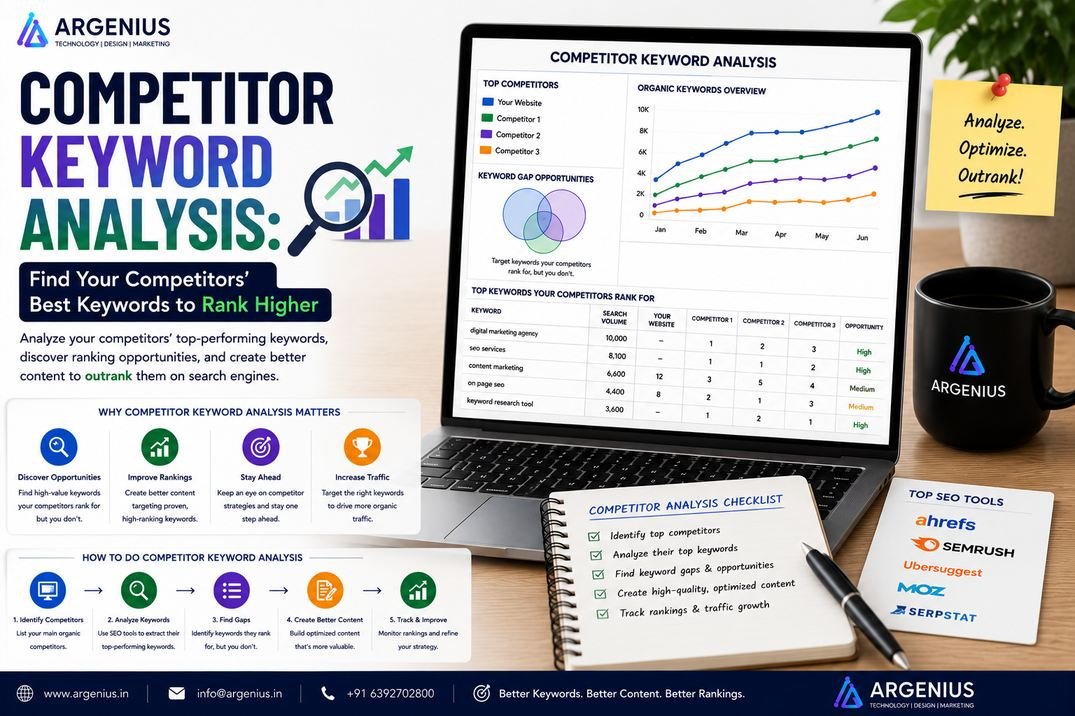
Competitor Keyword Analysis helps businesses identify the keywords their competitors rank for, uncover content opportunities, and improve search visibility. Learn how to analyze competitor SEO strategies, perform keyword gap analysis, and build a winning content plan that drives long-term organic growth.
Introduction
In today's competitive digital landscape, publishing high-quality content alone is no longer enough to achieve top rankings on Google. Every industry has businesses competing for the same audience, making it essential to understand not only your own SEO strategy but also what your competitors are doing successfully.
This is where Competitor Keyword Analysis becomes one of the most valuable parts of modern SEO.
Competitor keyword analysis is the process of identifying the search terms your competitors rank for, evaluating their content strategies, and discovering opportunities to improve your own website. Instead of guessing which keywords might work, you can use real data to identify proven opportunities that already generate traffic in your industry.
For example, if a competing software company ranks for keywords like "Flutter App Development Company", "Laravel Development Services", or "Custom CRM Development", analyzing their content can help you understand why those pages perform well. You can then create more comprehensive, user-focused content that better satisfies search intent.
Beyond traditional search engines, competitor analysis is also valuable for AI-powered search experiences such as Google AI Overviews, ChatGPT, Gemini, and Perplexity. These platforms prioritize authoritative, well-structured, and comprehensive content. Studying successful competitors can reveal content gaps, topical opportunities, and emerging trends that help strengthen your overall SEO strategy.
Whether you're running a local business, ecommerce store, SaaS platform, agency, or enterprise website, competitor keyword analysis enables smarter decision-making, more efficient content planning, and stronger organic growth.
In this guide, you'll learn how to identify your competitors' best keywords, perform keyword gap analysis, evaluate search intent, analyze ranking pages, and build a data-driven SEO strategy that improves rankings and attracts qualified traffic.
At Argenius, we use advanced competitor keyword research to help businesses discover untapped opportunities, outperform competitors, and build long-term search visibility.
What is Competitor Keyword Analysis?
Competitor Keyword Analysis is the process of researching the keywords your competitors rank for in search engines and using that information to improve your own SEO strategy.
Rather than relying on assumptions, competitor analysis provides real insights into:
- High-performing keywords
- Organic traffic sources
- Top-ranking pages
- Content topics
- Search intent
- Keyword gaps
- Ranking opportunities
- Content clusters
The goal is not to copy competitors but to understand what works and create content that provides greater value to users.
Why is Competitor Keyword Analysis Important?
Analyzing competitors provides valuable insights that help shape a stronger SEO strategy.
Benefits include:
- Discover High-Value Keywords
- Identify Content Gaps
- Find Low-Competition Opportunities
- Improve Organic Rankings
- Understand Search Intent
- Build Better Content
- Increase Topical Authority
- Save SEO Research Time
- Improve Conversion Opportunities
- Strengthen Long-Term Organic Growth
Instead of starting from scratch, you learn from proven strategies already succeeding in your market.
Who are Your SEO Competitors?
Your SEO competitors are not always the same as your business competitors.
For example:
- A software company may compete with blogs, agencies, SaaS platforms, or educational websites for the same keywords.
- An ecommerce store may compete with marketplaces, review sites, and niche blogs.
Identify competitors based on:
- Shared keywords
- Similar audience
- Similar products or services
- Similar search intent
- Organic search visibility
Understanding your true SEO competitors leads to more accurate analysis.
Types of Competitor Keywords
Competitors typically rank for several categories of keywords:
Informational Keywords
Used to educate users.
Examples:
- What is Technical SEO?
- Benefits of Flutter
- SEO Checklist
Commercial Keywords
Users compare options before making a purchase.
Examples:
- Best CRM Software
- Top SEO Agency
- Shopify vs WooCommerce
Transactional Keywords
Users are ready to take action.
Examples:
- Hire Flutter Developer
- Buy SEO Services
- Website Development Company
Local Keywords
Examples:
- SEO Company in Ahmedabad
- Website Development Company in Mumbai
- Mobile App Developers Near Me
Targeting a mix of keyword types creates a balanced SEO strategy.
How Competitor Keyword Analysis Improves Rankings
Competitor research helps you:
- Discover untapped keyword opportunities
- Improve content quality
- Cover missing subtopics
- Build stronger topic clusters
- Increase topical authority
- Optimize internal linking
- Match user search intent
- Identify Featured Snippet opportunities
Rather than copying competitors, use their success as inspiration to create even better content.
How to Identify Your SEO Competitors
You can identify competitors by:
- Searching your target keywords on Google
- Reviewing the first-page results
- Using Google Search Console
- Using Ahrefs or Semrush
- Checking industry directories
- Analyzing niche websites
Focus on websites consistently ranking for your target topics.
Competitor Keyword Gap Analysis
A keyword gap analysis identifies keywords your competitors rank for but your website does not.
This helps you:
- Discover new blog topics
- Expand topical authority
- Increase organic traffic
- Build better content clusters
- Prioritize high-value keywords
Keyword gap analysis is one of the fastest ways to grow an SEO content strategy.
Metrics to Analyze
When reviewing competitor keywords, evaluate:
- Search Volume
- Keyword Difficulty
- Search Intent
- Ranking Position
- Traffic Potential
- CPC
- Backlinks
- Content Quality
- Internal Links
- Featured Snippets
Don't choose keywords based only on search volume—consider their relevance to your business.
Competitor Content Analysis
Analyze each ranking page by reviewing:
- Page Structure
- Heading Hierarchy
- Content Length
- Images
- FAQs
- Internal Links
- External Links
- Schema Markup
- User Experience
- Page Speed
Your goal is to create a more helpful, comprehensive resource.
Best Tools for Competitor Keyword Research
Professional SEO teams commonly use:
Free Tools
- Google Search
- Google Search Console
- Google Trends
- Google Keyword Planner
Paid Tools
- Ahrefs
- Semrush
- SE Ranking
- Moz Pro
- Ubersuggest
- SpyFu
Each tool provides unique insights into keyword rankings, backlinks, traffic estimates, and competitor performance.
Competitor Analysis for AI Search
As AI-powered search continues to evolve, competitor analysis should go beyond keywords.
Study how competitors:
- Structure content
- Answer user questions
- Cover related topics
- Build topical authority
- Use FAQs
- Organize internal links
- Demonstrate expertise
This improves your visibility across Google AI Overviews, ChatGPT, Gemini, and Perplexity.
Step-by-Step Competitor Keyword Analysis Process
A structured competitor keyword analysis helps you identify valuable ranking opportunities and create content that outperforms competing websites.
Step 1: Identify Your SEO Competitors
Start by identifying websites that consistently rank for your target keywords.
Your SEO competitors may include:
- Businesses offering similar services
- Industry blogs
- SaaS companies
- Review websites
- Online marketplaces
- Educational websites
Remember, your SEO competitors are not always your direct business competitors.
Step 2: List Their Top Ranking Pages
Visit competitor websites and identify pages generating the most organic traffic.
Look for:
- Service Pages
- Blog Articles
- Landing Pages
- Category Pages
- Resource Guides
- Case Studies
These pages reveal which topics Google considers valuable.
Step 3: Find Their Best Keywords
Use SEO tools to discover:
- Primary Keywords
- Secondary Keywords
- Long-Tail Keywords
- Question-Based Keywords
- Local Keywords
- Commercial Keywords
Export these keywords into a spreadsheet for further analysis.
Step 4: Analyze Search Intent
Every competitor keyword should be categorized according to user intent.
Common intent types include:
- Informational
- Commercial Investigation
- Transactional
- Navigational
- Local Intent
Creating content that matches search intent improves ranking potential.
Step 5: Perform a Keyword Gap Analysis
Compare your website with competitors to identify missing keyword opportunities.
Ask questions such as:
- Which keywords are competitors ranking for that we are missing?
- Which topics have not been covered?
- Which service pages need improvement?
- Which informational guides can be created?
Keyword gap analysis provides a roadmap for future content.
Step 6: Evaluate Competitor Content Quality
Review each ranking page carefully.
Analyze:
- Content Depth
- Heading Structure
- Images
- Videos
- FAQs
- Internal Links
- Schema Markup
- Page Speed
- User Experience
Your objective is to publish content that is more comprehensive, helpful, and up to date.
Step 7: Build a Better Content Strategy
Instead of copying competitors, improve upon their work.
Focus on:
- Better explanations
- Updated information
- Better visuals
- Stronger internal linking
- AI-friendly formatting
- Comprehensive FAQs
- Real examples
- Better readability
This approach increases your chances of outranking existing pages.
Competitor Keyword Analysis Checklist
Before creating new content, ensure you have:
- ✅ Identified SEO Competitors
- ✅ Collected Competitor Keywords
- ✅ Completed Keyword Gap Analysis
- ✅ Analyzed Search Intent
- ✅ Evaluated Ranking Pages
- ✅ Reviewed Internal Linking
- ✅ Studied Backlink Opportunities
- ✅ Planned Topic Clusters
- ✅ Created Better Content Outline
- ✅ Optimized Metadata
- ✅ Added FAQs
- ✅ Included Internal Links
This checklist helps create a structured and scalable SEO strategy.
Best Tools for Competitor Keyword Analysis
Free Tools
- Google Search
- Google Search Console
- Google Trends
- Google Keyword Planner
- Google Related Searches
- People Also Ask
Paid Tools
- Ahrefs
- Semrush
- SE Ranking
- SpyFu
- Moz Pro
- Ubersuggest
Using multiple tools provides a more accurate understanding of competitor performance and keyword opportunities.
How AI is Changing Competitor Analysis
Traditional competitor analysis focused primarily on keywords.
Today, AI-powered search engines evaluate:
- Topic Coverage
- Search Intent
- Content Freshness
- Expertise
- Topical Authority
- User Experience
- Structured Information
To remain competitive:
- Build comprehensive topic clusters
- Answer user questions clearly
- Publish regularly updated content
- Strengthen internal linking
- Optimize for conversational searches
This improves visibility across Google AI Overviews, ChatGPT, Gemini, and Perplexity.
Cost of Competitor Keyword Analysis Services (₹ INR)
Professional competitor keyword research varies based on industry competition and project scope.
| Service |
Estimated Cost |
| Basic Competitor Keyword Research |
₹8,000 – ₹20,000 |
| Keyword Gap Analysis |
₹15,000 – ₹35,000 |
| Comprehensive Competitor SEO Audit |
₹35,000 – ₹80,000 |
| Enterprise Competitor Strategy |
Custom Pricing |
Factors Affecting Cost
Pricing depends on:
- Number of Competitors
- Industry Competition
- Website Size
- Keyword Volume
- Content Audit
- Technical SEO Review
- Backlink Analysis
- Reporting Requirements
A detailed competitor analysis helps prioritize SEO efforts and maximize return on investment.
Competitor Keyword Analysis Best Practices
Follow these proven practices:
- Analyze multiple competitors instead of one
- Focus on search intent, not just keywords
- Identify keyword gaps regularly
- Create better content than competitors
- Update existing pages before publishing new ones
- Build strong internal linking
- Track keyword performance monthly
- Monitor ranking changes
- Combine keyword data with business goals
- Keep content fresh and accurate
Consistent analysis helps maintain a competitive advantage.
Common Mistakes to Avoid
Avoid these common errors:
- Copying competitor content
- Targeting every competitor keyword
- Ignoring search intent
- Choosing keywords irrelevant to your business
- Ignoring content quality
- Forgetting internal linking
- Ignoring AI search optimization
- Publishing thin content
- Never updating competitor research
- Focusing only on search volume
The best strategy is to learn from competitors while creating more valuable content.
Future Trends in Competitor SEO Analysis
Competitor research is evolving with advances in AI and semantic search.
Key trends include:
- Google AI Overviews
- Generative Engine Optimization (GEO)
- Entity-Based SEO
- Semantic Search
- AI Content Analysis
- Search Intent Optimization
- Topical Authority
- Predictive Keyword Research
- Conversational Search
- AI-Powered SEO Insights
Businesses that continuously analyze competitors and adapt to these trends will be better positioned for long-term organic growth.
Why Businesses Choose Argenius
At Argenius, we use data-driven competitor analysis to build SEO strategies that generate measurable business results.
Our Competitor SEO Services include:
- Competitor Keyword Research
- Keyword Gap Analysis
- Content Gap Analysis
- Search Intent Mapping
- Topical Authority Planning
- Technical SEO Audits
- Content Strategy Development
- Internal Linking Strategy
- Performance Tracking
- Monthly SEO Reporting
Our focus is on identifying opportunities that help businesses improve rankings, increase qualified traffic, and outperform competitors.
Final Thoughts
Competitor Keyword Analysis is one of the most effective ways to build a smarter SEO strategy. Instead of relying on assumptions, it allows you to learn from real-world data, uncover keyword opportunities, identify content gaps, and understand what already works in your industry.
The goal isn't to copy competitors—it's to create content that is more useful, comprehensive, and aligned with user intent. By combining keyword gap analysis, search intent research, topic clusters, and high-quality content, businesses can improve organic rankings and establish stronger topical authority.
As search engines become more AI-driven, understanding competitor strategies will become even more valuable. If you're looking to strengthen your SEO performance, Argenius can help you build a customized competitor keyword strategy that supports sustainable growth and long-term visibility.
Frequently Asked Questions
What is Competitor Keyword Analysis?
Competitor Keyword Analysis is the process of identifying the keywords your competitors rank for and using those insights to improve your own SEO strategy and content planning.
Why is competitor keyword analysis important?
It helps you discover high-value keywords, identify content gaps, understand search intent, and create better content that can outperform competing websites.
What is a keyword gap analysis?
A keyword gap analysis compares your website with competitors to find keywords they rank for but your website does not, helping you identify new content opportunities.
Which tools are best for competitor keyword analysis?
Popular tools include Google Search Console, Google Keyword Planner, Ahrefs, Semrush, SE Ranking, SpyFu, and Moz Pro.
How often should I analyze competitors?
Review your competitors every 3–6 months, or more frequently in highly competitive industries where rankings and content change rapidly.
Does Argenius provide competitor keyword analysis services?
Yes. Argenius offers Competitor Keyword Analysis, Keyword Gap Analysis, Content Strategy, Technical SEO Audits, and Search Intent Research to help businesses improve search visibility and organic growth.