Learn how long your blog posts should be for better SEO, Google rankings, AI search visibility, and user engagement. Discover the ideal content length for different types of blog posts and industries.
Introduction
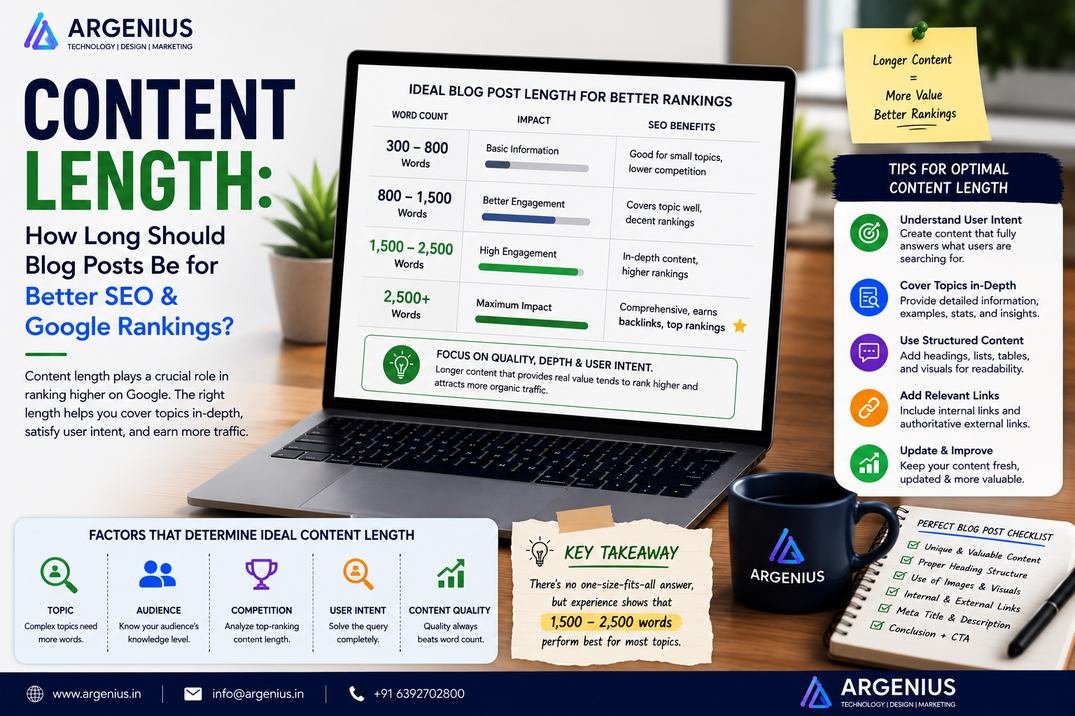
One of the most common questions in SEO and content marketing is, "How long should a blog post be?" Some marketers believe that longer articles always rank higher, while others focus on publishing shorter content more frequently. The truth is that there is no universal word count that guarantees top rankings.
Google doesn't rank pages simply because they contain more words. Instead, it rewards content that satisfies user intent, demonstrates expertise, and provides a better experience than competing pages. A 700-word article can outperform a 3,000-word article if it answers the user's question more effectively. Likewise, a comprehensive guide may need over 2,500 words to fully cover a complex topic.
Content length also influences how AI-powered search engines such as Google AI Overviews, ChatGPT, Gemini, and Perplexity evaluate your website. Detailed, well-structured content with complete topic coverage is more likely to be referenced by AI systems because it provides richer context and stronger topical authority.
The key is to write as much as necessary—but never more than needed. Your goal should always be to provide complete, accurate, and valuable information rather than reaching an arbitrary word count.
In this guide, you'll learn how content length affects SEO, the ideal word count for different types of blogs, when long-form content works best, and how to choose the right length based on search intent and business goals.
At Argenius, we create SEO-focused content strategies that balance content depth, readability, and search intent to help businesses improve rankings, attract qualified traffic, and generate long-term organic growth.
What is Content Length?
Content Length refers to the total number of words in a piece of content, such as a blog post, landing page, guide, or article.
It is commonly measured by word count and varies depending on the topic, audience, competition, and search intent.
Examples include:
- Short Articles (500–800 words)
- Standard Blogs (1,000–1,500 words)
- In-Depth Guides (2,000–3,000 words)
- Ultimate Resources (3,500+ words)
The ideal length depends on how much information is required to answer the user's query completely.
Why Content Length Matters for SEO
Content length alone is not a ranking factor, but it often correlates with higher rankings because comprehensive content tends to:
- Cover More Keywords
- Answer More Questions
- Build Topical Authority
- Earn More Backlinks
- Increase Time on Page
- Improve User Satisfaction
- Strengthen Internal Linking
- Support AI Search Visibility
- Increase Organic Traffic
- Improve Conversion Opportunities
Longer content performs best when every section provides genuine value.
Does Google Prefer Long Blog Posts?
The simple answer is No.
Google prefers helpful content, not longer content.
A blog ranks because it:
- Matches Search Intent
- Provides Accurate Information
- Demonstrates Experience
- Covers the Topic Thoroughly
- Offers Good User Experience
- Loads Quickly
- Is Mobile Friendly
- Includes Quality Internal Links
If a topic can be answered in 800 words, writing 3,000 words simply to increase length may reduce readability and user satisfaction.
Ideal Blog Length for Different Content Types
The recommended word count depends on the purpose of the content.
| Content Type |
Recommended Length |
| News Articles |
500–800 words |
| Simple How-To Guides |
800–1,200 words |
| Standard SEO Blogs |
1,200–1,800 words |
| Comprehensive Guides |
2,000–3,000 words |
| Pillar Pages |
3,000–5,000+ words |
| Ultimate Resources |
4,000+ words |
These ranges are guidelines rather than strict rules.
How Content Length Affects Google Rankings
Well-written long-form content often performs better because it can naturally include:
- More Related Keywords
- Additional FAQs
- Supporting Examples
- Case Studies
- Internal Links
- Visual Elements
- Expert Insights
However, quality should always take priority over quantity.
Short-Form vs Long-Form Content
| Short-Form Content |
Long-Form Content |
| Quick to Read |
Comprehensive Coverage |
| Faster to Produce |
Requires More Research |
| Best for Simple Topics |
Best for Complex Topics |
| Limited Keyword Coverage |
Strong Topical Authority |
| Lower Production Cost |
Higher Long-Term ROI |
Both formats have their place in a successful content strategy.
Factors That Determine the Right Content Length
Before deciding how long your article should be, consider:
- Search Intent
- Topic Complexity
- User Expectations
- Industry Competition
- Target Audience
- Keyword Difficulty
- Business Goals
- Content Format
The objective is to publish content that answers every important question without unnecessary repetition.
Content Length and AI Search
AI-powered search systems evaluate content differently from traditional search engines.
To improve visibility in Google AI Overviews, ChatGPT, Gemini, and Perplexity, your content should:
- Cover the topic comprehensively.
- Use logical headings.
- Answer common questions.
- Include semantic keywords.
- Demonstrate expertise.
- Stay updated with current information.
- Provide clear, actionable advice.
AI platforms value content depth more than raw word count.
Benefits of Publishing Comprehensive Content
High-quality long-form content can help businesses:
- Improve Organic Rankings
- Increase User Engagement
- Build Brand Authority
- Generate More Leads
- Improve AI Search Visibility
- Earn Quality Backlinks
- Increase Average Session Duration
- Strengthen Internal Linking
- Improve Content Discoverability
- Support Long-Term SEO Growth
These benefits are achieved through relevance and usefulness—not by adding unnecessary words.
Common Myths About Content Length
Many misconceptions exist about blog length.
Some common myths include:
- Longer content always ranks higher.
- Every blog should exceed 2,000 words.
- Google counts words as a ranking factor.
- Short blogs cannot rank.
- More words always mean more traffic.
In reality, success depends on content quality, relevance, and user satisfaction, not word count alone.
Industries That Benefit from Long-Form Content
Long-form content is particularly valuable for:
- Software Companies
- SaaS Businesses
- Ecommerce Stores
- Healthcare Providers
- Educational Websites
- Financial Services
- Legal Firms
- Technology Companies
- Digital Marketing Agencies
- B2B Businesses
These industries often require detailed explanations to address complex user questions.
Step-by-Step Content Length Strategy
Choosing the right Content Length is not about reaching a specific word count—it's about providing enough information to fully satisfy the user's search intent. The best-performing blogs are comprehensive, well-structured, and free from unnecessary filler.
Step 1: Understand Search Intent
Before writing, identify what users expect from the page.
Common search intents include:
- Informational
- Commercial Investigation
- Transactional
- Navigational
For example, a query like "What is SEO?" may require around 1,200–1,800 words, while "Complete SEO Guide" may need 3,000+ words to cover the topic thoroughly.
Step 2: Analyze Top-Ranking Pages
Search your target keyword on Google and review the top-ranking results.
Look for:
- Average Article Length
- Number of Headings
- Questions Covered
- Images and Visuals
- Internal Links
- Tables and Examples
This helps you understand the level of detail users expect.
Step 3: Match Content Length to Topic Complexity
Not every topic requires a long article.
| Topic Complexity |
Recommended Length |
| Basic Definitions |
600–900 words |
| How-To Guides |
1,000–1,500 words |
| Standard SEO Blogs |
1,500–2,000 words |
| Detailed Tutorials |
2,000–3,000 words |
| Pillar Pages |
3,000–5,000+ words |
Focus on answering every important question rather than targeting an arbitrary word count.
Step 4: Cover the Topic Completely
Instead of repeating information, expand the article by including valuable sections such as:
- Benefits
- Features
- Step-by-Step Process
- Examples
- Comparison Tables
- FAQs
- Best Practices
- Common Mistakes
- Future Trends
Every section should add value for the reader.
Step 5: Improve Readability
Long content only performs well when it is easy to read.
Use:
- Short paragraphs
- Clear headings
- Bullet points
- Numbered lists
- Tables
- Images
- Infographics
- Callout boxes
Good readability improves user engagement and reduces bounce rates.
Step 6: Optimize for SEO
Every article should include:
- Primary Keyword
- Secondary Keywords
- SEO Title
- Meta Description
- Internal Links
- Image ALT Text
- FAQ Section
- Optimized URL
- Mobile-Friendly Layout
SEO optimization helps both users and search engines understand your content.
Step 7: Update Existing Content
Content length is not permanent.
Regularly:
- Add new sections.
- Update outdated statistics.
- Improve examples.
- Refresh FAQs.
- Expand based on new search trends.
Fresh content often performs better than outdated articles.
Step 8: Measure Performance
Track key metrics to determine whether your content length is effective.
Monitor:
- Organic Traffic
- Keyword Rankings
- Average Time on Page
- Bounce Rate
- Scroll Depth
- CTR
- Leads Generated
- Conversion Rate
Use these insights to refine future content.
Content Length Planning Checklist
Before publishing, ensure your content includes:
- ✅ Clear Search Intent
- ✅ Comprehensive Topic Coverage
- ✅ SEO Title
- ✅ Meta Description
- ✅ Primary & Secondary Keywords
- ✅ Internal Links
- ✅ Images with ALT Text
- ✅ FAQ Section
- ✅ Mobile Optimization
- ✅ Strong Call-to-Action
A structured checklist helps maintain quality and consistency across all content.
Best Tools for Content Planning
Free Tools
- Google Search Console
- Google Analytics
- Google Trends
- Google Keyword Planner
- Google Docs
- Google PageSpeed Insights
Premium Tools
- Ahrefs
- Semrush
- Surfer SEO
- Frase
- Clearscope
- Grammarly
- Notion
These tools help with keyword research, competitor analysis, content optimization, readability, and performance tracking.
Content Length and AI Search
AI-powered search engines evaluate content based on usefulness, completeness, and structure rather than raw word count.
To improve visibility in Google AI Overviews, ChatGPT, Gemini, and Perplexity:
- Answer questions directly.
- Cover related subtopics.
- Use semantic keywords naturally.
- Structure content with logical headings.
- Include FAQs.
- Demonstrate expertise and real-world insights.
- Keep content regularly updated.
Comprehensive and trustworthy content has a better chance of being surfaced by AI search systems.
Cost of Professional Content Writing (₹ INR)
The cost of SEO content depends on research depth, topic complexity, and optimization requirements.
| Service |
Estimated Cost |
| SEO Blog (1,000–1,500 words) |
₹3,000 – ₹6,000 |
| Long-Form SEO Blog (2,000–3,000 words) |
₹6,000 – ₹12,000 |
| Pillar Page Content |
₹10,000 – ₹25,000 |
| Monthly Content Marketing Package |
₹25,000 – ₹75,000 |
| Enterprise Content Strategy |
Custom Pricing |
Factors Affecting Cost
Content pricing depends on:
- Word Count
- Research Requirements
- Keyword Research
- Industry Competition
- Technical Complexity
- SEO Optimization
- Graphics & Visual Assets
- Revision Requirements
Investing in quality content delivers long-term returns through sustained organic traffic and lead generation.
Best Practices
To create effective content regardless of length:
- Write to satisfy search intent.
- Prioritize quality over quantity.
- Avoid unnecessary repetition.
- Use clear and logical headings.
- Include real examples and practical insights.
- Optimize for mobile users.
- Add relevant internal links.
- Update older articles regularly.
- Monitor analytics to improve performance.
- Maintain a consistent publishing schedule.
Quality content consistently outperforms artificially extended articles.
Common Mistakes to Avoid
Avoid these mistakes:
- Writing long articles without adding value
- Keyword stuffing
- Ignoring search intent
- Publishing thin content
- Repeating the same information
- Poor formatting
- Weak internal linking
- Outdated statistics
- Ignoring mobile optimization
- Neglecting user experience
Every paragraph should contribute meaningful information.
Future Trends in Content Length
Content strategies continue to evolve alongside AI and changing search behavior.
Emerging trends include:
- Google AI Overviews
- Generative Engine Optimization (GEO)
- Semantic SEO
- Entity-Based Search
- Interactive Content
- Video-Integrated Articles
- Voice Search Optimization
- Personalized Content
- Topical Authority
- Experience-Based Content
Future success will depend on delivering comprehensive, user-first content rather than simply increasing word count.
Why Businesses Choose Argenius
At Argenius, we create SEO-driven content strategies that balance ideal content length, search intent, readability, and business objectives.
Our Content Writing Services include:
- SEO Blog Writing
- Long-Form Content Development
- Pillar Page Creation
- Keyword Research
- Content Strategy
- On-Page SEO
- Internal Linking
- Content Audits
- Technical SEO Support
- Performance Reporting
Our objective is to help businesses publish content that ranks well, engages readers, and generates measurable business growth.
Final Thoughts
There is no perfect word count that guarantees higher rankings. The ideal Content Length depends on the topic, user intent, and the depth of information required to answer the reader's questions effectively. A shorter article can rank exceptionally well if it completely satisfies the query, while complex topics often require detailed, long-form content to provide real value.
Instead of chasing a specific number of words, focus on creating content that is informative, well-structured, easy to read, and optimized for both search engines and users. By combining quality research, logical organization, SEO best practices, and regular updates, businesses can build content that performs consistently over time.
As AI-powered search continues to evolve, comprehensive and trustworthy content will play an even greater role in online visibility. Argenius helps businesses develop content strategies that balance ideal content length with search intent, user experience, and long-term SEO success.
Frequently Asked Questions
What is the ideal blog post length for SEO?
There is no fixed word count. Most SEO blogs perform well between 1,500 and 2,500 words, while comprehensive guides and pillar pages may require 3,000 words or more, depending on the topic.
Does Google rank longer content higher?
No. Google ranks content based on relevance, usefulness, expertise, and user satisfaction—not word count alone.
Can a 1,000-word blog rank on Google?
Yes. If a 1,000-word article completely answers the user's question and provides a great experience, it can rank very well.
Should every blog be over 2,000 words?
No. Choose the length based on the complexity of the topic and user intent rather than aiming for a fixed number of words.
Does content length matter for AI-powered search?
Yes. AI platforms such as Google AI Overviews, ChatGPT, Gemini, and Perplexity tend to favor well-structured, comprehensive, and authoritative content that covers a topic thoroughly.
Does Argenius provide SEO content writing services?
Yes. Argenius offers SEO Blog Writing, Long-Form Content Creation, Pillar Page Development, Content Strategy, Keyword Research, and Complete Content Marketing Services to help businesses improve search visibility and generate qualified leads.