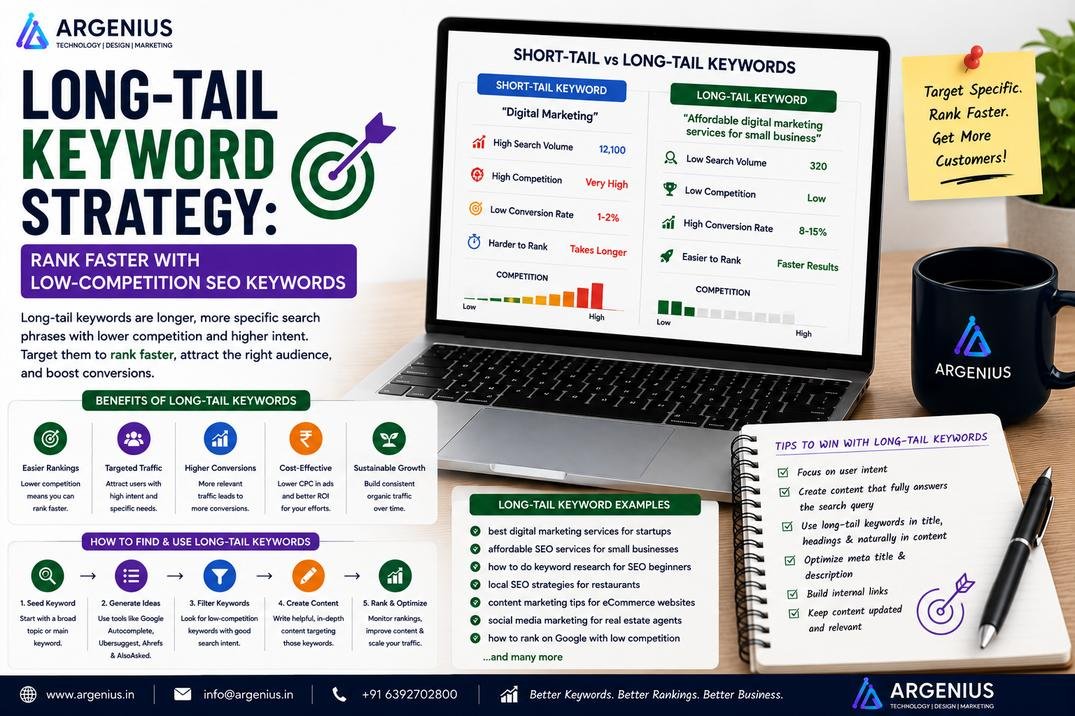
Long-Tail Keywords help websites rank faster by targeting highly specific search queries with lower competition and stronger user intent. This complete guide explains how to find, optimize, and use long-tail keywords to improve Google rankings, attract qualified traffic, and increase conversions.
Introduction
Getting your website to rank on Google has become more competitive than ever. Millions of webpages compete for the same popular keywords, making it difficult for new websites and small businesses to achieve first-page rankings. Many businesses spend months targeting broad keywords like SEO Services, Website Development, or Digital Marketing, only to see little progress because these search terms are dominated by high-authority websites.
A smarter and more effective approach is to focus on Long-Tail Keywords.
Long-tail keywords are longer, more specific search queries that usually have lower competition and stronger search intent. While they may receive fewer monthly searches than broad keywords, they often attract users who are closer to making a decision or completing a purchase.
For example, instead of targeting "Website Development", you could target "Affordable Website Development Company for Small Businesses". This keyword is more specific, faces less competition, and attracts visitors who know exactly what they're looking for.
Long-tail keywords also play a major role in AI-powered search experiences. Platforms like Google AI Overviews, ChatGPT, Gemini, and Perplexity increasingly prioritize content that answers detailed, conversational queries rather than pages optimized around short keywords alone.
Whether you manage a business website, ecommerce store, SaaS platform, blog, or local service company, building a strong Long-Tail Keyword Strategy can help you rank faster, attract qualified traffic, and generate more leads.
In this complete guide, you'll learn how to discover long-tail keywords, understand search intent, build content clusters, optimize pages, and create a scalable SEO strategy for sustainable growth.
At Argenius, we use long-tail keyword research to help businesses compete effectively, improve search visibility, and drive high-converting organic traffic.
What are Long-Tail Keywords?
Long-Tail Keywords are longer and more specific search phrases that users enter into search engines when they have a clear intent or a specific question.
Unlike broad keywords, long-tail keywords target niche topics and often reflect exactly what a user wants.
Examples:
Broad Keyword:
SEO
Long-Tail Keywords:
- Best SEO company for startups
- Affordable SEO services for small businesses
- Technical SEO audit services in India
- Local SEO agency near me
Although each keyword may have a lower search volume, they generally offer higher relevance and better conversion potential.
Why are Long-Tail Keywords Important?
Long-tail keywords provide significant advantages for businesses of all sizes.
Benefits include:
- Easier Rankings
- Lower SEO Competition
- Better Search Intent
- Higher Conversion Rates
- More Qualified Traffic
- Improved Content Relevance
- Stronger Topical Authority
- Better Voice Search Visibility
- AI Search Optimization
- Long-Term Organic Growth
Rather than competing with thousands of websites for broad keywords, long-tail keywords help you target users with specific needs.
Long-Tail Keywords vs Short-Tail Keywords
| Short-Tail Keywords |
Long-Tail Keywords |
| High Competition |
Lower Competition |
| Broad Search Intent |
Specific Search Intent |
| High Search Volume |
Moderate Search Volume |
| Lower Conversion Rate |
Higher Conversion Rate |
| Difficult to Rank |
Easier to Rank |
| Generic Audience |
Highly Targeted Audience |
For most businesses, a combination of both keyword types creates a balanced SEO strategy.
Why Long-Tail Keywords Rank Faster
Google evaluates content based on relevance and user intent.
Long-tail keywords help because they:
- Match user intent more accurately
- Face less competition
- Target niche audiences
- Improve click-through rates
- Increase engagement
- Reduce bounce rates
These factors contribute to better search performance over time.
Understanding Search Intent
Successful long-tail keyword strategies begin with understanding why users perform a search.
Common search intent categories include:
Informational
Examples:
- What is Technical SEO?
- How does Local SEO work?
- Benefits of Core Web Vitals
Commercial Investigation
Examples:
- Best CRM software for startups
- Top ecommerce SEO agencies
- Shopify vs WooCommerce
Transactional
Examples:
- Hire SEO expert
- Buy ecommerce website
- Website redesign services
Navigational
Examples:
- Argenius SEO Services
- Google Search Console
- Ahrefs Dashboard
Targeting keywords that align with user intent increases ranking opportunities and improves conversions.
How to Find Long-Tail Keywords
There are several proven methods for discovering valuable long-tail keywords.
Google Autocomplete
Google's search suggestions reveal popular queries entered by real users.
People Also Ask
These questions provide ideas for blog topics and FAQ sections.
Related Searches
Google displays additional relevant searches at the bottom of search results.
Competitor Research
Analyze competitors to discover keyword opportunities they already rank for.
Keyword Research Tools
Use professional SEO platforms to evaluate search volume, keyword difficulty, and trends.
Long-Tail Keywords for Local SEO
Local businesses benefit greatly from location-based long-tail keywords.
Examples:
- Best website development company in Ahmedabad
- Affordable SEO agency in Delhi
- Ecommerce website developer near me
- Mobile app development company in Pune
These keywords attract users with high purchase intent.
Long-Tail Keywords for Ecommerce
Examples include:
- Waterproof hiking shoes for women
- Best office chair under ₹10,000
- Organic skincare products for sensitive skin
- Bluetooth earbuds with noise cancellation
Specific product-focused keywords improve visibility and conversions.
Long-Tail Keywords for AI Search
AI-powered search engines understand natural language better than ever.
To optimize for AI search:
- Answer detailed questions
- Cover related subtopics
- Write naturally
- Build topical authority
- Include FAQs
- Use semantic keywords
This approach improves visibility across Google AI Overviews, ChatGPT, Gemini, and Perplexity.
Building Content Clusters
Instead of publishing isolated articles, organize related topics into clusters.
Example:
Pillar Topic:
SEO Guide
Supporting Articles:
- Keyword Research
- On-Page SEO
- Technical SEO
- Local SEO
- Long-Tail Keywords
- Core Web Vitals
Content clusters strengthen topical authority and improve internal linking.
Measuring Long-Tail Keyword Success
Track important metrics such as:
- Organic Traffic
- Keyword Rankings
- Click-Through Rate (CTR)
- Conversion Rate
- Bounce Rate
- Average Session Duration
- Search Console Impressions
Monitoring these metrics helps refine your keyword strategy over time.
Step-by-Step Long-Tail Keyword Strategy
Building an effective Long-Tail Keyword Strategy requires more than simply finding longer search phrases. It involves understanding your audience, identifying search intent, and creating content that answers specific questions better than your competitors.
Step 1: Identify Your Target Audience
Start by understanding:
- Customer Pain Points
- Industry
- Products or Services
- Frequently Asked Questions
- Buying Journey
Knowing your audience helps you discover keywords that match real user needs.
Step 2: Start with Seed Keywords
Create a list of broad topics related to your business.
Example for a software company:
- Website Development
- Mobile App Development
- SEO Services
- Digital Marketing
- Ecommerce Development
These seed keywords will generate hundreds of long-tail keyword opportunities.
Step 3: Expand into Long-Tail Keywords
Convert broad keywords into highly specific search phrases.
Example:
Instead of:
SEO Services
Use:
- Affordable SEO services for startups
- Ecommerce SEO services for Shopify stores
- Technical SEO services for enterprise websites
- Local SEO services for small businesses
These keywords attract users with clearer purchase intent.
Step 4: Analyze Search Intent
Every keyword should match the user's intent.
Ask:
- Are they learning?
- Comparing solutions?
- Looking for reviews?
- Ready to buy?
- Searching for a local provider?
Content that aligns with search intent performs better in Google and AI-powered search platforms.
Step 5: Check Keyword Metrics
Before selecting keywords, evaluate:
- Monthly Search Volume
- Keyword Difficulty
- Competition Level
- Search Intent
- CPC
- Business Relevance
- Conversion Potential
Avoid choosing keywords based only on search volume.
Step 6: Analyze Competitors
Study websites ranking for your target keywords.
Review:
- Page Structure
- Content Depth
- Internal Linking
- FAQs
- Featured Snippets
- Backlinks
Your goal is to create more comprehensive and valuable content—not to copy competitors.
Step 7: Build Topic Clusters
Group related keywords together instead of creating separate pages for each variation.
Example:
Primary Topic:
Long-Tail Keyword Strategy
Supporting Topics:
- Keyword Research
- Search Intent
- Keyword Clustering
- Content Marketing
- On-Page SEO
- Content Optimization
Topic clusters improve topical authority and strengthen internal linking.
Long-Tail Keyword Checklist
Before publishing any content, ensure you've completed the following:
- ✅ Focus Keyword Selected
- ✅ Long-Tail Keyword Included Naturally
- ✅ Search Intent Matches Content
- ✅ Supporting Keywords Added
- ✅ SEO Title Optimized
- ✅ Meta Description Written
- ✅ Internal Links Added
- ✅ FAQs Included
- ✅ User Questions Answered
- ✅ AI-Friendly Structure
- ✅ Mobile-Friendly Formatting
- ✅ Content Updated with Latest Information
Following this checklist improves both search visibility and user experience.
Best Tools for Finding Long-Tail Keywords
Professional SEO specialists use a combination of free and paid tools.
Free Tools
- Google Autocomplete
- Google Search Console
- Google Trends
- Google Keyword Planner
- People Also Ask
- Related Searches
Paid Tools
- Ahrefs
- Semrush
- SE Ranking
- Moz Keyword Explorer
- Mangools
- Ubersuggest
- Keyword Insights
Using multiple tools provides a more complete understanding of keyword opportunities and competition.
Long-Tail Keywords for AI Search
Search engines and AI assistants now focus on understanding context rather than matching exact keywords.
To optimize for AI-powered search:
- Write naturally
- Answer complete questions
- Cover related subtopics
- Build topical authority
- Include FAQs
- Use semantic keywords
- Add structured headings
- Update content regularly
This approach increases visibility in Google AI Overviews, ChatGPT, Gemini, and Perplexity.
Cost of Long-Tail Keyword Research Services (₹ INR)
The cost of keyword research depends on your industry, competition, and the depth of analysis required.
| Service |
Estimated Cost |
| Basic Long-Tail Keyword Research |
₹5,000 – ₹15,000 |
| SEO Content Strategy |
₹15,000 – ₹35,000 |
| Comprehensive Keyword Research & Clustering |
₹35,000 – ₹75,000 |
| Enterprise SEO Strategy |
Custom Pricing |
Factors Affecting Cost
Pricing depends on:
- Industry Competition
- Number of Keywords
- Competitor Analysis
- Local SEO Requirements
- Content Planning
- Topic Clustering
- Search Intent Mapping
- Ongoing SEO Strategy
A well-planned keyword strategy helps reduce content waste and improve long-term organic growth.
Long-Tail Keyword Best Practices
To maximize SEO performance:
- Focus on user intent instead of search volume alone
- Prioritize low-competition opportunities
- Write comprehensive content
- Optimize for Featured Snippets
- Build topic clusters
- Add internal links
- Update content regularly
- Track keyword rankings
- Improve content based on Search Console data
- Optimize for AI-powered search experiences
These practices help websites rank consistently over time.
Common Long-Tail Keyword Mistakes
Avoid these common mistakes:
- Targeting only broad keywords
- Ignoring search intent
- Keyword stuffing
- Creating thin content
- Publishing duplicate articles
- Ignoring internal linking
- Not updating keyword research
- Using outdated search data
- Forgetting mobile optimization
- Ignoring AI search optimization
Correcting these issues improves rankings and content quality.
Future Trends in Long-Tail Keyword SEO
SEO continues to evolve with advances in AI and search technology.
Key trends include:
- Google AI Overviews
- Generative Engine Optimization (GEO)
- Entity-Based SEO
- Conversational Search
- Voice Search Optimization
- Semantic Search
- Predictive Search
- AI-Assisted Keyword Discovery
- Search Intent Optimization
- Topical Authority Building
Businesses that adapt to these trends will be better positioned for future search algorithms.
Why Businesses Choose Argenius
At Argenius, we create keyword strategies that focus on attracting the right audience—not just increasing traffic.
Our Long-Tail Keyword Research Services include:
- Advanced Keyword Research
- Low-Competition Keyword Discovery
- Search Intent Analysis
- Keyword Clustering
- Competitor Research
- Content Strategy Planning
- Local SEO Keyword Research
- Technical SEO Support
- Content Gap Analysis
- Monthly SEO Reporting
Our approach helps businesses build topical authority, improve rankings, and generate qualified leads through organic search.
Final Thoughts
A well-planned Long-Tail Keyword Strategy is one of the most effective ways to achieve sustainable SEO success. Instead of competing for broad, highly competitive search terms, long-tail keywords allow you to target users with clear intent and specific needs.
By combining keyword research, search intent analysis, content clustering, and high-quality content, businesses can rank faster, attract more qualified visitors, and improve conversion rates. As AI-driven search continues to evolve, detailed and user-focused content built around long-tail queries will become even more valuable.
Whether you're building a new website or scaling an established business, investing in long-tail keyword optimization creates a strong foundation for long-term organic growth. Argenius helps businesses identify high-value keyword opportunities and develop SEO strategies that drive measurable results.
Frequently Asked Questions
What are long-tail keywords?
Long-tail keywords are specific search phrases, usually containing three or more words, that target a focused audience and often have lower competition than broad keywords.
Why are long-tail keywords easier to rank for?
Because they are more specific and face less competition, long-tail keywords typically provide better ranking opportunities, especially for newer websites and small businesses.
Do long-tail keywords generate more conversions?
Yes. Users searching with detailed queries often have stronger intent, making them more likely to take action, such as making a purchase or requesting a service.
How do I find long-tail keywords?
You can discover long-tail keywords using Google Autocomplete, People Also Ask, Google Search Console, Google Keyword Planner, Ahrefs, Semrush, and competitor analysis.
Are long-tail keywords important for AI search?
Absolutely. AI-powered search platforms prefer detailed, conversational, and intent-focused content, making long-tail keywords increasingly valuable.
Does Argenius provide long-tail keyword research services?
Yes. Argenius offers comprehensive Long-Tail Keyword Research services, including keyword discovery, search intent analysis, competitor research, content clustering, Local SEO planning, and ongoing SEO strategy development.