Learn how LSI Keywords (related search terms) help improve topical relevance, content quality, and search visibility. Discover semantic SEO, keyword clustering, search intent optimization, and AI-friendly content strategies for better rankings.
Introduction
Search Engine Optimization has changed significantly over the past decade. In the early days of SEO, many marketers believed that repeating the same keyword multiple times was enough to achieve higher rankings. Modern search engines, however, are much smarter. Google now focuses on understanding the meaning, context, and intent behind a search query rather than simply matching exact keywords.
This shift has made related search terms, semantic keywords, and topical relevance more important than ever. Many SEO professionals refer to these related phrases as LSI Keywords, although the term is often misunderstood.
A common misconception is that Google uses Latent Semantic Indexing (LSI) as part of its ranking algorithm. In reality, Google has stated that it does not use LSI technology for web search. Today, when people talk about "LSI Keywords," they usually mean related keywords, contextual phrases, and semantically connected terms that help search engines better understand the topic of a page.
Using related search terms naturally throughout your content improves topical depth, enhances user experience, and increases the chances of ranking for multiple relevant queries. It also helps AI-powered search systems such as Google AI Overviews, ChatGPT, Gemini, and Perplexity better understand your content.
In this guide, you'll learn what LSI keywords really are, why semantic SEO matters, how to find related search terms, and how to use them effectively without keyword stuffing.
At Argenius, we create content strategies that focus on topical authority and semantic relevance to help businesses achieve sustainable organic growth.
What are LSI Keywords?
Although the term LSI Keywords is widely used in SEO, it is important to understand its practical meaning.
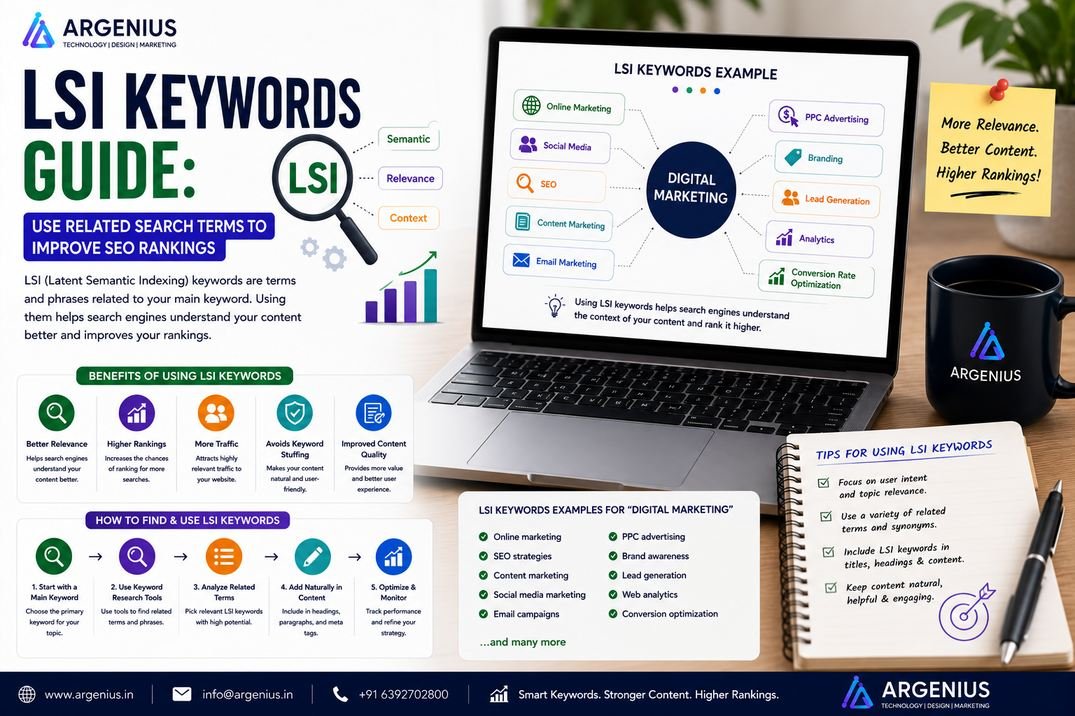
In modern SEO, LSI Keywords generally refer to related words and phrases that help search engines understand the overall topic of your content.
These include:
- Related Keywords
- Synonyms
- Topic-Specific Terms
- Industry Vocabulary
- Question-Based Keywords
- Entity Keywords
Rather than repeating the same keyword over and over, you should naturally include relevant concepts that provide complete coverage of the topic.
Does Google Use LSI Keywords?
This is one of the biggest myths in SEO.
Google has publicly clarified that it does not use Latent Semantic Indexing (LSI) as part of its ranking algorithm.
However, Google does understand:
- Context
- Search Intent
- Entities
- Semantic Relationships
- Natural Language
- Topic Relevance
This is why related keywords remain valuable—not because of LSI technology, but because they improve content quality and topical completeness.
Why Related Search Terms Matter
Including related search terms helps search engines understand your content more accurately.
Benefits include:
- Better Topical Relevance
- Improved Content Quality
- Higher Organic Visibility
- More Keyword Rankings
- Better User Experience
- Reduced Keyword Stuffing
- Improved AI Search Understanding
- Higher Topical Authority
- Better Featured Snippet Opportunities
- Sustainable SEO Growth
Well-written content naturally includes related concepts instead of repeating the same keyword excessively.
LSI Keywords vs Primary Keywords
| Primary Keyword |
Related Search Terms (Often Called LSI Keywords) |
| Website Development |
Web Design, Responsive Website, CMS, Frontend Development |
| SEO Services |
Technical SEO, On-Page SEO, Backlinks, Keyword Research |
| Mobile App Development |
Android Apps, iOS Apps, Flutter, React Native |
| Ecommerce SEO |
Product SEO, Category Pages, Schema Markup, Google Shopping |
The goal is to build context around the primary topic.
Semantic SEO Explained
Semantic SEO focuses on covering an entire topic rather than optimizing for a single keyword.
Instead of writing only about Keyword Research, you also discuss:
- Search Intent
- Long-Tail Keywords
- Keyword Clustering
- Keyword Difficulty
- Competitor Analysis
- Search Volume
- Content Strategy
This creates a richer, more helpful page for users and search engines.
How Search Engines Understand Context
Modern search engines analyze:
- User Intent
- Page Structure
- Entities
- Related Concepts
- Internal Links
- Content Depth
- User Behavior
They no longer rely on exact keyword repetition to determine relevance.
Examples of Related Keywords
Primary Keyword:
Website Development
Related Search Terms:
- Responsive Design
- UI/UX
- CMS Development
- Laravel Development
- React Development
- Frontend Development
- Backend Development
- Website Speed
- Hosting
- Domain
These related phrases strengthen topical relevance.
How to Find Related Search Terms
You can discover semantic keywords using:
- Google Autocomplete
- People Also Ask
- Related Searches
- Google Search Console
- Competitor Analysis
- Ahrefs
- Semrush
- Keyword Planner
These sources provide valuable ideas for expanding content naturally.
Using Related Keywords Naturally
Best practices include:
- Add them in headings where relevant
- Include them in body content
- Use them in FAQs
- Mention them in image alt text when appropriate
- Include them naturally in internal links
Avoid forcing keywords into every paragraph.
LSI Keywords for AI Search
AI-powered search engines understand language more like humans than traditional keyword-matching systems.
To optimize for AI search:
- Write naturally
- Cover the topic comprehensively
- Answer common questions
- Build topical authority
- Use semantic headings
- Include FAQs
- Connect related concepts
This improves visibility across Google AI Overviews, ChatGPT, Gemini, and Perplexity.
Keyword Clustering and Semantic SEO
Rather than creating multiple pages targeting similar keywords, organize related keywords into clusters.
Example:
Primary Topic:
Technical SEO
Supporting Topics:
- Core Web Vitals
- Robots.txt
- XML Sitemap
- Crawl Budget
- Site Speed
- Structured Data
Topic clustering improves topical authority and strengthens internal linking.
Common Sources of Semantic Keywords
You can collect related keywords from:
- Google Related Searches
- Search Console Queries
- Competitor Content
- Industry Glossaries
- Customer FAQs
- Reddit Discussions
- Community Forums
- Product Documentation
These sources reflect how real users talk about your topic.
Step-by-Step Strategy for Using Related Search Terms
Using related search terms effectively is about building comprehensive, user-focused content rather than repeating the same keyword multiple times.
Step 1: Choose a Primary Keyword
Start with one main keyword that represents the page's primary topic.
Example:
On-Page SEO
This keyword becomes the foundation of your content.
Step 2: Find Related Search Terms
Identify keywords and phrases closely connected to your primary topic.
For example, if your primary keyword is On-Page SEO, related search terms may include:
- Meta Title
- Meta Description
- Header Tags
- Internal Linking
- Image Optimization
- URL Structure
- Content Optimization
- Keyword Placement
- Schema Markup
- Core Web Vitals
These terms help search engines understand the complete context of your page.
Step 3: Understand Search Intent
Before adding related keywords, determine why users are searching.
Ask yourself:
- Are they looking for information?
- Do they want a tutorial?
- Are they comparing services?
- Are they ready to hire a company?
Content should satisfy the user's intent rather than simply targeting keywords.
Step 4: Organize Keywords into Topic Clusters
Instead of creating separate pages for every variation, group related keywords into one comprehensive topic.
Example:
Primary Topic:
Technical SEO
Supporting Topics:
- XML Sitemap
- Robots.txt
- Crawl Budget
- Structured Data
- Website Speed
- Core Web Vitals
This approach strengthens topical authority and improves internal linking.
Step 5: Use Keywords Naturally
Place related terms where they fit naturally.
Recommended locations:
- Headings
- Body Content
- FAQs
- Image ALT Text
- Internal Links
- Meta Description
Avoid inserting keywords unnaturally just to increase keyword density.
Step 6: Cover the Topic Completely
Search engines reward pages that answer all major questions related to a topic.
Instead of writing only about SEO, also explain:
- Keyword Research
- On-Page SEO
- Technical SEO
- Link Building
- User Experience
- Search Intent
Comprehensive content increases your chances of ranking for multiple related searches.
Step 7: Monitor Performance
Track how your content performs using SEO tools.
Review:
- Organic Traffic
- Search Rankings
- Search Console Queries
- Click-Through Rate (CTR)
- Average Position
- User Engagement
Update your content regularly based on performance data.
Related Search Terms Checklist
Before publishing, confirm that your page includes:
- ✅ One Clear Focus Keyword
- ✅ Relevant Related Search Terms
- ✅ Natural Keyword Usage
- ✅ Topic Cluster Coverage
- ✅ Search Intent Alignment
- ✅ Optimized Meta Title
- ✅ Meta Description
- ✅ Internal Links
- ✅ FAQ Section
- ✅ Helpful, Original Content
- ✅ Mobile-Friendly Formatting
- ✅ AI-Friendly Structure
Following this checklist helps create content that is useful for both users and search engines.
Best SEO Tools for Finding Related Keywords
Free Tools
- Google Autocomplete
- Google Search Console
- Google Trends
- Google Keyword Planner
- People Also Ask
- Google Related Searches
Paid Tools
- Ahrefs
- Semrush
- SE Ranking
- Moz Keyword Explorer
- Mangools
- Ubersuggest
- Surfer SEO
Using multiple tools provides broader keyword coverage and deeper competitive insights.
Related Search Terms and AI Search
Modern AI-powered search engines focus on context rather than exact keyword matching.
To optimize content for AI-driven search:
- Answer complete questions
- Cover related concepts
- Build topical authority
- Use conversational language
- Include semantic headings
- Add FAQs
- Keep information accurate and up to date
These practices improve visibility across Google AI Overviews, ChatGPT, Gemini, and Perplexity.
Cost of Semantic SEO & Keyword Research Services (₹ INR)
The cost of semantic keyword research depends on the complexity of your website and SEO goals.
| Service |
Estimated Cost |
| Basic Keyword & Semantic Research |
₹5,000 – ₹15,000 |
| SEO Content Planning |
₹15,000 – ₹35,000 |
| Advanced Semantic SEO Strategy |
₹35,000 – ₹75,000 |
| Enterprise SEO Planning |
Custom Pricing |
Factors Affecting Cost
Pricing depends on:
- Industry Competition
- Number of Target Topics
- Competitor Analysis
- Website Size
- Content Depth
- Topic Clustering
- Search Intent Research
- Ongoing SEO Optimization
Investing in semantic SEO helps create content that remains valuable as search algorithms evolve.
Semantic SEO Best Practices
To improve rankings and content quality:
- Focus on topics, not keyword repetition
- Use related search terms naturally
- Cover user questions in depth
- Create topic clusters
- Strengthen internal linking
- Keep content updated
- Optimize for Featured Snippets
- Improve readability
- Use structured headings
- Build topical authority over time
These practices support long-term SEO performance.
Common Mistakes to Avoid
Avoid these common errors:
- Believing Google uses LSI technology for rankings
- Repeating the same keyword excessively
- Ignoring search intent
- Publishing thin content
- Missing related subtopics
- Weak internal linking
- Creating duplicate pages
- Using outdated keyword research
- Forgetting mobile optimization
- Ignoring AI search optimization
High-quality, comprehensive content consistently performs better than pages built around keyword density.
Future Trends in Semantic SEO
Search continues to become more intelligent and context-aware.
Key trends include:
- Google AI Overviews
- Generative Engine Optimization (GEO)
- Entity-Based SEO
- Semantic Search
- Conversational Search
- Voice Search
- Topical Authority
- Knowledge Graph Optimization
- AI-Powered Content Discovery
- Search Intent Optimization
Businesses that create topic-focused, helpful content will be better prepared for future algorithm updates.
Why Businesses Choose Argenius
At Argenius, we focus on modern SEO strategies that prioritize topical authority, semantic relevance, and user experience rather than outdated keyword tactics.
Our Semantic SEO Services include:
- Comprehensive Keyword Research
- Related Search Term Analysis
- Topic Cluster Planning
- Search Intent Mapping
- Content Strategy Development
- Technical SEO
- On-Page SEO Optimization
- Internal Linking Strategy
- Content Gap Analysis
- Monthly SEO Performance Reporting
Our goal is to help businesses build long-term search visibility through high-quality, context-rich content.
Final Thoughts
The term LSI Keywords is still widely used in the SEO industry, but modern search optimization is really about semantic relevance and related search terms. Rather than relying on outdated concepts, successful SEO strategies focus on creating content that thoroughly covers a topic, answers user questions, and naturally incorporates related concepts.
By combining semantic SEO, search intent analysis, topic clusters, and high-quality content, businesses can improve visibility for a wide range of relevant search queries. This approach not only supports better rankings in traditional search engines but also increases the likelihood of being surfaced in AI-powered search experiences.
If you want to create content that builds topical authority and drives sustainable organic traffic, Argenius can help develop a semantic SEO strategy tailored to your business goals.
Frequently Asked Questions
What are LSI Keywords?
In modern SEO, LSI Keywords generally refer to related search terms and semantic keywords that help provide context around a topic. Google does not use LSI technology itself for web search.
Do related search terms improve SEO?
Yes. Naturally including relevant concepts and supporting keywords helps search engines better understand your content and improves topical relevance.
How can I find related search terms?
You can use Google Autocomplete, People Also Ask, Google Related Searches, Google Search Console, Ahrefs, Semrush, and competitor analysis to discover related keywords.
What is Semantic SEO?
Semantic SEO is the practice of creating comprehensive, context-rich content that covers an entire topic instead of focusing only on exact-match keywords.
Should I repeat my primary keyword many times?
No. Excessive repetition can reduce readability and may be considered keyword stuffing. Use your primary keyword naturally and support it with related search terms.
Does Argenius provide Semantic SEO services?
Yes. Argenius offers Semantic SEO, Keyword Research, Topic Cluster Planning, Content Strategy, Technical SEO, and On-Page SEO services to help businesses improve organic visibility and long-term search performance.