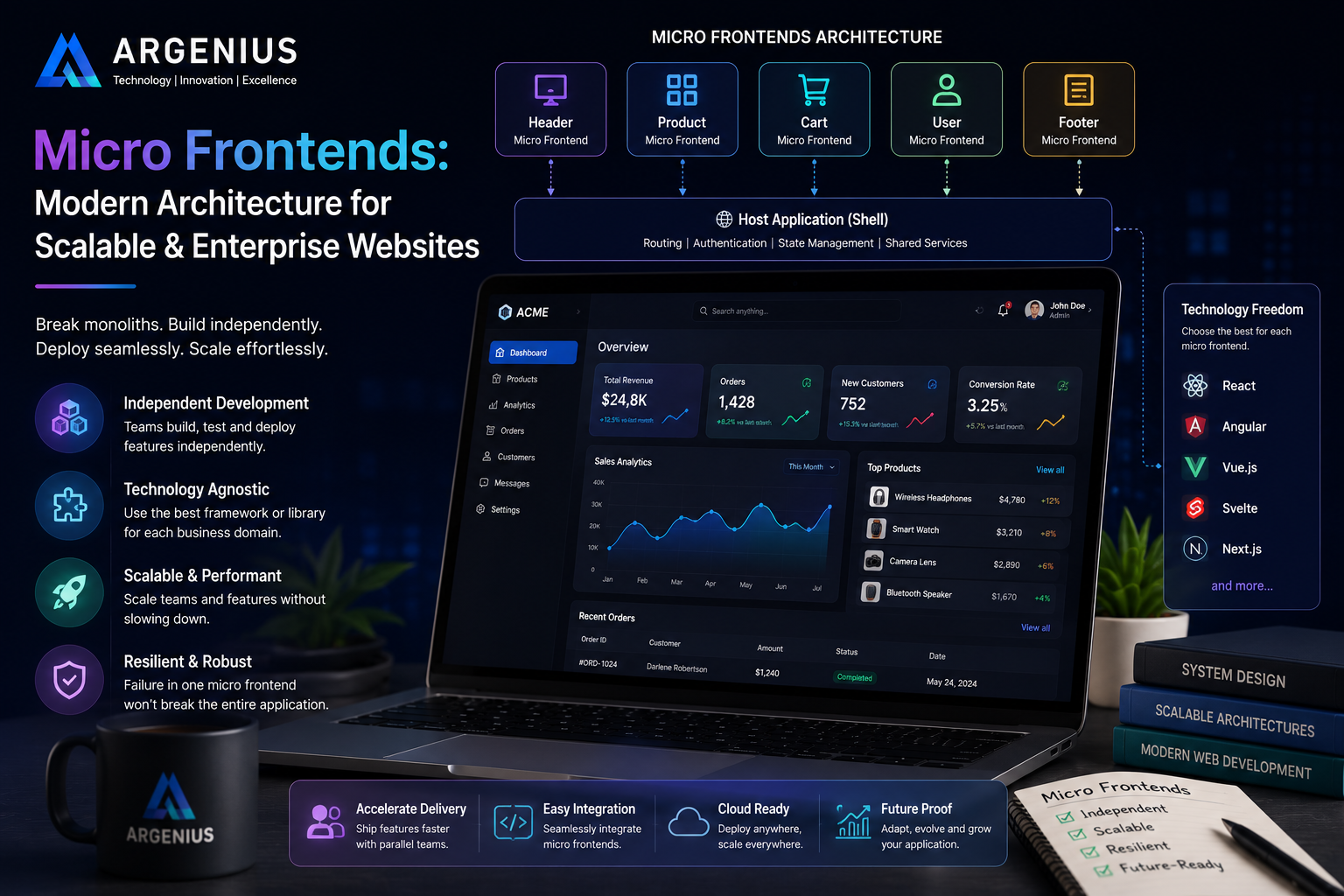
Micro Frontends enable development teams to build scalable web applications by dividing the frontend into independent modules. Learn how this modern architecture improves performance, flexibility, and enterprise software development.
Why Large Websites Need a Different Frontend Architecture
As businesses grow, their websites often evolve into much more than simple marketing platforms. A company that starts with a basic website may later add customer dashboards, employee portals, online payments, analytics, appointment booking, inventory management, multilingual support, and dozens of other features. Over time, managing all of these capabilities within a single frontend codebase becomes increasingly difficult.
Large development teams frequently face challenges such as slow deployments, code conflicts, long testing cycles, and complicated maintenance. Even a small update can affect unrelated parts of the application, making development slower and increasing the risk of bugs.
To solve these challenges, many enterprise organizations have adopted Micro Frontends, an architectural approach that breaks a large frontend into smaller, independent applications. Instead of one massive codebase managed by every developer, each section of the website becomes a self-contained module that can be developed, tested, deployed, and maintained independently.
At Argenius, we help businesses choose architectures that support long-term growth. For enterprise projects and large digital platforms, Micro Frontends provide the flexibility and scalability needed to keep development efficient as applications become more complex.
What Are Micro Frontends?
Micro Frontends are an architectural approach where the frontend of a website or web application is divided into smaller, independent modules. Each module is responsible for a specific feature or business function and can often be developed by a dedicated team.
For example, an enterprise portal might separate:
- User authentication
- Dashboard
- Product catalog
- Shopping cart
- Payment system
- Customer profile
- Reports
- Admin panel
Although these modules appear as one unified application to users, they can be developed and updated independently behind the scenes.
Why Businesses Are Adopting Micro Frontends
Modern businesses need websites that can evolve without slowing development.
Micro Frontends help organizations:
- Scale development teams
- Reduce deployment risks
- Improve maintainability
- Accelerate feature releases
- Simplify large applications
- Increase flexibility
- Support long-term growth
Instead of waiting for one large release, teams can deploy improvements more frequently and with greater confidence.
Independent Development Teams
One of the biggest advantages of Micro Frontends is team independence.
Different teams can own different parts of the application.
For example:
- Marketing manages the homepage.
- Sales manages the customer portal.
- Finance manages billing.
- HR manages recruitment pages.
- Support manages the help center.
Because each module is isolated, teams can work simultaneously without interfering with one another.
This improves productivity and shortens development cycles.
Faster Development and Deployment
Large applications often become difficult to update because every release affects multiple features.
Micro Frontends allow teams to deploy changes independently.
Benefits include:
- Faster releases
- Reduced downtime
- Smaller updates
- Easier rollback
- Lower deployment risk
Businesses can introduce new functionality without delaying unrelated improvements.
Better Scalability
As businesses expand, applications naturally become more complex.
Micro Frontends make scaling easier because new modules can be added without restructuring the existing frontend.
Examples include:
- New customer dashboard
- Loyalty program
- AI chatbot
- Vendor portal
- Subscription management
- Analytics dashboard
This modular architecture supports continuous business growth.
Technology Flexibility
Different modules may use different frontend technologies when appropriate.
For example:
- React for dashboards
- Vue.js for customer portals
- Angular for internal tools
This flexibility allows organizations to adopt new technologies gradually instead of rebuilding the entire application.
However, businesses should establish clear standards to maintain consistency and avoid unnecessary complexity.
Improved Maintainability
Large codebases often become difficult to understand and maintain.
Micro Frontends organize applications into smaller, manageable projects.
This makes it easier to:
- Fix bugs
- Add features
- Review code
- Train new developers
- Upgrade technologies
Well-structured modules reduce technical debt over time.
Better Business Agility
Today's businesses need to respond quickly to changing customer expectations.
Micro Frontends support agility by allowing organizations to:
- Launch new products
- Test new features
- Update specific sections
- Expand into new markets
- Support multiple brands
Instead of redesigning the entire website, businesses can improve individual modules as needed.
Performance Considerations
When implemented carefully, Micro Frontends can deliver excellent performance.
Optimization techniques include:
- Code splitting
- Lazy loading
- Shared libraries
- Asset optimization
- Caching
- Efficient routing
Poor implementation, however, can increase JavaScript size and duplicate dependencies, so architectural planning is essential.
At Argenius, performance remains a priority when designing modular frontend systems.
Security Best Practices
Every module should follow consistent security standards.
Recommended practices include:
- Secure authentication
- Centralized authorization
- HTTPS communication
- API security
- Input validation
- Role-based permissions
A unified security strategy ensures that independent modules do not create vulnerabilities.
Challenges of Micro Frontends
Although Micro Frontends provide many advantages, they are not the right solution for every project.
Potential challenges include:
- Increased architectural complexity
- More deployment coordination
- Shared dependency management
- Design consistency
- Communication between modules
- Monitoring multiple applications
Proper planning and experienced development teams help minimize these challenges.
When Should You Use Micro Frontends?
Micro Frontends are an excellent choice when your project includes:
- Enterprise applications
- Large SaaS platforms
- Multi-team development
- Multi-brand websites
- Large eCommerce platforms
- Customer portals
- Banking systems
- Healthcare platforms
- Government portals
For smaller business websites or simple landing pages, a traditional frontend architecture is often more practical and cost-effective.
Common Mistakes Businesses Make
Organizations sometimes adopt Micro Frontends simply because they are popular.
Common mistakes include:
- Using Micro Frontends for small websites
- No shared design system
- Duplicate libraries
- Weak module communication
- Inconsistent coding standards
- Ignoring performance optimization
- Lack of documentation
The architecture should always match the complexity of the project rather than current technology trends.
Why Businesses Choose Argenius
At Argenius, we help businesses design frontend architectures that support both current requirements and future growth. For enterprise applications, SaaS platforms, and large-scale websites, we implement Micro Frontend strategies that improve scalability, maintainability, and development efficiency without compromising performance or user experience.
Our development approach combines modern frontend technologies, reusable component libraries, API-driven architecture, responsive design, technical SEO, and performance optimization. Whether you're building a customer portal, enterprise dashboard, multi-brand platform, or complex web application, we create scalable solutions that remain easy to maintain as your business evolves.
Final Thoughts
Micro Frontends have transformed the way large web applications are built. By dividing complex frontends into independent modules, organizations gain greater flexibility, faster deployments, and improved collaboration between development teams. This architecture enables businesses to scale their digital platforms without creating a single, difficult-to-maintain codebase.
However, Micro Frontends are not the right choice for every project. Smaller websites often benefit more from a simpler architecture, while enterprise platforms with multiple teams and continuous feature development can take full advantage of this modular approach.
At Argenius, we help businesses evaluate their technical requirements before recommending the right architecture. Whether your project requires a traditional frontend, React application, Vue.js solution, or a Micro Frontend architecture, our goal is to build secure, scalable, and high-performing digital products that support long-term business success.
Frequently Asked Questions
What are Micro Frontends?
Micro Frontends are an architectural approach where a large frontend application is divided into smaller, independent modules that can be developed, deployed, and maintained separately.
Are Micro Frontends suitable for every website?
No. They are best suited for enterprise applications, SaaS platforms, large eCommerce websites, and projects with multiple development teams. Small business websites usually do not require this level of complexity.
Can Micro Frontends improve performance?
Yes, when implemented correctly using techniques such as code splitting, lazy loading, caching, and optimized asset management. Poor implementation, however, can negatively impact performance.
Which technologies can be used with Micro Frontends?
Micro Frontends can work with technologies such as React, Vue.js, Angular, and other frontend frameworks, depending on the project's architecture and requirements.
Can Argenius build Micro Frontend applications?
Yes. At Argenius, we design and develop enterprise-grade Micro Frontend architectures using modern technologies, focusing on scalability, security, performance, maintainability, and long-term business growth.