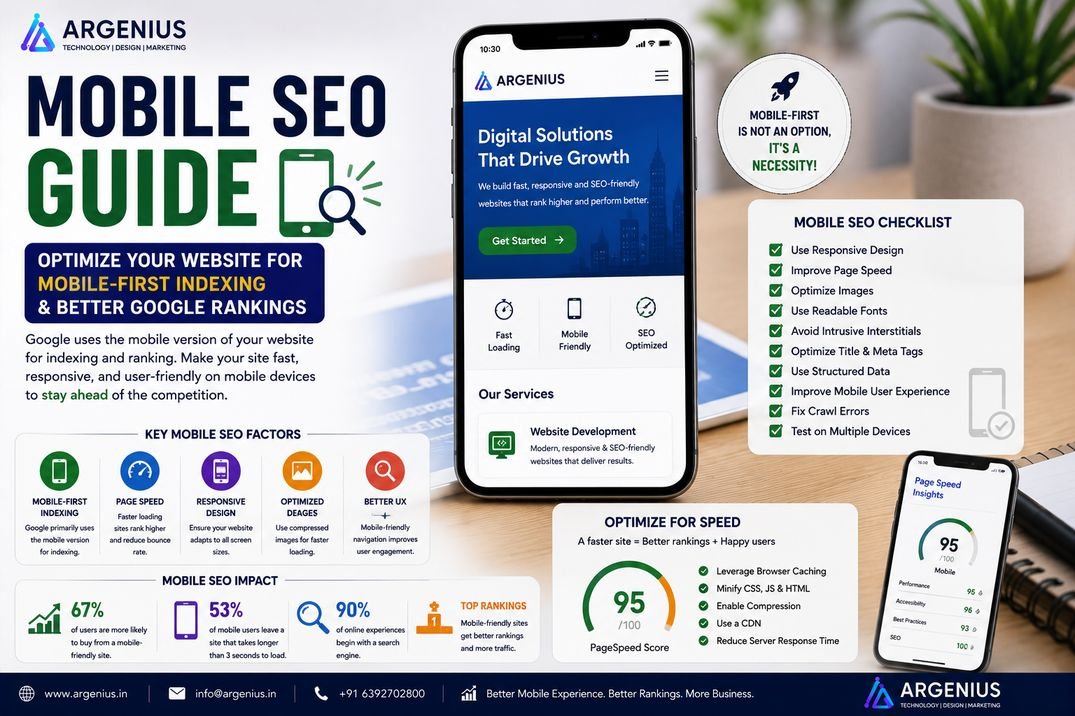
Google now uses Mobile-First Indexing, meaning your website's mobile version determines how it ranks in search results. This complete Mobile SEO Guide explains responsive design, mobile page speed, Core Web Vitals, technical SEO, mobile UX, and best practices to improve rankings and deliver a better user experience.
Introduction
More than 70% of global web traffic now comes from mobile devices, making smartphones the primary way people browse the internet. Whether users are searching for products, reading blogs, booking services, or making purchases, they expect websites to load quickly, display correctly, and provide a smooth mobile experience.
Recognizing this shift in user behavior, Google introduced Mobile-First Indexing, meaning it primarily uses the mobile version of a website to evaluate and rank pages in search results. If your mobile website is slow, difficult to navigate, or missing important content, your search rankings may suffer—even if your desktop version is excellent.
This is where Mobile SEO becomes essential.
Mobile SEO focuses on optimizing your website for smartphones and tablets by improving responsiveness, page speed, user experience, navigation, readability, and technical performance. A well-optimized mobile website not only ranks better in Google but also reduces bounce rates, increases engagement, and improves conversion rates.
Whether you run an ecommerce store, SaaS platform, local business website, corporate site, or blog, investing in Mobile SEO ensures your content reaches users wherever they are.
In this comprehensive guide, you'll learn everything about Mobile SEO, including Mobile-First Indexing, responsive design, mobile page speed, Core Web Vitals, technical optimization, common mistakes, and proven strategies to improve rankings and user experience.
At Argenius, we help businesses build fast, responsive, and mobile-friendly websites that perform exceptionally well in Google Search and deliver measurable business growth.
What is Mobile SEO?
Mobile SEO is the process of optimizing a website so it performs efficiently on smartphones and tablets while providing an excellent user experience and meeting Google's mobile ranking requirements.
It involves improving:
- Responsive Design
- Mobile Loading Speed
- Core Web Vitals
- Mobile Navigation
- Touch-Friendly Interface
- Readable Content
- Technical SEO
- Mobile User Experience
The goal is to ensure that users and search engines can easily access, understand, and interact with your website on mobile devices.
What is Mobile-First Indexing?
Mobile-First Indexing means Google primarily uses the mobile version of your website for crawling, indexing, and ranking instead of the desktop version.
Previously, Google evaluated desktop pages first. Today, if your mobile site lacks important content or provides a poor experience, it can negatively affect your rankings across all devices.
With Mobile-First Indexing:
- Mobile content becomes the primary version.
- Mobile performance influences rankings.
- Mobile usability impacts user engagement.
- Technical mobile optimization becomes essential.
A responsive and well-optimized mobile website is no longer optional—it's a critical part of modern SEO.
Why is Mobile SEO Important?
A strong Mobile SEO strategy provides benefits such as:
- Higher Google Rankings
- Better User Experience
- Faster Page Loading
- Lower Bounce Rates
- Increased Engagement
- More Conversions
- Improved Local SEO
- Better Core Web Vitals
- Enhanced Brand Credibility
- Higher Organic Traffic
Since most searches now occur on mobile devices, optimizing for mobile directly supports long-term business growth.
Key Elements of Mobile SEO
An effective Mobile SEO strategy includes several components working together:
- Responsive Web Design
- Mobile Page Speed
- Core Web Vitals
- Touch-Friendly Navigation
- Readable Typography
- Optimized Images
- Mobile-Friendly Forms
- Structured Data
- HTTPS Security
- Technical SEO
- Internal Linking
- Mobile Accessibility
Each of these contributes to better rankings and a smoother user experience.
Responsive Web Design
Responsive design allows your website to automatically adapt to different screen sizes and devices.
Instead of creating separate desktop and mobile websites, responsive design uses flexible layouts that provide a consistent experience everywhere.
Benefits of Responsive Design
- Better User Experience
- Easier Website Maintenance
- Improved SEO
- Faster Development
- Consistent Branding
- Lower Bounce Rates
Google recommends responsive web design as the preferred approach for mobile optimization.
Mobile Page Speed
Page speed is one of the most important ranking and user experience factors.
Users expect mobile websites to load within a few seconds. Slow-loading pages often lead to higher bounce rates and lower conversions.
Ways to Improve Mobile Speed
- Compress Images
- Enable Browser Caching
- Minify CSS & JavaScript
- Reduce HTTP Requests
- Use Lazy Loading
- Implement CDN
- Upgrade Hosting
- Optimize Fonts
- Remove Unused Code
- Enable GZIP Compression
Faster websites improve both rankings and customer satisfaction.
Core Web Vitals for Mobile
Google measures website performance using Core Web Vitals, which focus on real-world user experience.
Largest Contentful Paint (LCP)
Measures how quickly the main content loads.
Interaction to Next Paint (INP)
Measures how responsive your website is when users interact with it.
Cumulative Layout Shift (CLS)
Measures visual stability and tracks unexpected layout changes during loading.
Optimizing these metrics helps improve search visibility and user experience.
Mobile User Experience (UX)
A good mobile experience encourages visitors to stay longer and complete desired actions.
Focus on:
- Simple Navigation
- Large Touch Targets
- Clear Call-to-Action Buttons
- Readable Fonts
- Proper Spacing
- Easy Scrolling
- Minimal Pop-ups
- Accessible Design
A positive mobile UX improves engagement and conversions.
Mobile-Friendly Content
Content should be easy to consume on smaller screens.
Best Practices
- Short Paragraphs
- Descriptive Headings
- Bullet Points
- Optimized Images
- Readable Font Sizes
- Proper Line Spacing
- Scannable Layout
- Clear CTAs
Well-formatted content improves readability and user retention.
Technical Mobile SEO
Technical optimization ensures search engines can efficiently crawl and understand your mobile website.
Key areas include:
- Mobile XML Sitemap
- Robots.txt
- HTTPS
- Canonical Tags
- Structured Data
- Fast Server Response
- Crawl Optimization
- Clean URL Structure
A technically optimized website supports better indexing and rankings.
Mobile SEO for Local Businesses
Many local searches happen on smartphones.
Examples include:
- Restaurant Near Me
- Digital Marketing Agency Near Me
- Plumber Near Me
- Hospital Near Me
- Website Development Company Near Me
Optimizing your mobile website alongside your Google Business Profile improves visibility in local search results and Google Maps.
Common Mobile SEO Challenges
Businesses often struggle with:
- Slow Mobile Speed
- Poor Responsive Design
- Tiny Buttons
- Difficult Navigation
- Intrusive Pop-ups
- Unoptimized Images
- Missing Structured Data
- Mobile Crawl Errors
- Poor Core Web Vitals
- Low Mobile Conversions
Identifying and fixing these issues leads to better rankings and user satisfaction.
Mobile SEO Checklist
Before publishing or updating your website, make sure every important mobile SEO factor has been optimized.
Use this checklist regularly:
- ✅ Responsive Website Design
- ✅ Mobile-First Layout
- ✅ Fast Mobile Loading Speed
- ✅ Optimized Core Web Vitals
- ✅ Mobile-Friendly Navigation
- ✅ Readable Font Sizes
- ✅ Proper Button Spacing
- ✅ Compressed Images
- ✅ Lazy Loading Enabled
- ✅ HTTPS Security
- ✅ XML Sitemap Updated
- ✅ Correct Robots.txt Configuration
- ✅ Structured Data Implemented
- ✅ Mobile-Friendly Forms
- ✅ Internal Linking Optimized
- ✅ No Intrusive Pop-ups
- ✅ Canonical Tags Configured
- ✅ Google Search Console Verified
- ✅ Mobile Usability Errors Fixed
- ✅ Regular Performance Monitoring
Completing this checklist helps ensure your website is fully prepared for Mobile-First Indexing and delivers a smooth user experience.
Mobile SEO Audit Process
A regular mobile SEO audit helps identify issues before they impact rankings.
Step 1: Check Mobile Friendliness
Review how your website performs on different screen sizes.
Look for:
- Broken layouts
- Text that's too small
- Overlapping elements
- Navigation issues
Step 2: Measure Page Speed
Analyze loading performance using professional tools.
Review:
- Largest Contentful Paint (LCP)
- Interaction to Next Paint (INP)
- Cumulative Layout Shift (CLS)
- Server Response Time
Step 3: Review Technical SEO
Check technical elements including:
- XML Sitemap
- Robots.txt
- HTTPS
- Canonical Tags
- Structured Data
- Crawl Errors
Step 4: Test User Experience
Navigate the website as a mobile visitor.
Evaluate:
- Ease of navigation
- Button accessibility
- Form usability
- Readability
- Checkout process (for ecommerce)
Step 5: Fix Identified Issues
Prioritize improvements based on their impact on rankings and user experience.
Best Mobile SEO Tools
Professional SEO specialists use these tools to monitor mobile performance:
- Google Search Console
- Google PageSpeed Insights
- Google Lighthouse
- Google Analytics 4
- Chrome DevTools
- GTmetrix
- Screaming Frog SEO Spider
- Semrush
- Ahrefs
- Cloudflare Analytics
Using multiple tools provides a complete understanding of your mobile website's health.
Cost of Mobile SEO Services (₹ INR)
The cost of Mobile SEO depends on your website's size, current performance, and the level of optimization required.
| Service |
Estimated Cost |
| Basic Mobile SEO Audit |
₹10,000 – ₹20,000 |
| Small Business Mobile SEO |
₹20,000 – ₹50,000 |
| Ecommerce Mobile Optimization |
₹50,000 – ₹1,50,000+ |
| Enterprise Mobile SEO |
Custom Pricing |
Factors Affecting Cost
Pricing depends on:
- Website Size
- Number of Pages
- Current Mobile Performance
- Core Web Vitals Issues
- Responsive Design Requirements
- Technical SEO Complexity
- Mobile UX Improvements
- Ongoing Monitoring & Reporting
Investing in Mobile SEO helps improve both search rankings and conversion rates over the long term.
Mobile SEO Best Practices
Follow these best practices to maximize your mobile search performance:
- Design with a mobile-first approach
- Use responsive web design
- Optimize Core Web Vitals
- Compress images without sacrificing quality
- Enable browser caching
- Minify CSS and JavaScript
- Reduce server response time
- Use HTTPS across the entire website
- Create touch-friendly navigation
- Keep forms short and easy to complete
- Avoid intrusive interstitials
- Test your website on multiple devices
- Monitor Google Search Console regularly
- Continuously improve page speed
Consistency in these areas helps maintain strong rankings and user satisfaction.
Common Mobile SEO Mistakes
Many websites lose traffic because of avoidable mobile optimization issues.
Common mistakes include:
- Slow-loading pages
- Non-responsive layouts
- Tiny fonts that are difficult to read
- Buttons placed too close together
- Heavy, uncompressed images
- Blocking CSS or JavaScript
- Ignoring Core Web Vitals
- Excessive pop-ups
- Poor internal linking
- Missing structured data
- Broken mobile menus
- Not testing on real devices
Avoiding these mistakes creates a smoother experience for users and search engines alike.
Future Trends in Mobile SEO
Mobile SEO continues to evolve as technology and user behavior change.
Key trends include:
- Google AI Overviews
- Generative Engine Optimization (GEO)
- Progressive Web Apps (PWAs)
- 5G-Powered Mobile Experiences
- Voice Search Optimization
- Visual Search
- AI-Powered Personalization
- Entity-Based Search
- Core Web Vitals Evolution
- Mobile Commerce Growth
Businesses that embrace these trends early will be better positioned for future search algorithm updates.
Why Businesses Choose Argenius
At Argenius, we create mobile experiences that are fast, responsive, and optimized for both users and search engines.
Our Mobile SEO Services include:
- Complete Mobile SEO Audits
- Mobile-First Website Optimization
- Core Web Vitals Improvements
- Responsive Web Design
- Page Speed Optimization
- Technical SEO Enhancements
- Schema Markup Implementation
- Mobile UX Improvements
- Performance Monitoring
- Monthly SEO Reporting
Our objective is not just to improve rankings, but also to increase engagement, conversions, and business growth through a superior mobile experience.
Final Thoughts
With Google's Mobile-First Indexing, your website's mobile version has become the foundation of your SEO performance. A fast, responsive, and user-friendly mobile experience is no longer a competitive advantage—it's a requirement.
By focusing on responsive design, Core Web Vitals, page speed, technical SEO, and mobile usability, you can improve your visibility in search results while creating a better experience for visitors.
Mobile SEO should be treated as an ongoing process. Regular audits, continuous performance optimization, and adapting to evolving technologies ensure your website remains competitive as user expectations and search algorithms change.
If you're looking to improve your mobile search performance and deliver a seamless experience across all devices, Argenius can help with customized Mobile SEO solutions tailored to your business objectives.
Frequently Asked Questions
What is Mobile SEO?
Mobile SEO is the process of optimizing a website for smartphones and tablets to improve user experience, search engine rankings, and compatibility with Google's Mobile-First Indexing.
What is Mobile-First Indexing?
Mobile-First Indexing means Google primarily uses the mobile version of your website when crawling, indexing, and determining rankings in search results.
Why is responsive design important for SEO?
Responsive design ensures your website adapts to different screen sizes, improves user experience, reduces maintenance, and aligns with Google's recommended approach for mobile optimization.
How do Core Web Vitals affect Mobile SEO?
Core Web Vitals measure loading speed, responsiveness, and visual stability. Strong scores contribute to a better user experience and can positively influence search rankings.
How often should I perform a Mobile SEO audit?
A comprehensive Mobile SEO audit should be conducted every 3–6 months, or immediately after significant website updates or redesigns.
Does Argenius provide Mobile SEO services?
Yes. Argenius offers complete Mobile SEO services, including responsive optimization, Core Web Vitals improvements, page speed optimization, technical SEO, mobile UX enhancements, and ongoing performance monitoring.