Discover how People Also Search For (PASF) helps uncover search intent, related keywords, and content opportunities. Learn how to use PASF for SEO, Google rankings, AI search optimization, and higher organic traffic.
Introduction
SEO has evolved beyond simply targeting high-volume keywords. Modern search engines like Google focus on understanding search intent—the reason behind a user's search. One of the most valuable but often overlooked sources of keyword ideas is the People Also Search For (PASF) feature.
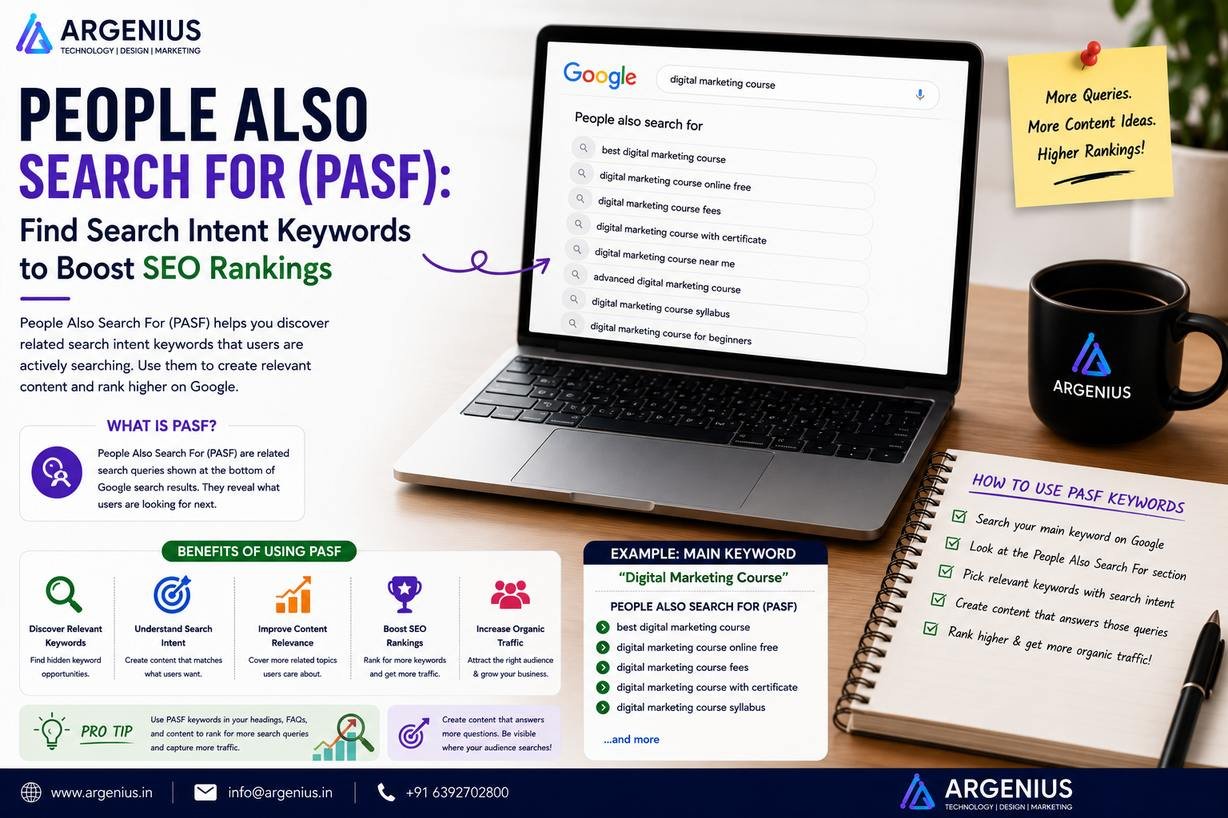
When a user clicks on a search result and then returns to Google, the search engine often displays a People Also Search For box. This section contains related searches that other users commonly explore after searching for the same topic. These suggestions reveal what users are genuinely interested in, making PASF an excellent resource for discovering related keywords, content gaps, and additional search intent.
For SEO professionals, content marketers, and business owners, PASF provides insights that go beyond traditional keyword research tools. It helps identify supporting topics, understand user behavior, and create comprehensive content that answers multiple related queries in a single article.
As AI-powered search platforms such as Google AI Overviews, ChatGPT, Gemini, and Perplexity continue to prioritize complete and context-rich answers, using PASF insights has become even more important. Instead of optimizing for a single keyword, businesses should build content that addresses an entire topic and the questions users ask around it.
Whether you're optimizing a blog, service page, ecommerce website, or knowledge base, understanding People Also Search For can help you improve rankings, increase organic traffic, and deliver a better user experience.
In this comprehensive guide, you'll learn what PASF is, how it works, why it's important for SEO, and how to use it to build an effective search intent strategy.
At Argenius, we use PASF insights alongside advanced keyword research and technical SEO to create content strategies that drive qualified traffic and long-term business growth.
What is People Also Search For (PASF)?
People Also Search For (PASF) is a Google search feature that displays related search queries users often explore after searching for a particular topic.
These suggestions help users discover additional information and help website owners understand related search intent.
For example, if someone searches for:
Keyword Research
Google may display PASF suggestions such as:
- Long-Tail Keywords
- Keyword Difficulty
- Search Intent
- LSI Keywords
- Competitor Keyword Analysis
- Google Keyword Planner
These related searches reveal what users want to learn next.
Why is PASF Important for SEO?
PASF provides valuable insights into user behavior and content opportunities.
Benefits include:
- Better Search Intent Understanding
- Discover Related Keywords
- Improve Content Depth
- Build Topic Clusters
- Increase Organic Traffic
- Reduce Content Gaps
- Improve User Experience
- Increase Internal Linking Opportunities
- Better AI Search Visibility
- Stronger Topical Authority
Instead of focusing on a single keyword, PASF helps you create content that covers an entire topic comprehensively.
How Does People Also Search For Work?
When users perform a search and interact with search results, Google collects behavioral signals to identify related interests.
If users frequently search for additional topics after their initial query, Google may display those searches in the PASF section.
Google considers factors such as:
- Search Intent
- User Behavior
- Query Relationships
- Search History Trends
- Topic Relevance
- Semantic Connections
These insights help Google recommend related searches that satisfy user intent.
PASF vs Related Searches vs People Also Ask
Although these features appear similar, they serve different purposes.
| Feature |
Purpose |
| People Also Search For (PASF) |
Shows related searches users perform after the original query. |
| People Also Ask (PAA) |
Displays common questions related to the topic. |
| Related Searches |
Shows broader keyword suggestions at the bottom of search results. |
Using all three features together provides a more complete understanding of user intent.
Benefits of Using PASF Keywords
Optimizing content with PASF insights can help you:
- Discover supporting topics
- Expand keyword coverage
- Improve semantic relevance
- Build comprehensive guides
- Increase dwell time
- Improve topical authority
- Enhance internal linking
- Support AI-generated search results
- Capture additional organic traffic
- Improve overall SEO performance
How to Find PASF Keywords
You can identify PASF keywords by using:
- Google Search
- Google Chrome (desktop)
- Google Search Console
- Ahrefs
- Semrush
- SE Ranking
- Keyword research tools
- Competitor analysis
- User search behavior
Search your primary keyword, click a result, return to Google, and observe the People Also Search For suggestions.
Where Should You Use PASF Keywords?
Include PASF keywords naturally in:
- Blog Articles
- Service Pages
- FAQ Sections
- Buying Guides
- Landing Pages
- Category Pages
- Internal Links
- Comparison Articles
- Knowledge Base Content
Use them to support the primary topic rather than replacing your main keyword.
PASF and Search Intent
One of the biggest advantages of PASF is understanding different types of search intent.
These include:
Informational Intent
Users want to learn something.
Example:
Commercial Investigation
Users compare options.
Example:
- Best SEO tools
- Best CRM software
Transactional Intent
Users are ready to purchase.
Example:
- Hire SEO Company
- Buy CRM Software
Navigational Intent
Users are looking for a specific website or brand.
Example:
- Google Search Console
- Ahrefs Login
Understanding intent helps you create content that matches what users expect.
PASF and AI Search
AI-powered search engines analyze related concepts instead of isolated keywords.
Using PASF helps you:
- Cover complete topics
- Improve semantic SEO
- Answer related user needs
- Increase topical authority
- Build AI-friendly content
This improves your chances of being referenced by Google AI Overviews and conversational AI platforms.
Industries That Benefit from PASF
PASF is valuable for nearly every industry, including:
- Software Companies
- SaaS Businesses
- Ecommerce Stores
- Healthcare
- Education
- Finance
- Travel
- Real Estate
- Legal Services
- Digital Marketing Agencies
Any business producing educational or commercial content can benefit from PASF-driven SEO.
Step-by-Step Strategy for Using People Also Search For (PASF)
To get the maximum SEO benefit from People Also Search For (PASF), you need a structured approach that focuses on user intent rather than simply collecting related keywords.
Step 1: Identify Your Primary Keyword
Start with your main target keyword.
Examples:
- SEO Services
- Website Development
- Flutter App Development
- CRM Software
- Ecommerce Development
Search your primary keyword on Google to analyze the related searches.
Step 2: Collect PASF Suggestions
Search your target keyword and examine the People Also Search For section.
Record every relevant suggestion.
For example, if your primary keyword is:
Keyword Research
Possible PASF suggestions may include:
- Search Intent
- Long-Tail Keywords
- Keyword Difficulty
- Competitor Keywords
- Google Keyword Planner
- LSI Keywords
- Semantic SEO
These keywords reveal additional topics your audience wants to explore.
Step 3: Understand Search Intent
Every PASF keyword has a specific purpose.
Classify each keyword based on intent:
- Informational
- Commercial Investigation
- Transactional
- Navigational
This helps you decide which pages should target which keywords.
Step 4: Build Comprehensive Content
Instead of writing separate thin articles, combine related PASF keywords into one in-depth guide.
For example:
Primary Topic:
Technical SEO
Supporting PASF Topics:
- Core Web Vitals
- XML Sitemap
- Robots.txt
- Crawl Budget
- Website Speed
- Mobile SEO
This creates topical authority and improves ranking potential.
Step 5: Optimize Content Naturally
Include PASF keywords in:
- SEO Title
- Meta Description
- Headings
- Introduction
- Body Content
- FAQ Section
- Internal Links
- Image ALT Text
Use them naturally to improve semantic relevance without keyword stuffing.
Step 6: Strengthen Internal Linking
Connect PASF-based content to:
- Related Blogs
- Service Pages
- Category Pages
- Case Studies
- Resource Hubs
Strong internal linking helps search engines understand topic relationships and improves crawlability.
Step 7: Monitor Performance
Measure your results regularly.
Track:
- Organic Traffic
- Keyword Rankings
- Click-Through Rate (CTR)
- User Engagement
- Bounce Rate
- Featured Snippets
- AI Search Visibility
- Conversion Rate
Use this data to update and expand your content strategy over time.
PASF SEO Checklist
Before publishing your content, confirm that it includes:
- ✅ Primary Keyword
- ✅ Relevant PASF Keywords
- ✅ Clear Search Intent Coverage
- ✅ Comprehensive Content
- ✅ Optimized SEO Metadata
- ✅ Internal Links
- ✅ FAQ Section
- ✅ Mobile-Friendly Design
- ✅ Fast Page Speed
- ✅ Structured Data (where appropriate)
- ✅ Strong Call-to-Action
A complete checklist helps improve both search visibility and user experience.
Best Tools for PASF Keyword Research
Free Tools
- Google Search
- Google Search Console
- Google Autocomplete
- Google Related Searches
- Google Trends
- Google Chrome Search Results
Premium Tools
- Ahrefs
- Semrush
- SE Ranking
- AlsoAsked
- AnswerThePublic
- Moz Pro
These tools help uncover related keywords, user intent, competitor strategies, and content opportunities.
People Also Search For and AI Search
AI-powered search engines evaluate topics rather than isolated keywords.
To improve visibility in Google AI Overviews, ChatGPT, Gemini, and Perplexity:
- Cover the topic comprehensively.
- Include related PASF keywords naturally.
- Answer follow-up questions.
- Use structured headings.
- Add FAQ sections.
- Build strong topical authority.
- Keep content accurate and updated.
Comprehensive content built around PASF insights is more likely to be surfaced by AI-powered search experiences.
Cost of PASF SEO & Content Optimization (₹ INR)
The cost of implementing a PASF-focused SEO strategy depends on research depth, content creation, and ongoing optimization.
| Service |
Estimated Cost |
| PASF Keyword Research |
₹5,000 – ₹15,000 |
| Content Gap Analysis |
₹10,000 – ₹20,000 |
| Topic Cluster Development |
₹15,000 – ₹35,000 |
| Complete PASF SEO Campaign |
₹30,000 – ₹75,000 |
| Enterprise SEO Strategy |
Custom Pricing |
Factors Affecting Cost
Pricing depends on:
- Industry Competition
- Number of Keywords
- Content Depth
- Competitor Research
- Technical SEO
- Internal Linking
- Content Updates
- Monthly Reporting
A strategic PASF campaign helps improve rankings while creating a better user experience.
Best Practices for Using PASF
To maximize SEO performance:
- Start with a primary keyword.
- Analyze Google PASF suggestions.
- Focus on user intent.
- Build comprehensive topic clusters.
- Create helpful and original content.
- Strengthen internal linking.
- Update content regularly.
- Optimize for mobile users.
- Improve page speed.
- Track performance continuously.
Following these practices helps establish authority and improve long-term organic growth.
Common Mistakes to Avoid
Avoid these common mistakes:
- Ignoring PASF suggestions
- Creating thin content
- Keyword stuffing
- Covering only the primary keyword
- Ignoring search intent
- Weak internal linking
- Publishing duplicate content
- Not updating outdated articles
- Overlooking AI search optimization
- Focusing only on search volume instead of user needs
SEO success comes from satisfying user intent, not just targeting keywords.
Future Trends in PASF SEO
The importance of PASF will continue to grow as search engines become more intelligent.
Key trends include:
- Google AI Overviews
- Generative Engine Optimization (GEO)
- Semantic SEO
- Entity-Based Search
- Conversational AI Search
- Voice Search
- Topic Clusters
- Predictive Search
- Zero-Click Search
- AI-Powered Content Recommendations
Businesses that build comprehensive, user-focused content around related search intent will remain competitive in the future of SEO.
Why Businesses Choose Argenius
At Argenius, we create SEO strategies that go beyond traditional keyword optimization by focusing on user intent and topical authority.
Our SEO Services include:
- PASF Keyword Research
- Search Intent Analysis
- Topic Cluster Strategy
- Content Gap Analysis
- Technical SEO
- On-Page SEO
- Internal Linking Strategy
- Schema Markup
- SEO Performance Tracking
- Monthly SEO Reports
Our goal is to help businesses attract qualified organic traffic, improve search visibility, and achieve sustainable business growth.
Final Thoughts
People Also Search For (PASF) is one of the most valuable resources for understanding user behavior and expanding your keyword strategy. Instead of optimizing content around a single keyword, PASF helps you discover related searches, uncover content gaps, and build comprehensive pages that address the full scope of a user's search intent.
By integrating PASF keywords into blog posts, service pages, FAQs, and topic clusters, businesses can improve semantic relevance, strengthen topical authority, and increase opportunities to rank for multiple related queries. This approach also aligns with how modern search engines and AI-powered platforms evaluate content.
As Google continues to emphasize helpful, intent-driven content and AI search becomes more sophisticated, businesses that invest in PASF-based SEO strategies will be better positioned to attract qualified traffic and generate long-term results. Argenius helps organizations leverage PASF insights to create scalable content strategies that improve rankings, engagement, and conversions.
Frequently Asked Questions
What is People Also Search For (PASF)?
People Also Search For (PASF) is a Google search feature that displays related search queries users commonly explore after searching for a particular topic.
Why is PASF important for SEO?
PASF helps identify related keywords, understand search intent, build comprehensive content, and improve topical authority, leading to better organic search performance.
How can I find PASF keywords?
You can find PASF keywords by using Google Search, observing the People Also Search For section, and supplementing your research with tools like Ahrefs, Semrush, SE Ranking, and AnswerThePublic.
Should PASF keywords be included in every blog?
Include relevant PASF keywords where they naturally support the main topic. They should enhance content quality rather than be added solely for keyword optimization.
Does PASF help AI-powered search?
Yes. Covering related topics and search intent through PASF-based content improves relevance for AI-powered search platforms such as Google AI Overviews, ChatGPT, Gemini, and Perplexity.
Does Argenius provide PASF-based SEO services?
Yes. Argenius offers PASF Keyword Research, Search Intent Analysis, Topic Cluster Development, Technical SEO, Content Strategy, and Complete SEO Campaign Management to help businesses improve rankings and drive qualified organic traffic.