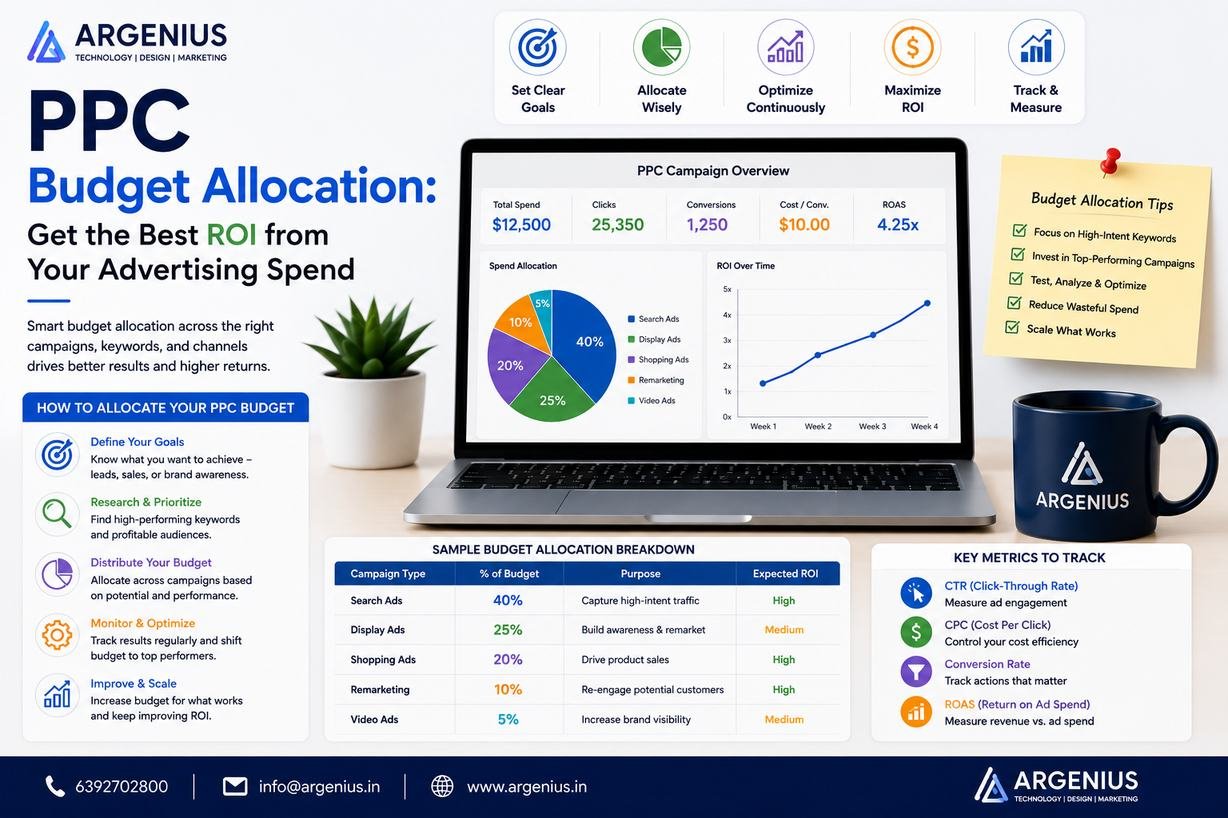
A smart PPC Budget Allocation Strategy helps businesses maximize ROI by investing advertising budgets in the highest-performing campaigns. Learn budget planning, bidding strategies, optimization techniques, and cost-saving best practices.
Introduction
One of the biggest challenges businesses face with paid advertising isn't choosing the right platform—it's deciding how to allocate their advertising budget effectively. Many companies invest heavily in Google Ads, Facebook Ads, LinkedIn Ads, or YouTube campaigns without a structured budget strategy, resulting in wasted spend, poor lead quality, and disappointing returns.
A successful PPC Budget Allocation strategy ensures every advertising rupee works harder by directing investment toward campaigns, audiences, and keywords that generate the highest return on investment (ROI). Rather than distributing budgets equally across all campaigns, smart advertisers use data, performance metrics, customer behavior, and AI-powered optimization to allocate funds where they produce the greatest business impact.
Budget allocation isn't simply about increasing spend—it's about spending intelligently. Businesses should evaluate factors such as customer acquisition cost (CAC), conversion rate, lifetime customer value (LTV), click-through rate (CTR), cost per click (CPC), return on ad spend (ROAS), and campaign objectives before deciding how much to invest in each marketing channel.
For example, a B2B software company may allocate more budget toward Google Search and LinkedIn Ads, while an ecommerce brand may prioritize Google Shopping, Meta Ads, and Dynamic Remarketing. Understanding your target audience and sales funnel is essential for making profitable budget decisions.
Modern advertising platforms also use machine learning to automate bidding, predict conversions, and optimize spending across campaigns. However, automation works best when supported by a well-planned budget strategy, quality conversion tracking, and ongoing campaign optimization.
In this comprehensive guide, you'll learn how PPC Budget Allocation works, how to distribute budgets across channels, avoid common budgeting mistakes, maximize advertising ROI, and create scalable campaigns for sustainable business growth.
At Argenius, we help businesses develop data-driven PPC budget strategies that reduce wasted ad spend, improve campaign efficiency, and maximize long-term return on investment.
What is PPC Budget Allocation?
PPC Budget Allocation is the process of distributing your advertising budget across campaigns, platforms, keywords, audience segments, and bidding strategies to achieve the highest possible return on investment.
Instead of spending equally everywhere, businesses invest more in campaigns that consistently generate qualified leads and profitable conversions.
Budget allocation involves:
- Campaign Planning
- Budget Forecasting
- Channel Selection
- Audience Prioritization
- Bid Optimization
- Performance Analysis
- ROI Tracking
- Budget Scaling
A strategic allocation plan ensures that advertising investments contribute directly to business growth.
Why PPC Budget Allocation is Important
Effective budget allocation helps businesses:
- Maximize Return on Investment (ROI)
- Reduce Wasted Ad Spend
- Improve Lead Quality
- Increase Conversion Rates
- Scale Profitable Campaigns
- Improve Customer Acquisition Cost (CAC)
- Allocate Resources Efficiently
- Improve Marketing Performance
- Support Long-Term Growth
- Increase Overall Profitability
Without a structured budget strategy, even well-designed PPC campaigns can underperform.
How PPC Budget Allocation Works
An effective budget allocation process typically includes:
- Define business goals.
- Analyze historical campaign performance.
- Identify high-performing channels.
- Allocate budgets by campaign objective.
- Launch campaigns.
- Monitor key performance metrics.
- Reallocate budgets based on results.
Continuous optimization ensures budgets remain aligned with business objectives.
Key Factors That Influence Budget Allocation
Before deciding where to spend, evaluate:
Business Goals
Examples:
- Lead Generation
- Sales
- Brand Awareness
- App Downloads
- Product Launches
Customer Lifetime Value (LTV)
Customers with higher lifetime value justify larger acquisition budgets.
Customer Acquisition Cost (CAC)
Compare acquisition costs across campaigns to identify the most efficient channels.
Conversion Rate
Campaigns with consistently higher conversion rates deserve larger budgets.
Competition
Highly competitive industries generally require larger advertising budgets.
Sales Funnel Stage
Different campaigns support different stages:
- Awareness
- Consideration
- Decision
- Retention
Allocate budgets accordingly.
Budget Allocation Across PPC Platforms
A diversified advertising strategy often produces the strongest results.
Google Search Ads
Best for:
- High Purchase Intent
- Lead Generation
- Local Services
- Professional Services
Google Shopping Ads
Ideal for:
- Ecommerce
- Retail
- Product Sales
Google Display Ads
Suitable for:
- Brand Awareness
- Remarketing
- Customer Engagement
YouTube Ads
Best for:
- Brand Awareness
- Product Demonstrations
- Customer Education
Facebook & Instagram Ads
Ideal for:
- Demand Generation
- Ecommerce
- Visual Products
- Retargeting
LinkedIn Ads
Recommended for:
- B2B Marketing
- Enterprise Sales
- Professional Services
- SaaS Companies
PPC Budget Allocation Models
Fixed Budget Model
A predetermined monthly advertising budget.
Suitable for:
- Small Businesses
- Startups
Performance-Based Budget
Budgets increase for campaigns delivering better ROI.
Ideal for businesses focused on scaling profitable campaigns.
Seasonal Budget Allocation
Increase spending during:
- Festivals
- Holiday Sales
- Product Launches
- Peak Demand Periods
AI-Driven Budget Allocation
Advertising platforms automatically optimize spending using machine learning.
Common PPC Budget Mistakes
Avoid these mistakes:
- Splitting budgets equally across all campaigns
- Ignoring conversion data
- Overfunding poor-performing campaigns
- No budget reviews
- Weak tracking setup
- No remarketing investment
- Scaling campaigns too quickly
- Ignoring customer lifetime value
- Poor keyword selection
- Focusing only on clicks instead of conversions
These mistakes reduce ROI and increase customer acquisition costs.
Step-by-Step PPC Budget Allocation Strategy
A successful PPC Budget Allocation Strategy ensures every advertising rupee contributes to measurable business growth. Instead of distributing budgets evenly across campaigns, businesses should invest more in channels, audiences, and keywords that consistently deliver the highest return on investment. A data-driven approach minimizes wasted spend while maximizing conversions, revenue, and long-term scalability.
Step 1: Define Your Business Goals
Before setting a budget, determine what success looks like.
Common PPC objectives include:
- Lead Generation
- Ecommerce Sales
- Brand Awareness
- Website Traffic
- App Installs
- Phone Calls
- Product Launches
- Local Business Growth
- Customer Retention
- Subscription Signups
Your budget should align with these objectives.
Step 2: Analyze Historical Performance
Review previous campaign data to identify profitable opportunities.
Analyze:
- Click-Through Rate (CTR)
- Cost Per Click (CPC)
- Conversion Rate
- Cost Per Acquisition (CPA)
- Return on Ad Spend (ROAS)
- Customer Acquisition Cost (CAC)
- Revenue
- Impression Share
Historical performance provides valuable insights for future budget decisions.
Step 3: Prioritize High-Performing Channels
Not every advertising platform delivers the same results.
Allocate budgets based on business type.
B2B Companies
- Google Search
- LinkedIn Ads
- Remarketing
Ecommerce Stores
- Google Shopping Ads
- Facebook Ads
- Instagram Ads
- Dynamic Remarketing
Local Businesses
- Google Search
- Google Maps
- Facebook Ads
SaaS Companies
- Google Search
- LinkedIn Ads
- YouTube Ads
- Remarketing
Invest more in platforms that consistently produce profitable conversions.
Step 4: Allocate Budget by Funnel Stage
A balanced marketing funnel generates sustainable growth.
Example allocation:
- Top of Funnel (Awareness): 30%
- Middle of Funnel (Consideration): 30%
- Bottom of Funnel (Conversions): 40%
This approach supports both customer acquisition and conversion.
Step 5: Invest in Remarketing
Returning visitors often convert at higher rates than first-time visitors.
Allocate 10–25% of your PPC budget to:
- Website Visitors
- Cart Abandoners
- Existing Leads
- Previous Customers
- Product Viewers
- Blog Readers
Remarketing helps recover lost opportunities while lowering acquisition costs.
Step 6: Scale Winning Campaigns
Increase budgets gradually for campaigns that consistently achieve:
- High Conversion Rates
- Low CPA
- High ROAS
- Strong Lead Quality
- Consistent Revenue
Avoid sudden budget increases, as they can disrupt campaign performance.
Step 7: Monitor Performance Weekly
Review campaign performance regularly.
Track:
- CTR
- CPC
- CPA
- ROAS
- Revenue
- Conversion Rate
- Quality Score
- Impression Share
Continuous optimization ensures budgets remain focused on high-performing campaigns.
PPC Budget Distribution Framework
A balanced allocation model improves campaign stability.
| Campaign Type |
Suggested Budget Allocation |
| Google Search Ads |
35% |
| Google Shopping Ads |
20% |
| Display & Remarketing |
15% |
| YouTube Ads |
10% |
| Facebook & Instagram Ads |
15% |
| Testing New Campaigns |
5% |
Adjust these percentages based on your industry, goals, and historical performance.
Smart Bidding Strategies
Google Ads offers AI-powered bidding strategies that optimize budget allocation automatically.
Maximize Conversions
Ideal for:
- Lead Generation
- Service Businesses
- Local Businesses
Target CPA
Google aims to generate conversions within your desired acquisition cost.
Suitable for businesses with established conversion tracking.
Target ROAS
Designed for ecommerce businesses focused on maximizing revenue.
Google optimizes bids based on expected return on ad spend.
Maximize Conversion Value
Best for campaigns where different conversions have different monetary values.
Manual CPC
Provides complete control over keyword bids.
Useful for experienced advertisers managing specialized campaigns.
ROI Calculation Framework
Measure advertising profitability using key formulas.
Return on Ad Spend (ROAS)
ROAS = Revenue ÷ Advertising Cost
Example:
Revenue = ₹5,00,000
Advertising Spend = ₹1,00,000
ROAS = 5X
Customer Acquisition Cost (CAC)
CAC = Total Advertising Spend ÷ Number of Customers Acquired
Lower CAC generally indicates a more efficient campaign.
Return on Investment (ROI)
ROI = ((Revenue − Total Cost) ÷ Total Cost) × 100
Tracking these metrics helps determine which campaigns deserve additional investment.
Best PPC Budget Management Tools
Free Tools
- Google Ads
- Google Analytics 4
- Google Tag Manager
- Google Keyword Planner
- Google Looker Studio
- Google Trends
- Microsoft Clarity
Premium Tools
- Semrush
- Ahrefs
- Optmyzr
- Supermetrics
- SpyFu
- Hotjar
- Triple Whale
- Funnel.io
These tools assist with campaign analysis, attribution, reporting, optimization, and budget forecasting.
Cost of PPC Campaign Management (₹ INR)
| Service |
Estimated Cost |
| PPC Strategy & Budget Planning |
₹10,000 – ₹30,000 |
| Google Ads Account Setup |
₹10,000 – ₹25,000 |
| Audience & Keyword Research |
₹8,000 – ₹20,000 |
| Monthly PPC Management |
₹25,000 – ₹1,50,000 |
| Enterprise PPC Management |
Custom Pricing |
Factors Affecting Cost
Campaign costs depend on:
- Industry Competition
- Monthly Advertising Budget
- Number of Campaigns
- Geographic Targeting
- Keyword Competition
- Landing Page Quality
- Conversion Tracking
- Reporting Requirements
Professional PPC management often improves ROI by reducing wasted spend and optimizing campaign performance.
Best Practices
For effective PPC Budget Allocation:
- Set measurable campaign goals.
- Allocate budgets based on performance data.
- Review campaign metrics weekly.
- Invest in remarketing.
- Test new campaigns with smaller budgets.
- Optimize landing pages.
- Use AI-powered Smart Bidding where appropriate.
- Pause consistently underperforming campaigns.
- Scale profitable campaigns gradually.
- Monitor ROI instead of focusing only on clicks.
These practices help maximize advertising efficiency and long-term profitability.
Common Mistakes to Avoid
Avoid these budgeting mistakes:
- Spending equally across all campaigns
- Ignoring conversion tracking
- Scaling campaigns too quickly
- Chasing low CPC instead of high ROI
- Never reviewing budget allocation
- Ignoring seasonal demand
- Poor audience segmentation
- Weak landing pages
- No A/B testing
- Failing to track customer lifetime value
Avoiding these issues leads to better campaign performance and stronger financial returns.
Future Trends in PPC Budget Allocation
Paid advertising continues to evolve with AI and automation.
Emerging trends include:
- AI-Driven Budget Forecasting
- Predictive Bid Management
- First-Party Data Strategies
- Privacy-Focused Attribution
- Performance Max Optimization
- Cross-Channel Budget Automation
- Real-Time Budget Adjustments
- Incrementality Testing
- Multi-Touch Attribution
- Predictive Customer Lifetime Value Modeling
Businesses embracing these innovations will make smarter budget decisions and achieve higher returns.
Why Businesses Choose Argenius
At Argenius, we help businesses maximize every advertising investment through data-driven PPC Budget Allocation strategies.
Our PPC services include:
- Budget Planning
- Google Ads Management
- Performance Marketing
- Keyword Research
- Audience Segmentation
- Smart Bidding Optimization
- Remarketing Campaigns
- Landing Page Optimization
- Conversion Tracking
- Performance Reporting
Our team continuously analyzes campaign performance to ensure advertising budgets are invested where they generate the highest ROI.
Final Thoughts
A well-planned PPC Budget Allocation strategy is one of the most important factors in achieving consistent advertising success. Businesses that base their spending decisions on performance data, customer behavior, and measurable KPIs are far more likely to reduce wasted spend, improve lead quality, and increase long-term profitability.
Instead of simply increasing advertising budgets, successful marketers focus on investing more in campaigns that deliver the highest value. By combining accurate conversion tracking, AI-powered bidding, remarketing, continuous testing, and regular optimization, businesses can maximize ROI, improve ROAS, and scale profitable campaigns with confidence. Argenius helps organizations build performance-focused PPC strategies that support sustainable business growth while making every advertising rupee count.
Frequently Asked Questions
What is PPC Budget Allocation?
PPC Budget Allocation is the process of distributing your advertising budget across campaigns, platforms, audiences, and keywords to maximize return on investment and minimize wasted ad spend.
How much should I spend on PPC each month?
The ideal budget depends on your business goals, industry, competition, and target audience. Many small and medium-sized businesses start with ₹30,000–₹1,00,000 per month and scale based on campaign performance.
Which platform deserves the largest PPC budget?
For many businesses, Google Search Ads receive the largest share because they target users with strong purchase intent. However, ecommerce brands often allocate significant budgets to Google Shopping and Meta Ads, while B2B companies may prioritize LinkedIn Ads.
How often should I review my PPC budget?
Review campaign performance weekly and conduct a more detailed budget analysis every month to ensure funds remain allocated to the highest-performing campaigns.
What metrics should I track?
Focus on CTR, CPC, CPA, Conversion Rate, ROAS, CAC, Revenue, and ROI to evaluate campaign performance and make informed budget decisions.
Does Argenius provide PPC budget planning?
Yes. Argenius offers complete PPC Budget Planning, Campaign Management, Google Ads Optimization, Performance Marketing, Conversion Tracking, Remarketing, and ROI Optimization services to help businesses maximize advertising performance.