Discover how a powerful Remarketing Strategy helps businesses reconnect with website visitors, recover abandoned carts, improve conversion rates, and maximize ROI using Google Ads, Meta Ads, and AI-powered audience targeting.
Introduction
Most website visitors don't convert during their first visit. Research across digital marketing consistently shows that many users explore products, compare competitors, read reviews, or simply leave before making a purchase or submitting a lead form. This doesn't mean they're no longer interested—it simply means they need another reason to return.
This is where a well-planned Remarketing Strategy becomes one of the most profitable digital marketing techniques. Instead of constantly spending money to attract new visitors, remarketing allows businesses to reconnect with people who have already interacted with their website, mobile app, landing page, or online store.
Remarketing works by displaying personalized ads to previous visitors across platforms such as Google Display Network, YouTube, Facebook, Instagram, and other partner websites. These ads remind users about the products they viewed, the services they explored, or the forms they started but never completed. Because these users are already familiar with your brand, remarketing campaigns often deliver higher click-through rates (CTR), lower customer acquisition costs (CAC), and better conversion rates than campaigns targeting completely new audiences.
Modern remarketing has become even more powerful with AI-driven audience segmentation, dynamic product recommendations, predictive bidding, and personalized creative optimization. Businesses can now create highly relevant campaigns for specific user behaviors, such as abandoned carts, product page visitors, repeat customers, or users who watched a video but didn't convert.
Whether you run an ecommerce store, SaaS company, healthcare clinic, educational platform, real estate agency, or service-based business, remarketing helps recover lost opportunities and maximize the value of every website visitor.
In this complete guide, you'll learn how Remarketing Strategy works, different types of remarketing campaigns, audience segmentation techniques, optimization strategies, and best practices for increasing conversions and return on investment.
At Argenius, we build intelligent remarketing campaigns that reconnect businesses with high-intent audiences, improve conversion rates, and deliver measurable business growth.
What is Remarketing Strategy?
A Remarketing Strategy is a digital advertising approach that targets users who have previously interacted with your website, app, landing page, or digital content but did not complete the desired action.
Instead of marketing to completely new users, remarketing focuses on audiences who already know your brand.
Common goals include:
- Recover Abandoned Carts
- Generate More Leads
- Increase Product Sales
- Improve Brand Recall
- Boost Repeat Purchases
- Encourage Demo Bookings
- Increase Website Engagement
- Improve Customer Retention
Why Remarketing is Important
Remarketing helps businesses:
- Recover Lost Customers
- Increase Conversion Rates
- Improve ROI
- Reduce Customer Acquisition Cost (CAC)
- Strengthen Brand Awareness
- Increase Repeat Purchases
- Generate Qualified Leads
- Improve Customer Lifetime Value (CLV)
- Build Customer Trust
- Maximize Advertising Budget
Instead of paying repeatedly to attract new visitors, remarketing increases the value of existing traffic.
How Remarketing Works
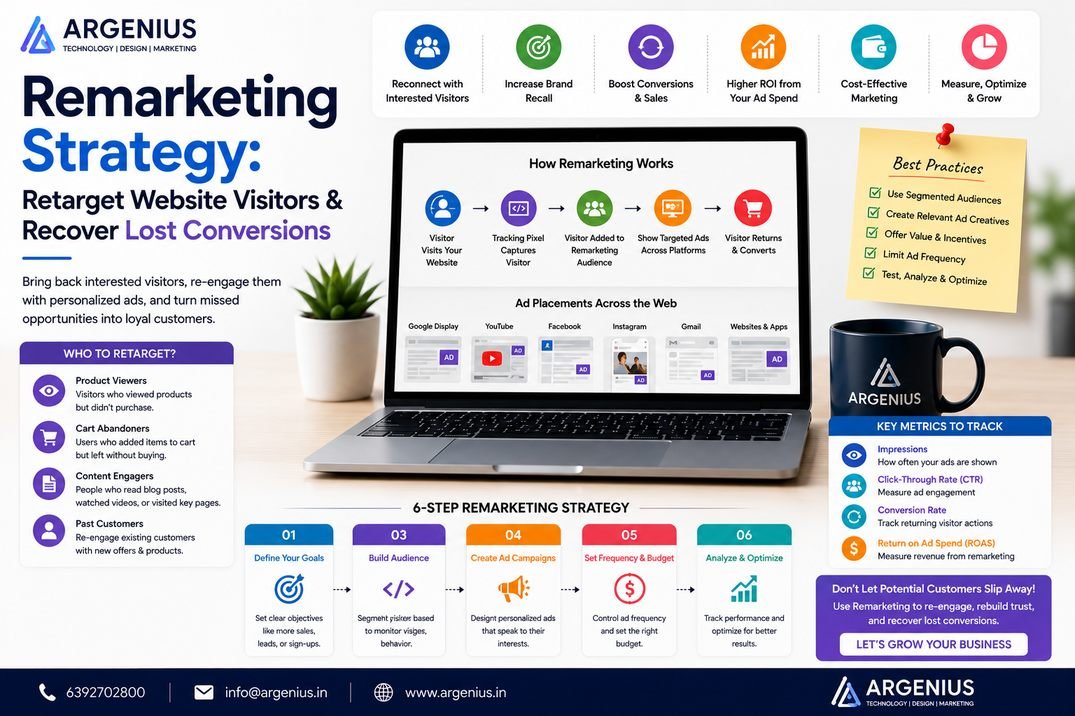
A typical remarketing campaign follows these steps:
- A visitor lands on your website.
- A tracking tag or pixel records the visit.
- The visitor leaves without converting.
- The visitor is added to a remarketing audience.
- Personalized ads are shown across different platforms.
- The visitor returns and completes the desired action.
This process keeps your brand visible throughout the customer's decision-making journey.
Types of Remarketing Campaigns
Standard Remarketing
Shows display ads to previous website visitors as they browse other websites.
Dynamic Remarketing
Displays personalized ads featuring products or services that users previously viewed.
Ideal for:
- Ecommerce Stores
- Travel Websites
- Online Marketplaces
- Fashion Brands
Search Remarketing (RLSA)
Allows businesses to customize Google Search Ads for previous website visitors.
Video Remarketing
Targets users who interacted with your YouTube videos.
Social Media Remarketing
Reconnects visitors through:
- Facebook Ads
- Instagram Ads
- LinkedIn Ads
- Messenger Ads
Email Remarketing
Uses personalized email campaigns to re-engage inactive users.
Examples include:
- Abandoned Cart Emails
- Product Recommendations
- Limited-Time Offers
- Renewal Reminders
Benefits of Remarketing
Businesses invest in remarketing because it provides:
- Higher Conversion Rates
- Lower Cost Per Acquisition
- Better ROI
- Personalized Advertising
- Strong Brand Recall
- Audience Segmentation
- AI-Powered Optimization
- Improved Customer Retention
- Increased Repeat Purchases
- Better Advertising Efficiency
Remarketing vs Retargeting
| Remarketing |
Retargeting |
| Broader customer re-engagement strategy |
Focuses primarily on paid advertising |
| Can include email marketing |
Mostly display and social ads |
| Encourages repeat engagement |
Encourages return visits |
| Useful for customer retention |
Useful for recovering lost visitors |
Although the terms are often used interchangeably, both strategies work best when combined.
Platforms for Remarketing
Businesses can run remarketing campaigns through:
- Google Ads
- Google Display Network
- YouTube
- Facebook Ads
- Instagram Ads
- LinkedIn Ads
- Microsoft Advertising
- Email Marketing Platforms
Using multiple channels creates a consistent experience across the customer journey.
Common Remarketing Mistakes
Avoid these mistakes:
- Showing the same ad repeatedly
- No audience segmentation
- Ignoring cart abandoners
- Weak ad creatives
- Poor landing pages
- No conversion tracking
- Excessive ad frequency
- Generic messaging
- No exclusion audiences
- Ignoring campaign analytics
These issues reduce campaign effectiveness and can increase advertising costs.
Step-by-Step Remarketing Strategy
A successful Remarketing Strategy focuses on reconnecting with users who have already shown interest in your products or services. Since these visitors are familiar with your brand, remarketing campaigns generally achieve higher conversion rates, lower acquisition costs, and better ROI than campaigns targeting completely new audiences.
Step 1: Install Tracking Tags
Before launching remarketing campaigns, ensure proper tracking is in place.
Install:
- Google Ads Remarketing Tag
- Google Analytics 4
- Google Tag Manager
- Meta Pixel
- LinkedIn Insight Tag
- Microsoft UET Tag
Accurate tracking allows you to build highly targeted remarketing audiences.
Step 2: Define Remarketing Goals
Identify what you want users to do after returning.
Common goals include:
- Complete a Purchase
- Submit a Lead Form
- Book a Consultation
- Download an Ebook
- Register for a Webinar
- Request a Quote
- Start a Free Trial
- Contact Sales
Each objective should have a dedicated remarketing campaign.
Step 3: Segment Your Audience
Avoid showing the same ad to every visitor.
Create separate audiences such as:
- Homepage Visitors
- Product Page Visitors
- Category Page Visitors
- Blog Readers
- Pricing Page Visitors
- Cart Abandoners
- Checkout Abandoners
- Existing Customers
- Repeat Buyers
- High-Value Customers
Audience segmentation significantly improves ad relevance and performance.
Step 4: Create Personalized Ads
Personalization is the key to successful remarketing.
Examples include:
- Recently Viewed Products
- Limited-Time Discounts
- Customer Testimonials
- Case Studies
- Free Consultation Offers
- Product Recommendations
- Free Shipping Offers
- New Product Launches
Relevant messaging increases the likelihood of conversion.
Step 5: Set Frequency Caps
Showing ads too often can frustrate users.
Best practices:
- Limit daily impressions.
- Rotate creatives regularly.
- Refresh offers every few weeks.
- Exclude users who have already converted.
Balanced frequency keeps your brand visible without causing ad fatigue.
Step 6: Use Dynamic Remarketing
Dynamic remarketing automatically displays products or services users previously viewed.
Ideal for:
- Ecommerce Stores
- Travel Websites
- Real Estate Portals
- SaaS Products
- Online Courses
Dynamic ads are highly personalized and often outperform standard remarketing campaigns.
Step 7: Launch Cross-Platform Campaigns
Reach users across multiple channels.
Recommended platforms:
- Google Display Network
- YouTube
- Facebook
- Instagram
- LinkedIn
- Gmail Ads
- Microsoft Advertising
Cross-platform exposure increases brand recall throughout the buying journey.
Step 8: Optimize Campaign Performance
Monitor campaign metrics regularly.
Track:
- Click-Through Rate (CTR)
- Cost Per Click (CPC)
- Conversion Rate
- Cost Per Acquisition (CPA)
- Return on Ad Spend (ROAS)
- Customer Lifetime Value (CLV)
- Frequency
- Impression Share
Continuous optimization improves campaign efficiency and profitability.
Audience Segmentation Framework
Effective segmentation helps deliver the right message to the right audience.
New Visitors
Objective:
- Build Brand Awareness
- Encourage Return Visits
Recommended ads:
- Brand Introduction
- Customer Reviews
- Educational Content
Product Viewers
Objective:
Recommended ads:
- Product Benefits
- Testimonials
- Product Comparisons
- Limited-Time Discounts
Cart Abandoners
Objective:
Recommended ads:
- Free Shipping
- Discount Coupons
- Urgency Messages
- Checkout Reminder
Cart abandonment campaigns often deliver the highest return on investment.
Existing Customers
Objective:
- Increase Customer Lifetime Value
Recommended ads:
- Upselling
- Cross-Selling
- Product Upgrades
- Loyalty Rewards
Inactive Customers
Objective:
- Re-engage Previous Buyers
Recommended ads:
- Exclusive Offers
- New Arrivals
- Seasonal Promotions
- Membership Benefits
Dynamic Remarketing Best Practices
Dynamic campaigns perform best when:
- Product feeds remain updated.
- Images are high quality.
- Prices are accurate.
- Inventory syncs automatically.
- Landing pages load quickly.
- Personalized recommendations are enabled.
- Conversion tracking is configured correctly.
Accurate product data improves user experience and conversion rates.
Cross-Platform Remarketing Strategy
Instead of relying on a single platform, combine multiple channels.
Example customer journey:
- User visits your website.
- Sees Google Display Ads.
- Watches a YouTube remarketing video.
- Encounters Instagram Story Ads.
- Receives a personalized email.
- Returns to complete the purchase.
A multi-channel approach increases visibility and strengthens brand recall.
Best Remarketing Tools
Free Tools
- Google Ads
- Google Analytics 4
- Google Tag Manager
- Meta Pixel
- Microsoft Clarity
- Google Merchant Center
Premium Tools
- HubSpot
- Klaviyo
- AdRoll
- Criteo
- Triple Whale
- Hotjar
- Semrush
- Ahrefs
These tools help businesses build audiences, automate campaigns, analyze behavior, and improve conversions.
Cost of Remarketing Campaign Management (₹ INR)
| Service |
Estimated Cost |
| Remarketing Setup |
₹10,000 – ₹25,000 |
| Tracking & Pixel Implementation |
₹8,000 – ₹20,000 |
| Creative Design |
₹10,000 – ₹30,000 |
| Monthly Remarketing Management |
₹20,000 – ₹1,00,000 |
| Enterprise Multi-Channel Remarketing |
Custom Pricing |
Factors Affecting Cost
Remarketing costs depend on:
- Website Traffic Volume
- Number of Audience Segments
- Advertising Platforms
- Creative Requirements
- Campaign Objectives
- Industry Competition
- Geographic Targeting
- Monthly Advertising Budget
Professional remarketing management helps maximize ROI by focusing on users with the highest purchase intent.
Best Practices
To improve remarketing performance:
- Segment audiences carefully.
- Use personalized messaging.
- Limit ad frequency.
- Refresh creatives regularly.
- Exclude converted users.
- Optimize landing pages.
- Track all conversions.
- Use dynamic remarketing where applicable.
- Run cross-platform campaigns.
- Analyze performance weekly.
These practices increase engagement while minimizing wasted ad spend.
Common Mistakes to Avoid
Avoid these common errors:
- Targeting all visitors with identical ads
- Ignoring audience segmentation
- Excessive ad frequency
- Weak creatives
- Outdated product feeds
- Poor landing pages
- Missing conversion tracking
- No exclusion lists
- Stopping campaigns too early
- Ignoring campaign data
Correcting these issues leads to higher conversions and improved campaign efficiency.
Future Trends in Remarketing
Remarketing continues to evolve through AI, automation, and privacy-first technologies.
Emerging trends include:
- AI-Powered Audience Segmentation
- Predictive Remarketing
- First-Party Data Strategies
- Cookieless Tracking Solutions
- Dynamic Creative Optimization
- Personalized Product Recommendations
- Cross-Device Retargeting
- Omnichannel Remarketing
- Conversion API Integration
- Machine Learning-Based Bidding
Businesses that adopt these innovations will build more effective remarketing campaigns in the years ahead.
Why Businesses Choose Argenius
At Argenius, we create intelligent Remarketing Strategies that help businesses recover lost opportunities, re-engage interested visitors, and maximize advertising ROI.
Our remarketing services include:
- Google Remarketing Campaigns
- Meta Remarketing Campaigns
- Dynamic Product Remarketing
- Audience Segmentation
- Pixel & Conversion Tracking
- Cross-Platform Retargeting
- Creative Design
- Campaign Optimization
- Performance Reporting
- ROAS Improvement Strategy
We use data-driven audience insights and AI-powered optimization to help businesses convert more visitors into loyal customers.
Final Thoughts
A well-executed Remarketing Strategy is one of the most cost-effective ways to improve digital marketing performance. Instead of focusing solely on attracting new visitors, remarketing enables businesses to reconnect with users who have already expressed interest, making them far more likely to convert. By combining audience segmentation, personalized creatives, dynamic product recommendations, and cross-platform advertising, businesses can significantly increase conversion rates while lowering customer acquisition costs.
As privacy regulations evolve and AI-powered advertising becomes more sophisticated, first-party data, predictive audience modeling, and personalized customer experiences will play an even greater role in remarketing success. Businesses that invest in these strategies today will build stronger customer relationships and achieve more sustainable growth. Argenius helps organizations design scalable Remarketing Strategies that recover lost conversions, improve ROAS, and drive long-term business success.
Frequently Asked Questions
What is a Remarketing Strategy?
A Remarketing Strategy is a digital marketing approach that targets users who have previously visited your website or interacted with your business, encouraging them to return and complete a desired action such as a purchase or lead submission.
What is the difference between remarketing and retargeting?
Remarketing is a broader customer re-engagement strategy that can include email marketing, while retargeting primarily refers to displaying paid ads to previous website visitors. In practice, the terms are often used interchangeably.
Which platforms support remarketing?
Popular remarketing platforms include Google Ads, Google Display Network, YouTube, Facebook, Instagram, LinkedIn, Microsoft Advertising, and various email marketing platforms.
Why is audience segmentation important?
Audience segmentation allows businesses to show personalized ads based on user behavior, such as product views, abandoned carts, or previous purchases, leading to higher engagement and better conversion rates.
How long should a remarketing campaign run?
Campaign duration depends on your sales cycle and business goals. Most businesses see the best results by continuously optimizing remarketing campaigns and refreshing creatives every few weeks.
Does Argenius provide remarketing services?
Yes. Argenius offers complete Remarketing Strategy, Google & Meta Remarketing, Dynamic Product Ads, Audience Segmentation, Pixel Setup, Conversion Tracking, and ongoing optimization to improve conversions and maximize return on ad spend.