Learn how Topic Clusters help organize your website around core topics, improve topical authority, strengthen internal linking, increase Google rankings, and drive sustainable organic traffic.
Introduction
Publishing more blog posts doesn't always result in better Google rankings. Many businesses create dozens of articles targeting related keywords, yet struggle to build authority because their content is scattered across the website without a clear structure.
Modern SEO is no longer focused on ranking individual pages alone. Google increasingly evaluates whether a website demonstrates expertise across an entire subject. This is why Topic Clusters have become one of the most effective content organization strategies for improving search visibility.
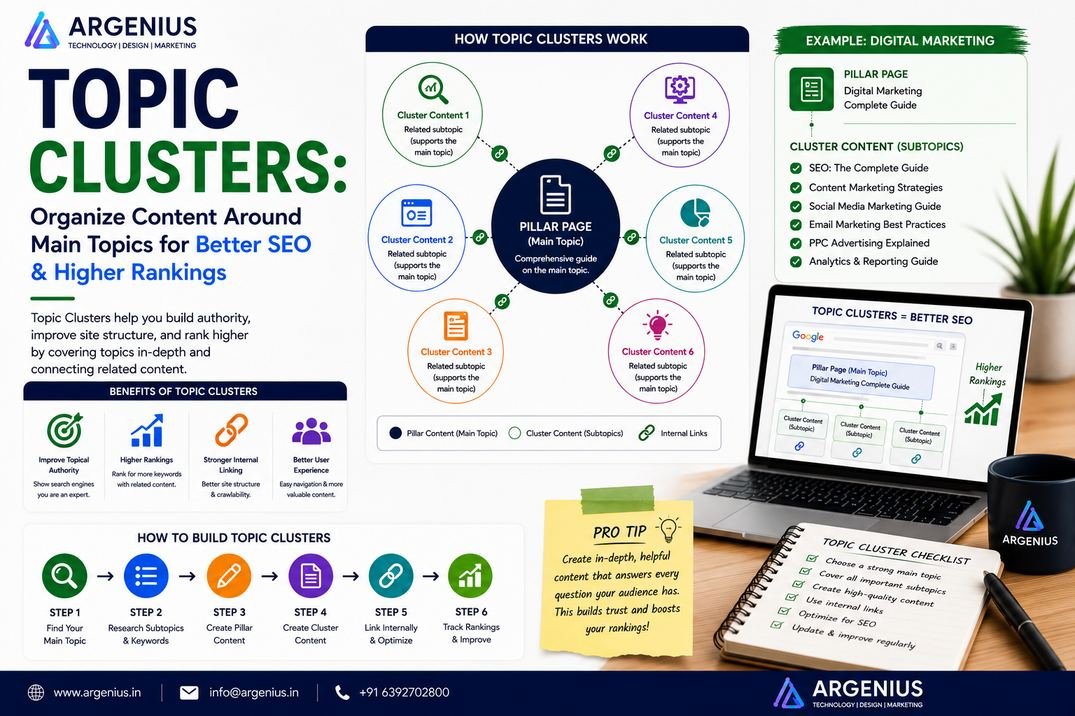
A Topic Cluster groups related articles around a central subject. Instead of treating each blog as an independent page, multiple supporting articles are connected to a comprehensive pillar page using strategic internal links. This organized structure helps search engines understand how different pieces of content relate to one another while making it easier for visitors to explore additional information.
Topic Clusters also play an important role in AI-powered search. Platforms such as Google AI Overviews, ChatGPT, Gemini, and Perplexity favor websites that provide complete coverage of a subject rather than isolated answers to individual questions.
Whether you manage a software company, ecommerce business, healthcare website, educational portal, or digital marketing agency, implementing Topic Clusters can improve topical authority, strengthen SEO performance, and create a better user experience.
In this guide, you'll learn what Topic Clusters are, how they work, why they matter, and how to build a scalable content strategy that supports long-term organic growth.
At Argenius, we create SEO-driven content strategies using Topic Clusters that help businesses increase rankings, improve topical authority, and generate qualified organic traffic.
What are Topic Clusters?
A Topic Cluster is a collection of related content organized around one primary topic.
Instead of publishing disconnected blog posts, each supporting article focuses on a specific subtopic while linking to a central pillar page.
For example:
Main Topic
SEO
Supporting Topics
- Keyword Research
- On-Page SEO
- Technical SEO
- Local SEO
- Link Building
- Mobile SEO
- Core Web Vitals
- Content Marketing
- Blog SEO
- Schema Markup
Together, these articles create a complete knowledge hub around SEO.
How Topic Clusters Work
The Topic Cluster model follows a simple but powerful structure.
The pillar page links to every supporting article, and each supporting article links back to the pillar page. This creates a strong internal linking network that helps search engines understand your website's content hierarchy.
Why Topic Clusters are Important for SEO
Google wants to rank websites that demonstrate expertise across an entire topic.
Topic Clusters help by:
- Building Topical Authority
- Improving Internal Linking
- Increasing Crawl Efficiency
- Reducing Keyword Cannibalization
- Improving User Experience
- Increasing Organic Traffic
- Supporting Semantic SEO
- Improving AI Search Visibility
- Increasing Time on Site
- Strengthening Website Architecture
Instead of competing against each other, your pages work together to improve overall SEO performance.
Pillar Pages vs Topic Clusters
Although they work together, they are not the same.
| Pillar Page |
Topic Cluster |
| One comprehensive page |
Collection of related pages |
| Covers a broad topic |
Covers individual subtopics |
| Central content hub |
Complete content ecosystem |
| Links to supporting pages |
Connected through internal links |
| Builds authority |
Expands topical coverage |
Think of the pillar page as the foundation and the Topic Cluster as the complete structure built around it.
Benefits of Topic Clusters
Implementing Topic Clusters provides several long-term advantages:
- Higher Google Rankings
- Better Topical Authority
- Stronger Internal Linking
- Improved User Experience
- Increased Organic Traffic
- Better Keyword Coverage
- Lower Bounce Rate
- Improved Crawlability
- Better AI Search Performance
- Higher Conversion Opportunities
These benefits compound over time as your content library grows.
Components of a Strong Topic Cluster
A successful Topic Cluster typically includes:
- One Pillar Page
- Multiple Supporting Articles
- Strategic Internal Links
- Keyword Research
- Search Intent Optimization
- Consistent Content Structure
- Optimized Metadata
- FAQs
- Clear Call-to-Action
Every component contributes to a more organized and authoritative website.
Examples of Topic Clusters
SEO Cluster
- Keyword Research
- Technical SEO
- Local SEO
- Blog SEO
- Internal Linking
- Core Web Vitals
- Schema Markup
Website Development Cluster
- Custom Website Development
- WordPress Development
- Laravel Development
- Ecommerce Website Development
- Website Maintenance
- Website Security
Mobile App Development Cluster
- Android App Development
- iOS App Development
- Flutter Development
- React Native Development
- App Testing
- App Maintenance
Digital Marketing Cluster
- Content Marketing
- Email Marketing
- Social Media Marketing
- PPC Advertising
- Conversion Rate Optimization
- Analytics
Each cluster helps establish authority within a specific business area.
Topic Clusters and AI Search
AI-powered search engines understand relationships between topics rather than isolated keywords.
A well-structured Topic Cluster helps:
- Improve Semantic Understanding
- Increase Entity Recognition
- Strengthen Knowledge Graph Signals
- Improve AI Citations
- Answer Multiple User Questions
- Build Content Depth
This improves visibility in Google AI Overviews, ChatGPT, Gemini, and Perplexity.
Industries That Benefit from Topic Clusters
Topic Clusters are effective across many industries, including:
- Software Development
- SaaS
- Ecommerce
- Healthcare
- Education
- Finance
- Real Estate
- Travel
- Legal Services
- Digital Marketing
Any business that regularly publishes educational content can benefit from this approach.
Common Mistakes When Building Topic Clusters
Avoid these common issues:
- Publishing duplicate content
- Weak internal linking
- Overlapping topics
- Ignoring search intent
- Poor keyword research
- Thin supporting articles
- Inconsistent content quality
- Failing to update existing content
Planning your content architecture in advance helps avoid these problems.
Step-by-Step Topic Cluster Strategy
A successful Topic Cluster Strategy helps search engines understand your website's expertise while making it easier for users to find related information. Instead of creating isolated blog posts, you build an interconnected content ecosystem centered around a primary topic.
Step 1: Choose a Core Topic
Start by selecting a broad topic that aligns with your products, services, or industry expertise.
Examples:
- SEO
- Digital Marketing
- Website Development
- Mobile App Development
- Ecommerce Development
- Artificial Intelligence
This becomes the foundation of your Topic Cluster.
Step 2: Identify Supporting Subtopics
Break your core topic into multiple detailed subjects that users frequently search for.
Example:
Core Topic
Website Development
Supporting Topics:
- Custom Website Development
- WordPress Development
- Laravel Development
- Ecommerce Website Development
- Website Security
- Website Maintenance
- Responsive Web Design
- Website Speed Optimization
- Website Hosting
- UI/UX Design
Each supporting topic becomes a dedicated article.
Step 3: Perform Keyword Research
Research keywords for both the main topic and every supporting article.
Focus on:
- Primary Keywords
- Long-Tail Keywords
- Question-Based Keywords
- Search Volume
- Keyword Difficulty
- User Intent
- Semantic Keywords
This ensures every article targets a unique search opportunity without competing against others.
Step 4: Create a Pillar Page
Develop one comprehensive Pillar Page that introduces the entire topic.
The pillar page should include:
- Topic Overview
- Definitions
- Benefits
- Key Concepts
- Internal Links to Supporting Articles
- FAQs
- CTA
Think of it as the central hub that connects the entire content cluster.
Step 5: Publish Supporting Articles
Create detailed content for each subtopic.
For example:
Pillar:
Digital Marketing
Supporting Articles:
- SEO Guide
- PPC Advertising
- Content Marketing
- Email Marketing
- Social Media Marketing
- Conversion Rate Optimization
Each article should cover one topic in depth while linking back to the pillar page.
Step 6: Build Strategic Internal Links
Internal linking is the backbone of Topic Clusters.
Every supporting article should:
- Link to the pillar page.
- Link to other related supporting articles where relevant.
The pillar page should link to every supporting article.
This structure strengthens your website's authority and improves navigation.
Step 7: Optimize Every Page
Every page in the cluster should include:
- Primary Keyword
- Related Keywords
- SEO Title
- Meta Description
- Optimized URL
- Image ALT Text
- FAQ Section
- Mobile-Friendly Design
- Fast Loading Speed
Consistent optimization improves rankings across the entire cluster.
Step 8: Measure and Expand
Monitor your Topic Cluster using SEO tools.
Track:
- Organic Traffic
- Keyword Rankings
- CTR
- Time on Page
- Internal Link Performance
- User Engagement
- Conversion Rate
Continue publishing new supporting articles to expand your topical authority over time.
Topic Cluster Planning Checklist
Before launching a Topic Cluster, verify that you have:
- ✅ One Core Topic
- ✅ Comprehensive Pillar Page
- ✅ Multiple Supporting Articles
- ✅ Keyword Research Completed
- ✅ Search Intent Alignment
- ✅ Internal Linking Structure
- ✅ SEO Metadata
- ✅ Optimized Images
- ✅ FAQ Section
- ✅ Mobile Optimization
- ✅ Clear CTA
A well-planned checklist helps maintain consistency and quality across your content ecosystem.
Best Tools for Topic Cluster Planning
Free Tools
- Google Search Console
- Google Analytics
- Google Trends
- Google Keyword Planner
- Google Search
- Google Sheets
Premium Tools
- Ahrefs
- Semrush
- SE Ranking
- Surfer SEO
- Screaming Frog SEO Spider
- Notion
- Trello
These tools help identify content opportunities, manage publishing schedules, monitor rankings, and improve overall SEO performance.
Topic Clusters and AI Search
AI-powered search engines increasingly evaluate websites based on topic depth and content relationships rather than individual keywords.
To improve visibility in Google AI Overviews, ChatGPT, Gemini, and Perplexity:
- Build comprehensive topic hubs.
- Cover every important subtopic.
- Answer related user questions.
- Use semantic keywords naturally.
- Strengthen internal linking.
- Update content regularly.
- Demonstrate expertise through practical insights.
A well-developed Topic Cluster makes your website easier for AI systems to understand and recommend.
Cost of Building Topic Clusters (₹ INR)
The cost depends on the number of articles, content quality, keyword research, and SEO implementation.
| Service |
Estimated Cost |
| Topic Research & Planning |
₹8,000 – ₹20,000 |
| Pillar Page Development |
₹10,000 – ₹25,000 |
| SEO Blog Writing (Per Article) |
₹3,000 – ₹8,000 |
| Complete Topic Cluster (8–15 Articles) |
₹40,000 – ₹1,20,000+ |
| Enterprise Content Strategy |
Custom Pricing |
Factors Affecting Cost
Pricing depends on:
- Number of Supporting Articles
- Content Length
- Keyword Research
- Industry Competition
- Internal Linking Strategy
- Technical SEO
- Graphics & Visual Content
- Ongoing Updates
A well-executed Topic Cluster is a long-term investment that can generate sustainable traffic and leads.
Best Practices
To build effective Topic Clusters:
- Focus on one core topic at a time.
- Create one authoritative pillar page.
- Publish comprehensive supporting articles.
- Use descriptive internal link anchor text.
- Cover every important user question.
- Avoid duplicate or overlapping content.
- Update pillar pages as new content is added.
- Maintain consistent branding and formatting.
- Optimize for mobile performance.
- Review analytics regularly and refine your strategy.
These practices help strengthen topical authority and improve long-term SEO performance.
Common Mistakes to Avoid
Avoid these mistakes when building Topic Clusters:
- Targeting the same keyword across multiple pages
- Weak internal linking
- Publishing thin supporting content
- Ignoring search intent
- Poor content organization
- Inconsistent metadata
- Keyword stuffing
- Failing to update existing articles
- Ignoring technical SEO
- Creating clusters without a pillar page
Proper planning ensures your content works together instead of competing for rankings.
Future Trends in Topic Cluster SEO
Search engines continue moving toward understanding topics instead of isolated keywords.
Important trends include:
- Google AI Overviews
- Generative Engine Optimization (GEO)
- Semantic SEO
- Entity-Based Search
- Knowledge Graph Optimization
- Topic Authority
- Conversational Search
- Voice Search Optimization
- AI-Driven Content Recommendations
- Content Experience Optimization
Businesses that organize their websites into comprehensive Topic Clusters will be better positioned for future algorithm updates.
Why Businesses Choose Argenius
At Argenius, we help businesses build scalable Topic Cluster strategies that improve SEO performance, strengthen topical authority, and support long-term digital growth.
Our Topic Cluster Services include:
- Topic Cluster Planning
- Pillar Page Development
- SEO Blog Writing
- Keyword Research
- Content Strategy
- Internal Linking Optimization
- Technical SEO
- On-Page SEO
- Content Audits
- Monthly SEO Performance Reports
Our goal is to create organized content ecosystems that increase search visibility, attract qualified traffic, and generate measurable business results.
Final Thoughts
A Topic Cluster strategy is one of the most effective ways to organize content for modern SEO. Instead of publishing disconnected articles, it creates a logical structure where every page supports a broader topic. This approach improves internal linking, strengthens topical authority, and helps search engines understand your expertise.
As Google's algorithms and AI-powered search platforms continue to prioritize comprehensive, well-organized content, Topic Clusters have become an essential part of a successful content marketing strategy. They not only improve rankings for individual pages but also increase the authority of your entire website.
Whether you're launching a new website or improving an existing one, building Topic Clusters around your core business topics is a smart long-term investment. Argenius helps businesses design SEO-focused content architectures that deliver sustainable organic traffic, higher rankings, and stronger lead generation.
Frequently Asked Questions
What is a Topic Cluster?
A Topic Cluster is a group of related articles organized around one central topic and connected through strategic internal links to improve SEO and user experience.
How do Topic Clusters improve SEO?
They strengthen topical authority, improve crawlability, enhance internal linking, reduce keyword cannibalization, and help search engines understand the relationships between your content.
What is the difference between a Pillar Page and a Topic Cluster?
A Pillar Page is the central page covering a broad topic, while a Topic Cluster includes the pillar page and all supporting articles connected through internal links.
How many articles should a Topic Cluster include?
There is no fixed number, but a strong Topic Cluster typically starts with 8–15 supporting articles and expands as your content strategy grows.
Do Topic Clusters help AI-powered search?
Yes. Topic Clusters make it easier for Google AI Overviews, ChatGPT, Gemini, and Perplexity to understand your website's expertise and recommend your content.
Does Argenius offer Topic Cluster strategy services?
Yes. Argenius provides Topic Cluster Planning, Pillar Page Development, SEO Content Writing, Keyword Research, Internal Linking Strategy, Technical SEO, and Complete Content Marketing Solutions tailored to business goals.