Not sure whether to choose WordPress or a custom website? This complete guide compares features, pricing, SEO, performance, scalability, security, and maintenance to help you make the right decision.
Launching a business website is one of the most important decisions any company makes today. Whether you're starting a new business, expanding an existing one, or planning a digital transformation, choosing the right development approach can directly impact your growth.
One of the biggest questions business owners ask is:
Should I build my website using WordPress, or invest in Custom Website Development?
There isn't a one-size-fits-all answer. Both options have their own strengths, limitations, and ideal use cases. The right choice depends on your business goals, budget, scalability requirements, and long-term vision.
In this guide, we'll compare WordPress and custom website development across every major factor so you can confidently choose the best solution for your business.
What is WordPress?
WordPress is the world's most popular content management system (CMS). It allows businesses to build websites quickly using themes and plugins without writing everything from scratch.
Millions of blogs, business websites, portfolios, and online stores run on WordPress because it offers flexibility and a huge ecosystem of plugins.
It is especially suitable for businesses that need a website quickly and have a limited budget.
What is Custom Website Development?
Custom website development means building a website from scratch using programming languages and frameworks such as Laravel, React, Next.js, Node.js, or other modern technologies.
Instead of relying on ready-made themes or plugins, every feature is designed and developed specifically for your business.
This approach gives complete control over design, functionality, security, performance, and scalability.
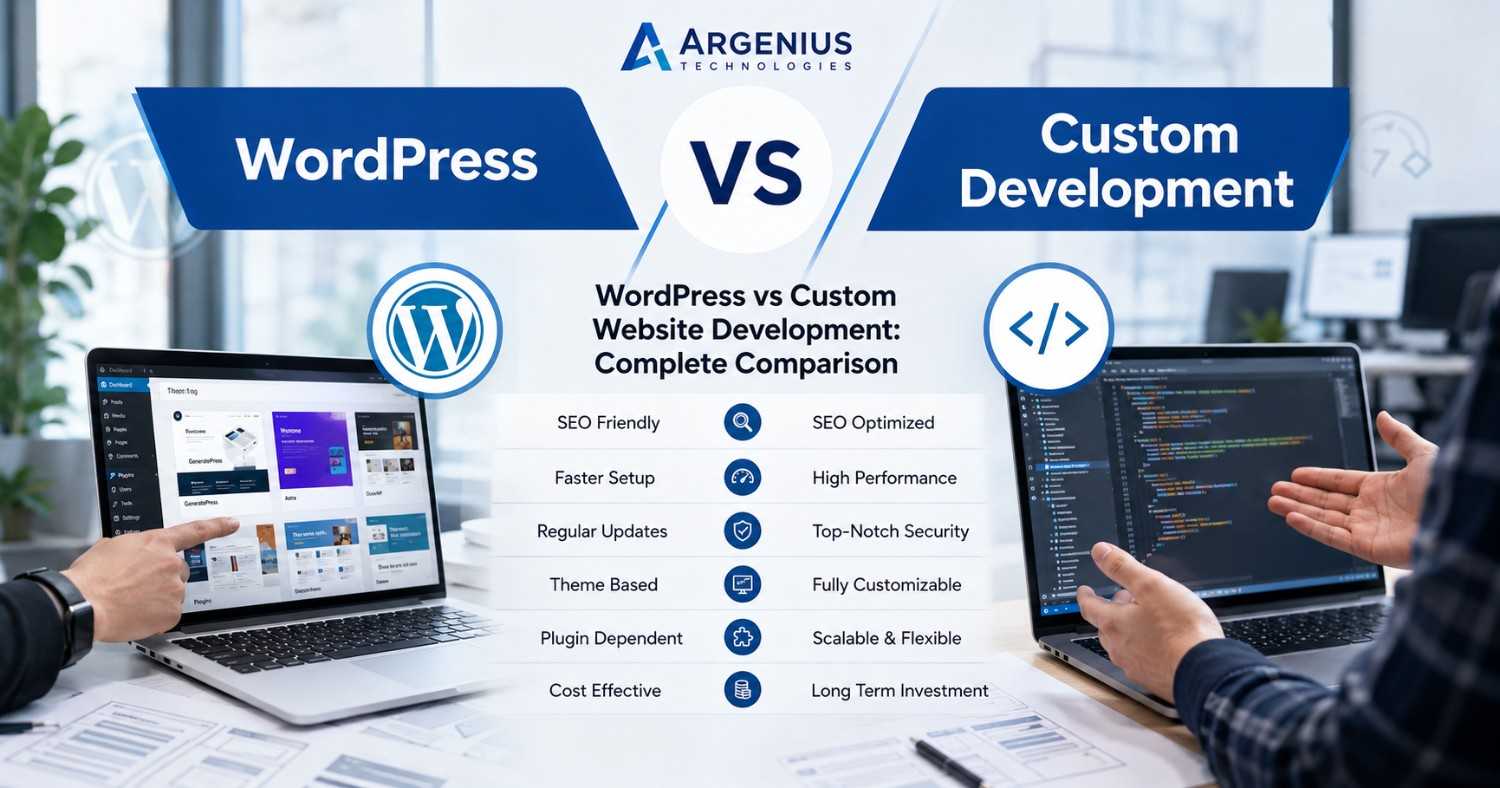
WordPress vs Custom Website Development
1. Development Cost
WordPress generally costs less because it uses pre-built themes and plugins.
Custom development requires experienced developers, designers, testing, and planning, making the initial investment higher.
However, if your business needs unique features, custom development often becomes more cost-effective in the long run.
2. Design Flexibility
WordPress offers thousands of templates that can be customized to some extent.
But businesses wanting a completely unique identity may find limitations.
Custom websites provide unlimited design flexibility.
Every page, animation, interaction, and user journey can be built exactly according to your brand.
3. Performance
Website speed affects both user experience and search rankings.
Many WordPress websites become slower because they rely on multiple plugins.
Custom-developed websites contain only the necessary code, making them significantly faster when built correctly.
Better speed means better conversions and lower bounce rates.
4. SEO Friendliness
Both WordPress and custom websites can rank well on Google.
WordPress offers several SEO plugins that make optimization easier.
Custom websites, however, allow developers to optimize every technical SEO factor, including structured data, page speed, clean URLs, Core Web Vitals, and server-side rendering.
For businesses targeting competitive keywords, custom development often provides more control.
5. Security
WordPress powers millions of websites, making it a common target for hackers.
Most security issues occur because of outdated plugins or themes.
Custom websites generally have fewer vulnerabilities since only required functionality is developed.
With proper coding standards, security becomes much stronger.
6. Scalability
As your business grows, your website should grow with it.
Adding advanced workflows, dashboards, APIs, CRM integrations, or customer portals can become difficult in WordPress.
Custom development is designed for future expansion and can easily handle business growth.
7. Maintenance
WordPress requires regular updates for themes, plugins, and the core system.
Ignoring updates may create compatibility or security issues.
Custom websites require maintenance too, but updates are fully controlled by the development team rather than third-party plugins.
8. Custom Features
If your business only needs a basic website, WordPress may be sufficient.
However, businesses requiring features like:
- Customer Dashboard
- Vendor Panel
- Booking System
- CRM Integration
- ERP Integration
- Mobile App API
- AI Features
- Subscription System
- Real-time Notifications
will benefit much more from custom website development.
9. Business Growth
Many startups begin with WordPress because it allows them to launch quickly.
As the business grows, they often migrate to custom solutions to improve performance, security, and scalability.
Planning for future growth from the beginning can save both time and money.
Quick Comparison Table
| Feature |
WordPress |
Custom Website |
| Initial Cost |
Lower |
Higher |
| Development Time |
Faster |
Longer |
| Performance |
Good |
Excellent |
| SEO |
Good |
Excellent |
| Security |
Good |
Excellent |
| Scalability |
Medium |
High |
| Custom Features |
Limited |
Unlimited |
| Maintenance |
Plugin Based |
Developer Controlled |
| Long-Term Growth |
Moderate |
Excellent |
Which Option Should You Choose?
Choose WordPress if:
- You need a website quickly.
- Your budget is limited.
- You need a blog or small business website.
- You don't require advanced functionality.
Choose Custom Website Development if:
- You want a unique brand identity.
- You expect rapid business growth.
- You need custom workflows or integrations.
- Security is a top priority.
- Website performance is critical.
- You plan to build mobile apps connected to your website.
Why Businesses Prefer Custom Development Today
Modern businesses are moving toward personalized digital experiences. Instead of fitting their operations into ready-made software, they want websites built around their unique processes.
Custom development provides complete ownership of your code, better scalability, stronger security, and the flexibility to integrate with third-party tools such as payment gateways, CRMs, ERPs, marketing automation platforms, and mobile applications. While the initial investment may be higher, it often delivers better long-term value for growing businesses.
Final Thoughts
Choosing between WordPress and Custom Website Development depends on your business goals—not just your current budget. If you need a simple website with quick deployment, WordPress is a practical choice. However, if your vision includes long-term growth, unique functionality, high performance, and enhanced security, a custom-built website is the better investment.
At Argenius, we help businesses evaluate their requirements and build websites that are fast, secure, scalable, and optimized for search engines. Whether you need a professional WordPress website or a fully customized web solution, our team focuses on creating digital experiences that support your business growth.
Frequently Asked Questions (FAQs)
Is WordPress better than custom website development?
WordPress is ideal for simple websites and blogs, while custom development is better for businesses needing unique features, better performance, and long-term scalability.
Which option is more SEO-friendly?
Both can perform well in search engines, but custom websites offer greater control over technical SEO, speed optimization, and structured data implementation.
Is custom website development more secure?
Yes. A custom-built website generally has fewer vulnerabilities because it uses only the necessary code and avoids reliance on multiple third-party plugins.
Which is more cost-effective?
WordPress has a lower initial cost, whereas custom development often provides better long-term value for businesses that expect to grow.
Can I migrate from WordPress to a custom website later?
Yes. Many businesses start with WordPress and later migrate to a custom solution as their requirements expand.