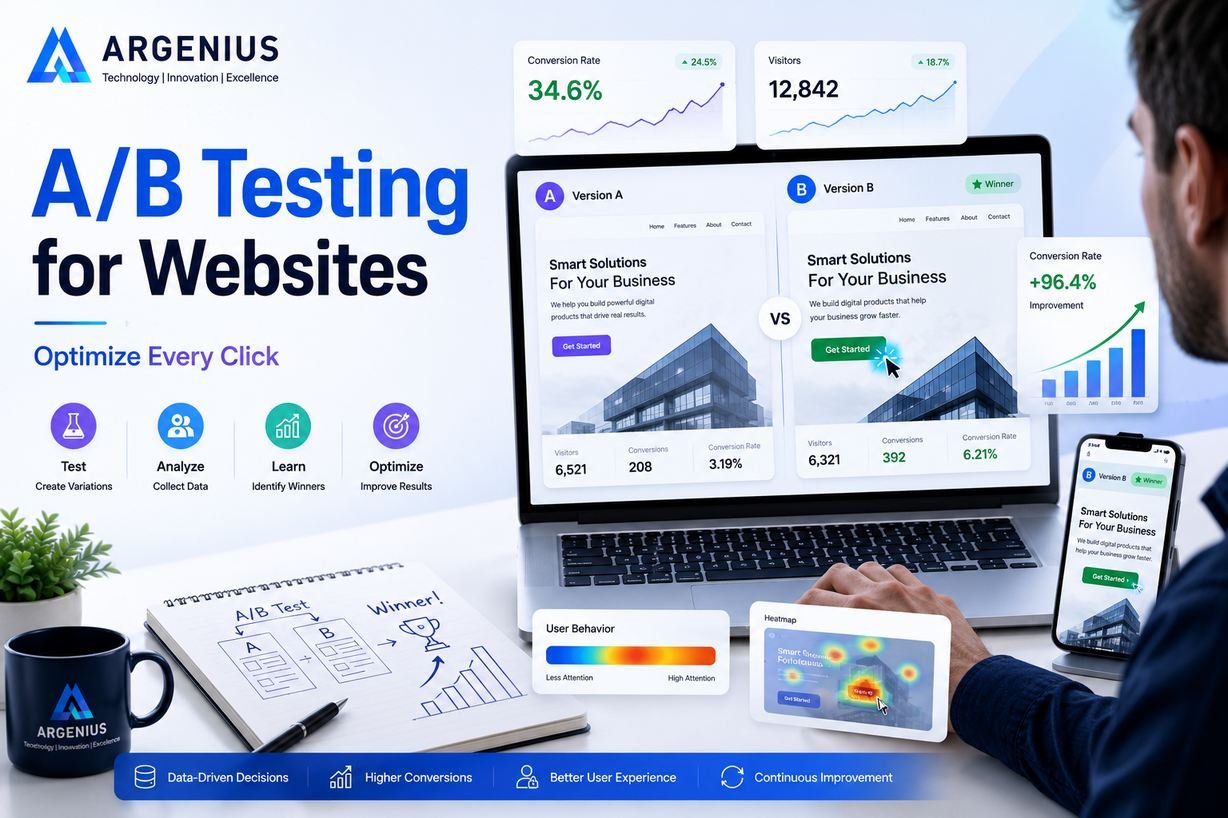
A/B testing helps businesses make smarter website decisions using real user data instead of assumptions. Learn how to test, analyze, and optimize your website to increase conversions and improve user experience.
Why Guesswork Is Hurting Your Website Conversions
Many businesses invest in attractive website designs, SEO, and digital marketing campaigns but still struggle to generate enough leads or sales. In most cases, the problem isn't the amount of traffic—it's what happens after visitors arrive. Small design choices, button text, page layouts, headlines, or form structures can significantly influence whether someone becomes a customer or leaves without taking action.
Instead of making changes based on personal opinions or assumptions, successful businesses rely on data. This is where A/B testing becomes one of the most valuable optimization techniques available. By comparing two versions of the same webpage, businesses can understand which version performs better based on actual user behavior.
At Argenius, we believe website improvements should be driven by measurable results rather than guesswork. A/B testing allows businesses to make informed decisions that improve user experience, increase conversion rates, and maximize the return on every marketing campaign.
What Is A/B Testing?
A/B testing, also known as split testing, is the process of comparing two versions of a webpage or website element to determine which one performs better. One version is shown to a group of visitors, while another version is displayed to a different group. User interactions are then measured to identify which variation achieves the desired goal more effectively.
Rather than relying on assumptions, A/B testing uses real visitor data to guide website improvements. Even small adjustments can have a meaningful impact on lead generation, sales, and customer engagement.
Why A/B Testing Matters for Businesses
Every website has opportunities for improvement. Without testing, businesses may unknowingly keep design elements that reduce conversions.
A/B testing helps businesses:
- Increase conversion rates
- Improve user experience
- Reduce bounce rates
- Generate more qualified leads
- Optimize marketing campaigns
- Make data-driven decisions
- Improve return on investment (ROI)
Instead of redesigning an entire website, businesses can improve performance through gradual, measurable changes.
How A/B Testing Works
The process begins by identifying a page or element that could perform better. A second version is created with one meaningful change while everything else remains the same. Traffic is divided between both versions, and visitor behavior is measured over time.
Once enough data has been collected, the version with better performance becomes the preferred choice.
The key principle is simple: test one major change at a time so you can clearly identify what influenced the results.
What Can You Test?
Almost every important website element can be tested to improve performance.
Common examples include:
- Headlines
- Call-to-action buttons
- Contact forms
- Hero sections
- Landing page layouts
- Images
- Product descriptions
- Navigation menus
- Pricing tables
- Trust badges
- Testimonials
- Button placement
Testing these elements helps businesses understand what encourages visitors to take action.
Improve Call-to-Action Performance
Call-to-action buttons are among the most frequently tested elements because they directly influence conversions.
You can experiment with:
- Button text
- Button size
- Button placement
- Visual contrast
- Supporting text
Small improvements to CTA design often produce measurable increases in inquiries, sign-ups, or purchases.
Optimize Landing Pages
Landing pages are designed with a single objective, making them ideal candidates for A/B testing.
Businesses often test:
- Hero headlines
- Form length
- Customer testimonials
- Images
- Benefit-focused content
- CTA placement
Optimized landing pages typically generate more leads without increasing advertising costs.
Test Forms to Reduce Friction
Long or complicated forms often discourage visitors from completing inquiries.
Testing different form versions can reveal whether reducing fields, improving labels, or changing layouts encourages more submissions.
A smoother form experience generally improves lead generation.
Use Analytics Alongside A/B Testing
Testing should never happen in isolation.
Analytics helps explain:
- User behavior
- Traffic sources
- Conversion rates
- Engagement time
- Exit pages
- Device performance
At Argenius, we combine website analytics with A/B testing to ensure every optimization decision is supported by meaningful data rather than assumptions.
Focus on Meaningful Metrics
Successful A/B testing measures business outcomes instead of vanity metrics.
Useful performance indicators include:
- Conversion rate
- Form submissions
- Quote requests
- Sales
- Newsletter sign-ups
- Revenue
- Click-through rate
- Average engagement time
The goal is to improve actions that directly contribute to business growth.
Give Tests Enough Time
One of the biggest mistakes businesses make is ending tests too early.
Reliable results require:
- Adequate traffic
- Consistent measurement
- Statistical confidence
- Sufficient testing duration
Making decisions too quickly may lead to incorrect conclusions.
Common A/B Testing Mistakes
Avoid these common errors:
- Testing multiple major changes simultaneously
- Ending experiments too early
- Ignoring mobile users
- Measuring the wrong metrics
- Making decisions without enough data
- Running tests on low-traffic pages
- Failing to document results
A structured testing process produces more reliable outcomes.
A/B Testing and SEO
Many businesses worry that testing could negatively affect SEO.
When implemented correctly, A/B testing supports SEO by improving user engagement, conversions, and overall website quality. Since tests are temporary and focused on user experience, they generally complement long-term optimization efforts rather than conflict with them.
The key is to follow search engine best practices and avoid creating duplicate or misleading content.
Build a Culture of Continuous Improvement
Website optimization is not a one-time project. User expectations, technology, and market trends continue to evolve.
Businesses that regularly test and refine their websites often discover new opportunities to improve performance over time.
Even modest improvements across multiple pages can produce significant long-term gains.
Why Businesses Choose Argenius
At Argenius, we help businesses improve website performance through data-driven optimization rather than assumptions. Our team combines A/B testing, user experience research, website analytics, SEO, and conversion rate optimization to identify opportunities that increase leads and improve customer engagement.
Whether we're optimizing landing pages, service pages, eCommerce checkouts, or inquiry forms, every recommendation is based on measurable user behavior and business goals. Our objective is to help businesses achieve continuous improvement instead of relying on one-time redesigns.
Final Thoughts
A/B testing is one of the most effective ways to improve website performance because it replaces guesswork with evidence. By testing headlines, layouts, forms, calls-to-action, and other key elements, businesses can make informed decisions that enhance user experience and increase conversion rates.
Rather than making large-scale changes without validation, organizations should adopt a culture of continuous optimization where every improvement is measured and refined over time. This approach not only delivers better business results but also creates a website that evolves alongside user expectations.
At Argenius, we help businesses implement data-driven optimization strategies that combine A/B testing, analytics, and UX best practices to build websites that perform better, convert more visitors, and support sustainable business growth.
Frequently Asked Questions
What is A/B testing?
A/B testing is the process of comparing two versions of a webpage or website element to determine which one performs better based on real user behavior.
What can I test on my website?
You can test headlines, CTA buttons, forms, landing pages, images, pricing sections, navigation, testimonials, and other elements that influence user behavior.
Does A/B testing improve SEO?
While A/B testing is not a direct ranking factor, improving user experience and engagement can positively support your overall SEO strategy.
How long should an A/B test run?
The duration depends on your website traffic and conversion volume. Tests should continue until you have enough reliable data to make an informed decision.
Can Argenius help with A/B testing?
Yes. At Argenius, we plan, implement, monitor, and analyze A/B tests to improve website performance, increase conversions, and help businesses make confident, data-driven decisions.