Explore the top front end technologies list including HTML, CSS, JavaScript, React, and more. Learn what front end technologies are and how they are used in modern web development.
Introduction
In today’s digital era, a website is often the first interaction between a business and its users. A fast, attractive, and user-friendly interface can make a huge difference. This is why understanding front end technologies is extremely important.
If you are a beginner or someone planning to become a developer, you might be wondering what are front end technologies and which tools you should learn. This guide will help you understand the complete front end technologies list, along with detailed explanations of each technology.
At Argenius, we believe that choosing the right front end development technologies is the key to building high-performing websites that users love.
What Are Front End Technologies?
Before diving into the list, let’s clearly understand what are the front end technologies.
Front end technologies are the tools, languages, and frameworks used to create the visible part of a website — the part that users interact with directly. This includes everything from buttons and layouts to animations and responsiveness.
In simple words, when you open any website and see its design, colors, text, or click on anything, all of that is built using front end developer technologies.
Why Front End Technologies Are Important
Understanding the front end technologies list is important because it directly affects user experience.
A well-developed front end ensures:
- Faster loading speed
- Better mobile responsiveness
- Smooth navigation
- Higher engagement and conversions
Modern businesses rely heavily on front end development technologies to create professional and user-friendly websites.
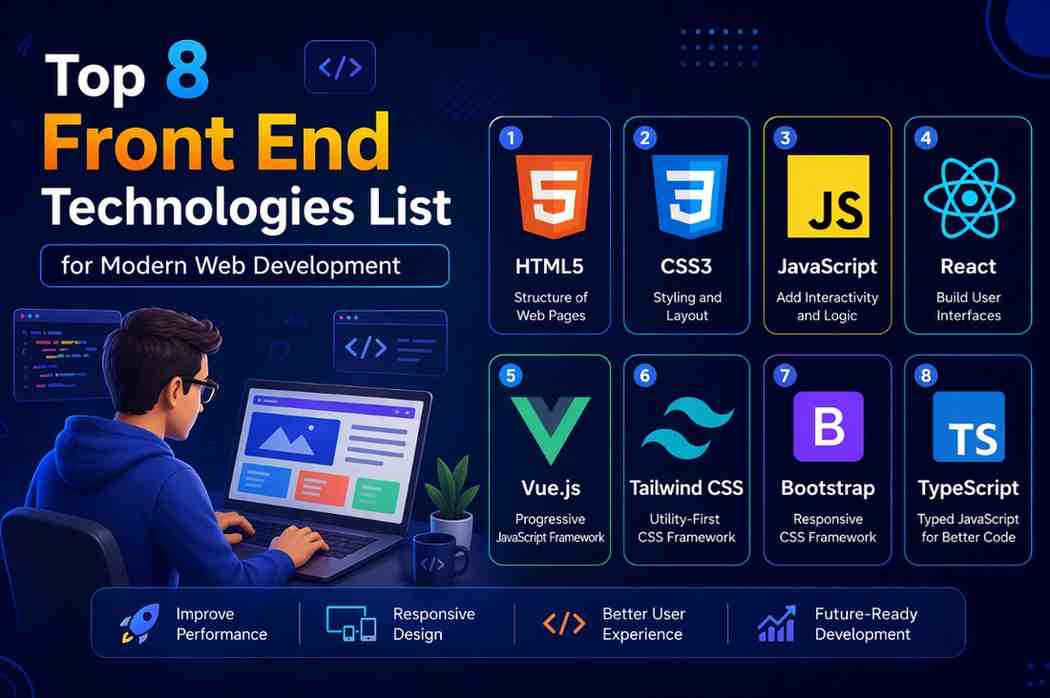
Top 8 Front End Technologies List (Detailed Explanation)
Now let’s explore the most important front end technologies list with detailed explanations so you can clearly understand how each one works.
1. HTML (HyperText Markup Language)
HTML is the backbone of all websites. It is the first technology you need to learn when understanding what are front end technologies.
What HTML Does
HTML defines the structure of a webpage. It tells the browser what elements to display, such as headings, paragraphs, images, links, and buttons.
Example
When you see a blog title or an image on a website, it is created using HTML tags.
Why It’s Important
Without HTML, a website cannot exist. It is the foundation of all front end technologies.
2. CSS (Cascading Style Sheets)
CSS is used to style and design your website. It makes your website visually attractive.
What CSS Does
It controls colors, fonts, layouts, spacing, and responsiveness.
Example
When a website has a beautiful design, animations, or responsive layout, it is because of CSS.
Why It’s Important
CSS transforms a plain HTML page into a modern and professional website. It is a core part of the front end technologies list.
3. JavaScript
JavaScript is the most powerful and essential language in front end development technologies.
What JavaScript Does
It adds interactivity to websites. Without JavaScript, websites would be static and boring.
Example
- Clicking a button
- Form validation
- Image sliders
- Dynamic content updates
Why It’s Important
JavaScript is a must-have skill in every front end developer technologies stack.
4. React.js
React is one of the most popular libraries used in modern front end technologies.
What React Does
It allows developers to build user interfaces using reusable components. This makes development faster and more efficient.
Example
Large platforms like Facebook and Instagram use React for their front end.
Why It’s Important
React helps in building fast, scalable, and dynamic web applications, making it a key part of the front end technologies list.
5. Angular
Angular is a full-fledged framework developed by Google. It is used for building complex web applications.
What Angular Does
It provides a complete structure for developing large-scale applications with built-in tools and features.
Example
Enterprise-level applications and dashboards often use Angular.
Why It’s Important
It is widely used in professional environments and is a strong part of front end development technologies.
6. Vue.js
Vue.js is a lightweight and flexible framework that is easy to learn.
What Vue Does
It helps developers create interactive interfaces with less complexity compared to other frameworks.
Example
Many startups and small projects use Vue because it is simple and fast.
Why It’s Important
Vue is beginner-friendly and an important option in the front end technologies list.
7. Bootstrap
Bootstrap is a popular CSS framework that speeds up development.
What Bootstrap Does
It provides ready-made components like buttons, forms, navigation bars, and grids.
Example
Instead of writing CSS from scratch, developers can use Bootstrap classes to design quickly.
Why It’s Important
It saves time and ensures responsive design, making it a key part of front end technologies.
8. Tailwind CSS
Tailwind CSS is a modern utility-first CSS framework.
What Tailwind Does
It allows developers to design directly in HTML using utility classes.
Example
Instead of writing custom CSS, you can apply styles using predefined classes like spacing, colors, and layout.
Why It’s Important
It is highly flexible and widely used in modern front end development technologies.
How to Choose the Right Front End Technologies
Choosing the right tools from the front end technologies list depends on your project.
- For simple websites → HTML, CSS, JavaScript
- For dynamic apps → React or Vue
- For enterprise projects → Angular
At Argenius, we always select the best front end developer technologies based on performance and user experience.
Front End Developer Technologies Stack
A complete front end developer technologies stack includes:
- HTML (structure)
- CSS (design)
- JavaScript (functionality)
- Frameworks (React, Angular, Vue)
- Tools (Git, APIs, etc.)
This combination helps developers build modern web applications efficiently.
Benefits of Learning Front End Technologies
Learning front end technologies opens many opportunities:
- High-demand career options
- Freelancing opportunities
- Ability to build your own websites
- Better understanding of UI/UX
With the right knowledge of the front end technologies list, you can create professional-level projects.
Future of Front End Development
The future of front end development technologies is evolving rapidly.
New trends like:
- AI-powered UI
- Faster frameworks
- Better performance tools
are shaping the industry. Developers who stay updated with front end technologies will always stay ahead.
Conclusion
Understanding the front end technologies list is the first step toward becoming a successful web developer. From basic tools like HTML and CSS to advanced frameworks like React and Angular, each technology plays a crucial role.
If you want to build modern, fast, and user-friendly websites, mastering these front end developer technologies is essential.
At Argenius, we focus on using the best front end development technologies to create high-quality digital experiences that deliver real results.
About Argenius
Argenius is a leading web development and digital marketing company that helps businesses grow online. From frontend development to SEO optimization, we provide complete solutions to build powerful and scalable websites.