GraphQL and REST API are two powerful approaches for building modern web applications. Learn their differences, advantages, limitations, and discover which solution is best for your business project.
Why Choosing the Right API Architecture Matters
Modern websites and web applications rarely operate as standalone systems. They communicate with payment gateways, CRMs, ERP software, mobile apps, cloud services, analytics platforms, and countless third-party applications. Behind these seamless interactions lies an API architecture that determines how information is requested, delivered, and managed.
When planning a new digital product, one of the most common technical decisions is choosing between REST API and GraphQL. Both technologies are widely used and capable of powering high-performance applications, but they solve problems in different ways. Selecting the wrong approach can affect performance, scalability, development time, and long-term maintenance.
At Argenius, we evaluate every project based on business objectives rather than technology trends. Whether we're building a custom web application, SaaS platform, mobile backend, or enterprise portal, we recommend the API architecture that delivers the best balance of flexibility, performance, and maintainability.
What Is REST API?
REST (Representational State Transfer) is one of the most widely adopted architectural styles for building APIs.
A REST API exposes different endpoints that represent resources. For example, separate endpoints may exist for users, products, orders, or categories.
A client requests information from a specific endpoint, and the server returns a predefined response.
REST APIs are known for their simplicity, predictable structure, and broad compatibility with almost every programming language and framework.
What Is GraphQL?
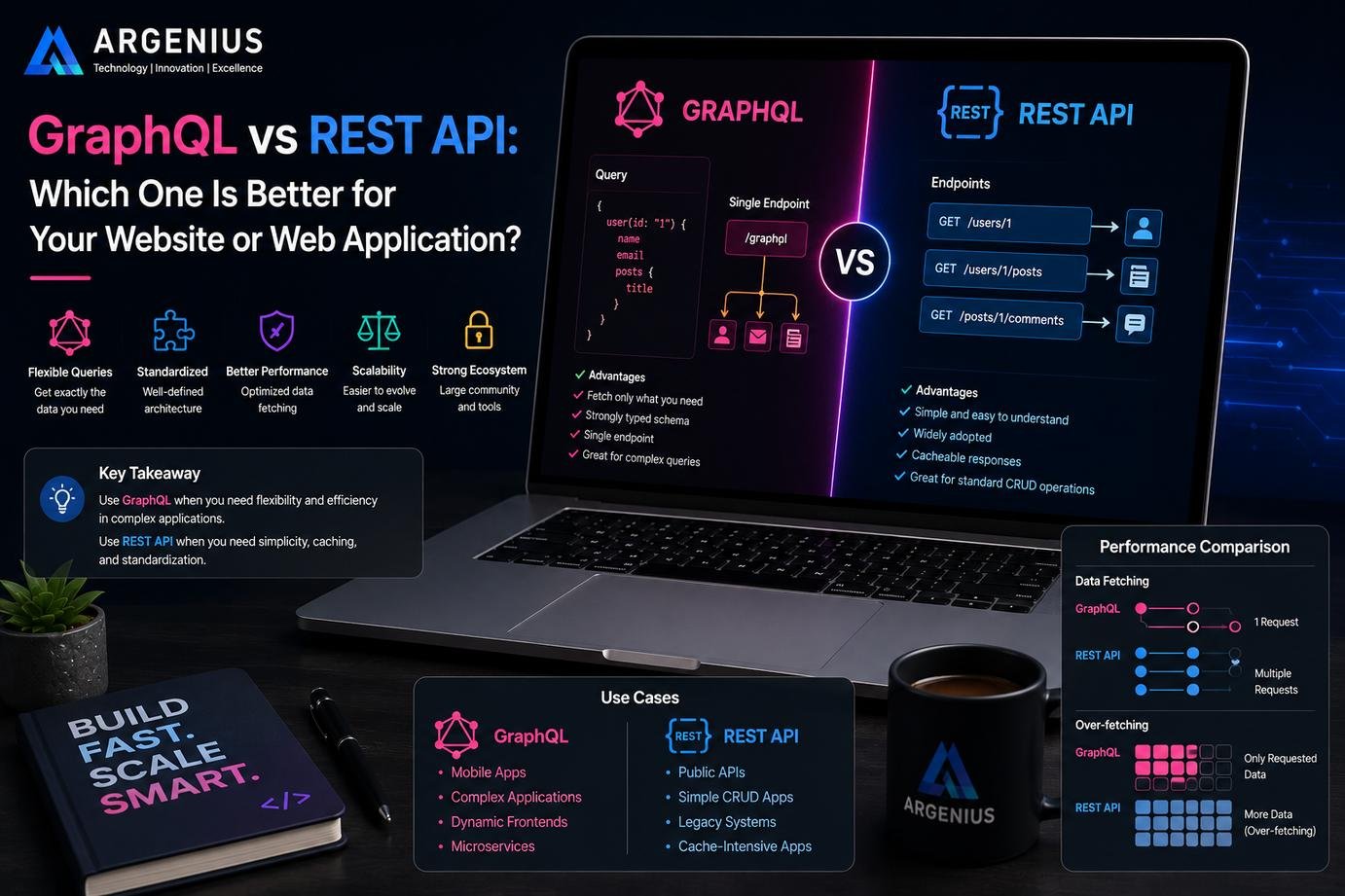
GraphQL is a query language and API runtime that allows clients to request exactly the data they need.
Instead of accessing multiple endpoints, applications communicate through a single endpoint and define the required data within the request itself.
This approach minimizes unnecessary data transfer while providing greater flexibility for frontend developers.
GraphQL has become increasingly popular for applications with complex user interfaces and dynamic data requirements.
Understanding the Core Difference
The biggest difference between REST and GraphQL is how data is requested.
With REST, the server determines the structure of the response. Clients receive the predefined data returned by the endpoint.
With GraphQL, the client decides exactly which fields should be returned.
This difference gives GraphQL greater flexibility while allowing REST to remain simpler for many traditional applications.
REST API Advantages
REST continues to dominate web development because of its reliability and simplicity.
Benefits include:
- Easy to understand
- Large developer community
- Wide framework support
- Excellent documentation
- Strong caching support
- Simple debugging
- Mature ecosystem
For many business websites and standard applications, REST remains an excellent choice.
GraphQL Advantages
GraphQL offers several advantages for data-intensive applications.
Key benefits include:
- Request only required data
- Single API endpoint
- Reduced network requests
- Better frontend flexibility
- Faster UI development
- Easier integration for multiple devices
These features make GraphQL especially useful for applications with complex interfaces.
Performance Comparison
Performance depends on how an API is designed rather than the technology alone.
REST performs extremely well when endpoints are carefully planned and caching is implemented correctly.
GraphQL often performs better when applications need data from multiple related resources because everything can be retrieved in one request.
For example, instead of making separate API calls for users, orders, and addresses, GraphQL can retrieve all required information simultaneously.
Flexibility
GraphQL provides exceptional flexibility.
Frontend developers can request only the information required for a particular screen.
REST APIs often return fixed responses, which may include unnecessary information or require multiple requests.
As applications become more dynamic, GraphQL's flexibility becomes increasingly valuable.
Scalability
Both REST and GraphQL support scalable architectures.
REST scales particularly well for:
- Standard websites
- Business portals
- Public APIs
- CRUD applications
GraphQL becomes attractive for:
- SaaS platforms
- Enterprise dashboards
- Mobile applications
- Real-time systems
- Complex frontend applications
The appropriate choice depends on project complexity rather than application size alone.
Security Considerations
Security is essential regardless of API architecture.
Recommended practices include:
- Authentication
- Authorization
- HTTPS
- Rate limiting
- Input validation
- Logging
- Monitoring
GraphQL requires additional attention because unrestricted queries can increase server workload if proper limits are not implemented.
At Argenius, security is integrated into every API solution from the earliest stages of development.
API Development Experience
REST APIs are generally easier for new developers because the architecture is straightforward.
GraphQL introduces additional concepts such as:
- Schemas
- Types
- Queries
- Mutations
- Resolvers
Although GraphQL requires a slightly steeper learning curve, it often improves productivity on complex frontend projects.
Mobile Application Development
Mobile applications often benefit from GraphQL because network efficiency is extremely important.
GraphQL reduces unnecessary data transfer, helping applications:
- Load faster
- Use less bandwidth
- Improve responsiveness
- Reduce API requests
For mobile-first businesses, this can create a noticeably better user experience.
Integration with Modern Frontend Frameworks
Both technologies integrate well with modern frameworks.
Popular combinations include:
REST API:
- Laravel + React
- Laravel + Vue
- Express + React
GraphQL:
- React + Apollo
- Vue + GraphQL
- Next.js + GraphQL
- Nuxt + GraphQL
Choosing the right stack depends on project requirements and team expertise.
When Should You Choose REST API?
REST is an excellent choice for:
- Business websites
- Company portals
- CMS development
- Standard CRUD systems
- Public APIs
- eCommerce websites
- Internal management systems
It offers a balance of simplicity, stability, and maintainability.
When Should You Choose GraphQL?
GraphQL is often the better solution for:
- SaaS platforms
- Enterprise dashboards
- Mobile applications
- Customer portals
- Multi-platform applications
- Real-time systems
- Complex frontend experiences
Projects requiring flexible data delivery usually benefit from GraphQL.
Common Mistakes Businesses Make
Many businesses select GraphQL simply because it is newer.
Common mistakes include:
- Using GraphQL for very simple projects
- Building poorly designed REST APIs
- Ignoring API documentation
- Weak authentication
- No rate limiting
- Overcomplicated architecture
- Choosing technology without business planning
Technology should always support business objectives rather than trends.
Why Businesses Choose Argenius
At Argenius, we design API architectures based on your project's technical and business requirements instead of following one-size-fits-all approaches. Our development team has experience building secure, scalable, and high-performance REST APIs as well as GraphQL-powered applications for startups, enterprises, and growing businesses.
Whether you're developing a Laravel backend, React application, Vue.js platform, mobile application, SaaS product, or enterprise portal, we focus on delivering API solutions that are reliable, maintainable, and optimized for long-term growth. Every API we build follows best practices for security, documentation, performance, and scalability to ensure your application remains ready for future expansion.
Final Thoughts
Both GraphQL and REST API are excellent technologies, and neither is universally better than the other. REST remains the preferred choice for many business websites and traditional web applications because of its simplicity, maturity, and broad ecosystem. GraphQL, on the other hand, offers unmatched flexibility for applications that require dynamic data fetching, multiple client platforms, and complex user interfaces.
The right decision depends on your project's goals, architecture, frontend requirements, development resources, and future scalability. Choosing the correct API strategy early can reduce development costs, improve application performance, and simplify long-term maintenance.
At Argenius, we help businesses evaluate their requirements before selecting the most suitable API architecture. Whether your project benefits from REST, GraphQL, or a hybrid approach, our team delivers secure, scalable, and future-ready API solutions designed to support sustainable digital growth.
Frequently Asked Questions
What is the main difference between GraphQL and REST API?
REST uses multiple endpoints with predefined responses, while GraphQL typically uses a single endpoint that allows clients to request exactly the data they need.
Is GraphQL faster than REST?
Not always. GraphQL can reduce unnecessary network requests for complex applications, while REST can perform exceptionally well for standard business websites when implemented correctly.
Which is easier to learn?
REST is generally easier for beginners because of its straightforward architecture. GraphQL has a steeper learning curve but provides greater flexibility for complex applications.
Which is better for mobile applications?
GraphQL is often preferred for mobile applications because it reduces unnecessary data transfer and allows clients to fetch only the required information.
Can Argenius develop both REST and GraphQL APIs?
Yes. At Argenius, we build secure, scalable REST APIs and GraphQL solutions for websites, mobile apps, SaaS platforms, enterprise systems, and custom web applications based on your business requirements.