Choosing the right CMS can influence your website's performance, scalability, SEO, and future growth. Learn the differences between Headless CMS and Traditional CMS to make the best decision for your business.
Choosing the Right CMS Can Shape Your Website's Future
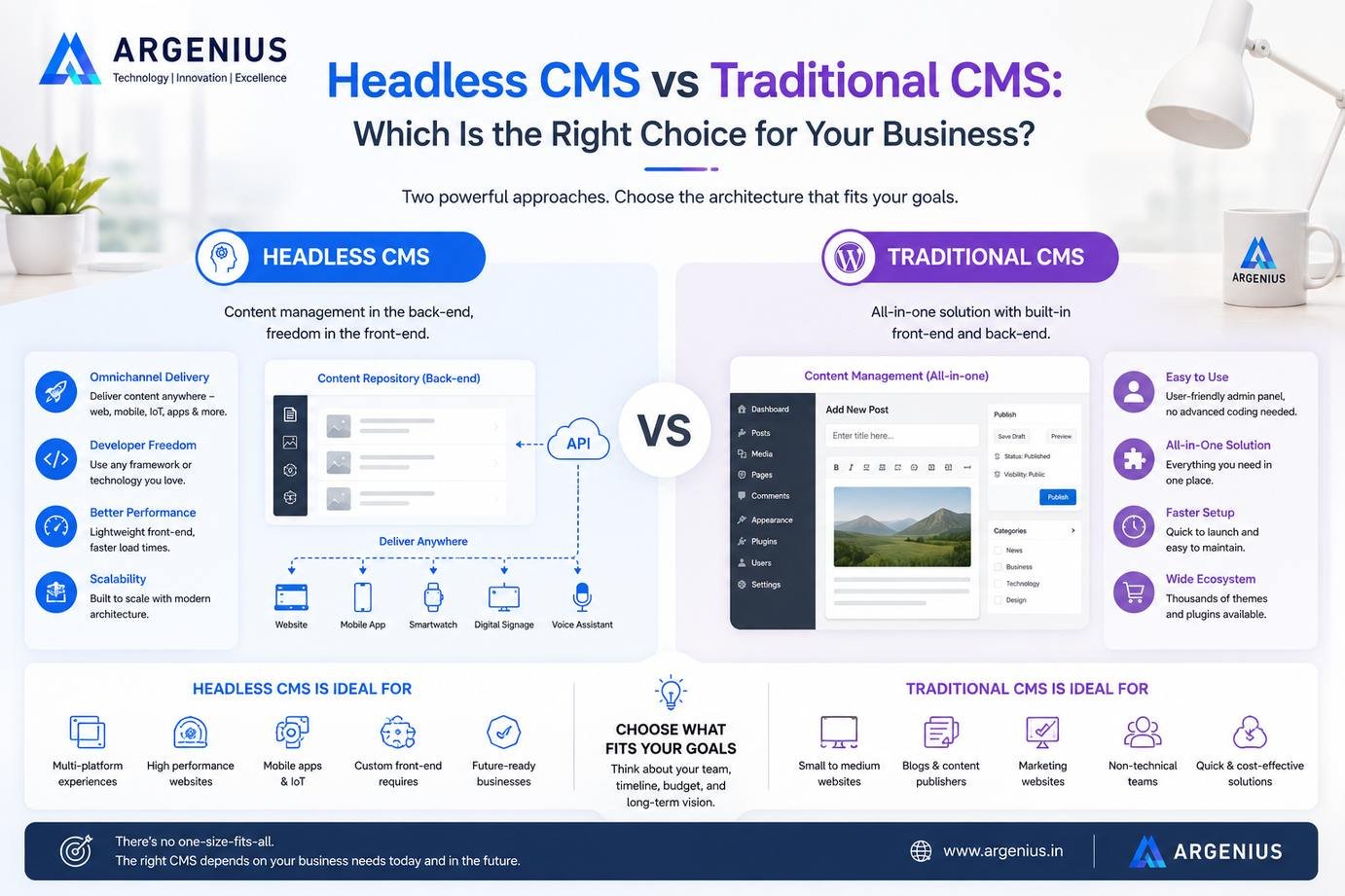
When businesses plan a new website, one of the biggest technical decisions is selecting the right Content Management System (CMS). This choice affects much more than content editing. It influences website performance, flexibility, scalability, SEO, security, maintenance, and even future development costs.
For many years, traditional CMS platforms such as WordPress dominated website development because they combined content management and frontend presentation in a single system. Today, however, businesses are increasingly adopting Headless CMS solutions to support modern websites, mobile applications, and multiple digital platforms from one centralized content source.
Neither approach is universally better. The right option depends on your business goals, technical requirements, publishing workflow, and long-term digital strategy.
At Argenius, we help businesses evaluate both approaches before development begins, ensuring the selected CMS aligns with current needs while supporting future growth.
What Is a Traditional CMS?
A Traditional CMS combines content management and website presentation within the same platform.
When content is created inside the CMS, it is immediately connected to the website's frontend through built-in themes or templates.
Popular examples include:
These systems allow businesses to publish pages, blogs, images, and media without requiring advanced programming knowledge.
Traditional CMS platforms are ideal for organizations that want an easy-to-manage website with built-in editing capabilities.
What Is a Headless CMS?
A Headless CMS separates content management from the frontend.
Instead of controlling how content is displayed, it simply stores and delivers content through APIs.
Developers can then use technologies like:
- React
- Next.js
- Vue.js
- Nuxt
- Angular
- Mobile Apps
- Smart Devices
This architecture provides greater flexibility because the same content can appear across multiple digital platforms.
Understanding the Core Difference
The biggest difference between these two approaches lies in how content reaches users.
With a Traditional CMS, content and presentation are tightly connected. The CMS controls both content editing and website rendering.
With a Headless CMS, content is managed independently while developers create completely custom frontends using modern frameworks.
This separation provides greater development freedom but also increases technical complexity.
Ease of Content Management
Traditional CMS platforms are designed primarily for editors.
Content creators can:
- Publish blogs
- Edit pages
- Upload images
- Manage menus
- Update websites
Most tasks require little or no developer involvement.
Headless CMS platforms also provide excellent editing experiences, but frontend updates generally require developer implementation.
Businesses with non-technical content teams often find Traditional CMS platforms easier to manage.
Flexibility and Customization
Customization is where Headless CMS offers significant advantages.
Because frontend development is completely independent, developers can build:
- Custom websites
- Mobile apps
- Customer portals
- Digital kiosks
- Smart TV applications
- Progressive Web Apps (PWAs)
Traditional CMS platforms also support customization but usually depend on themes and plugins.
For highly customized digital products, Headless CMS provides greater long-term flexibility.
Performance
Modern businesses expect fast-loading websites.
Headless CMS often performs exceptionally well because developers can combine it with high-performance frontend frameworks such as React, Vue, or Next.js.
Benefits include:
- Faster page rendering
- Better Core Web Vitals
- Improved scalability
- Reduced server load
Traditional CMS platforms can also achieve excellent performance when properly optimized through caching, image optimization, and clean development practices.
SEO Considerations
SEO is often a deciding factor.
Traditional CMS platforms provide:
- SEO plugins
- Metadata management
- URL customization
- XML sitemaps
- Internal linking tools
Headless CMS requires developers to implement SEO manually, but this also allows greater flexibility.
Modern Headless websites using Server-Side Rendering (SSR) or Static Site Generation (SSG) can achieve outstanding SEO performance.
At Argenius, every CMS project includes technical SEO planning regardless of the chosen architecture.
Scalability
Growing businesses need technology that supports expansion.
Headless CMS is designed for scalability because one content source can power:
- Websites
- Mobile applications
- Digital displays
- Customer portals
- Multiple brands
- International websites
Traditional CMS platforms can scale effectively for most business websites, but managing multiple platforms may become more complex.
Security
Security differs between both architectures.
Traditional CMS platforms require:
- Plugin updates
- Theme updates
- Core CMS updates
- Security monitoring
Headless CMS reduces some attack surfaces because the frontend is separated from the content management system.
However, API security and authentication become extremely important.
Regardless of architecture, proper security practices remain essential.
Development Cost
Cost depends largely on project complexity.
Traditional CMS generally requires:
- Lower development cost
- Faster implementation
- Lower initial investment
Headless CMS projects often involve:
- Custom frontend development
- API integration
- Separate deployment
- Advanced architecture
Initial costs are usually higher but may provide better long-term flexibility.
When Should You Choose a Traditional CMS?
Traditional CMS is often the right choice if you need:
- Business website
- Blog
- Company profile
- Portfolio
- Marketing website
- Small or medium eCommerce website
- Easy content editing
It provides excellent value for businesses that prioritize simplicity and rapid deployment.
When Should You Choose a Headless CMS?
Headless CMS is better suited for projects requiring:
- React websites
- Vue applications
- Mobile apps
- Multi-platform publishing
- Enterprise websites
- SaaS products
- Customer dashboards
- API-first architecture
- High scalability
It offers greater flexibility for businesses investing in modern digital ecosystems.
Common Mistakes Businesses Make
Many organizations select a CMS based solely on popularity.
Common mistakes include:
- Choosing Headless CMS for simple brochure websites
- Using Traditional CMS for complex enterprise platforms
- Ignoring future scalability
- Underestimating maintenance requirements
- Selecting technology without business planning
Technology decisions should always support long-term business goals.
Why Businesses Choose Argenius
At Argenius, we don't believe there is a single CMS that's right for every project. Instead, we begin by understanding your business objectives, content workflow, audience, and future growth plans. Based on those requirements, we recommend the architecture that offers the best balance of flexibility, performance, maintainability, and cost.
Our team develops both Traditional CMS websites and modern Headless CMS solutions using technologies such as React, Next.js, Vue.js, Laravel, and API-driven architectures. Every project is built with responsive design, technical SEO, strong security, and long-term scalability in mind.
Whether you're launching a content-rich business website or building a complex digital platform, we create solutions designed to grow with your business.
Final Thoughts
Both Headless CMS and Traditional CMS are powerful solutions, but they solve different business challenges. Traditional CMS platforms remain an excellent choice for organizations that prioritize simple content management and faster deployment. Headless CMS, on the other hand, offers unmatched flexibility for businesses building modern, API-driven digital experiences across multiple platforms.
Rather than choosing based on current trends, businesses should evaluate their content strategy, development requirements, budget, scalability goals, and technical resources before making a decision.
At Argenius, we help businesses select, develop, and optimize CMS solutions that support long-term growth. Whether your project requires the simplicity of a Traditional CMS or the flexibility of a Headless architecture, our team delivers secure, high-performance, and SEO-ready websites built for the future.
Frequently Asked Questions
What is the main difference between a Headless CMS and a Traditional CMS?
A Traditional CMS manages both content and website presentation together, while a Headless CMS separates content management from the frontend and delivers content through APIs.
Which CMS is better for SEO?
Both can perform well. Traditional CMS platforms often provide built-in SEO tools, while Headless CMS solutions require custom SEO implementation but offer greater flexibility when built correctly.
Is Headless CMS more secure?
Headless CMS can reduce some common attack surfaces because the frontend is separated from the CMS, but API security, authentication, and infrastructure still require proper implementation.
Which CMS is better for a small business website?
For most small businesses, a Traditional CMS such as WordPress is easier to manage and more cost-effective. Businesses with advanced technical requirements or multi-platform publishing needs may benefit from a Headless CMS.
Can Argenius build both Traditional CMS and Headless CMS websites?
Yes. At Argenius, we develop WordPress, Laravel-based CMS solutions, and modern Headless CMS websites using React, Next.js, Vue.js, and other technologies based on your business requirements.