Discover how a professional portfolio website can help showcase your work, build trust, attract clients, and grow your career. Learn the essential features, design principles, and development process in this complete guide.
Why Every Professional Needs a Portfolio Website
In today's digital world, your portfolio website is often the first impression potential clients, employers, or business partners have of your work. Whether you're a freelancer, software developer, graphic designer, photographer, architect, digital marketer, writer, or creative agency, a professional portfolio website helps establish credibility and demonstrates your expertise far more effectively than a resume or social media profile.
A well-designed portfolio website does more than display completed projects. It tells your story, highlights your skills, showcases your achievements, and gives visitors confidence in your abilities. Unlike third-party platforms, your own website gives you complete control over branding, content, user experience, and search engine visibility. It also becomes a valuable marketing asset that works for you 24/7 by attracting new opportunities and generating inquiries.
As competition grows across every industry, relying only on LinkedIn or freelance marketplaces is no longer enough. Businesses and recruiters often search online before making hiring decisions, and a professionally developed portfolio website helps you stand out while strengthening your personal brand.
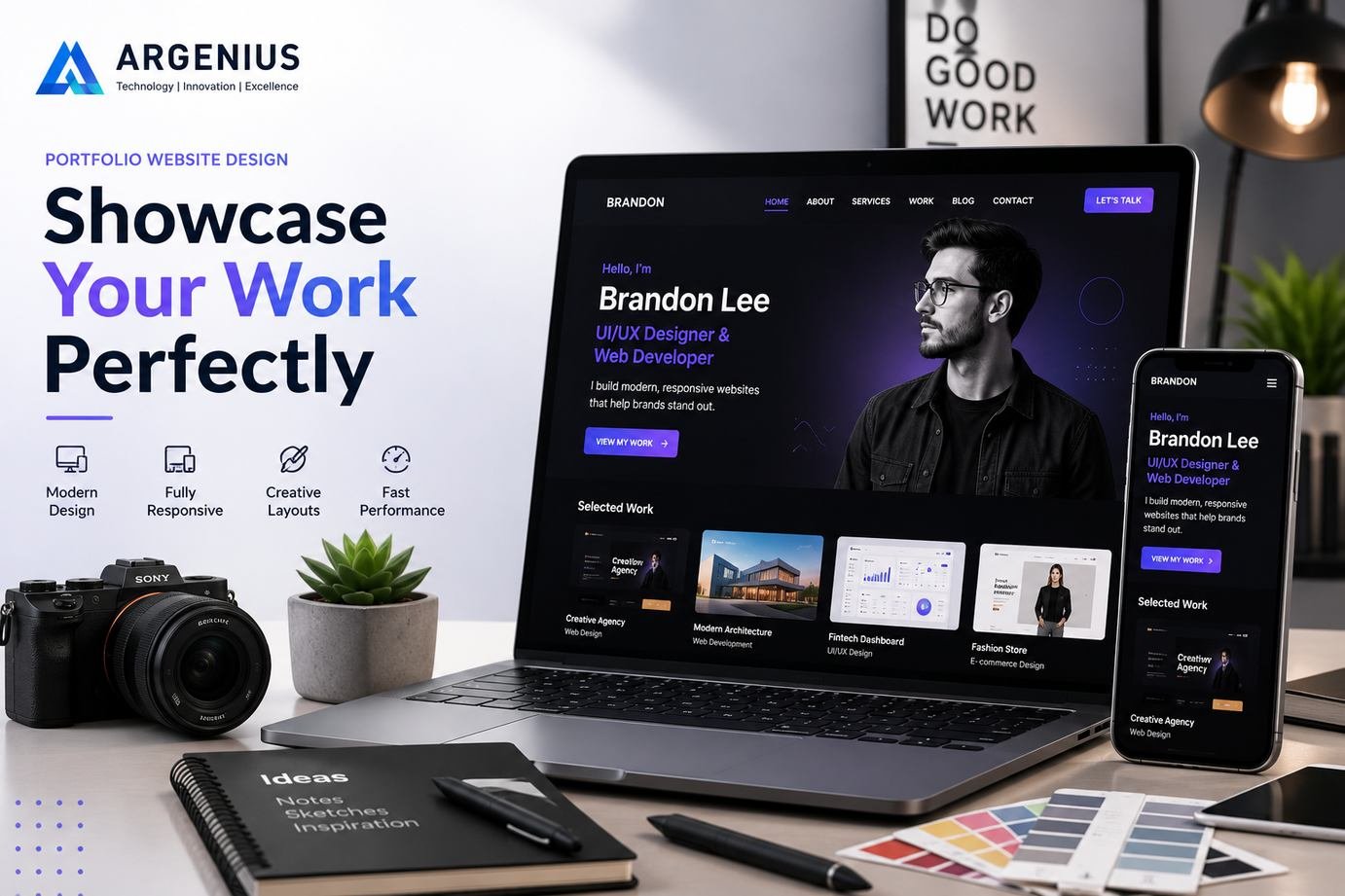
At Argenius, we design and develop modern portfolio websites that combine clean aesthetics, responsive layouts, fast performance, SEO optimization, and conversion-focused design. Whether you're an individual professional or a creative agency, we build portfolio websites that showcase your work beautifully while helping you attract more clients and career opportunities.
What Is a Portfolio Website?
A portfolio website is a personal or business website created to showcase your work, skills, achievements, experience, and services. Unlike a traditional business website that focuses on products or company information, a portfolio website is centered around your expertise and completed projects.
A professional portfolio typically includes project galleries, case studies, client testimonials, certifications, awards, service details, and contact information. It allows visitors to evaluate your capabilities through real examples rather than relying solely on written descriptions.
Portfolio websites are widely used by:
- Software Developers
- Web Designers
- Graphic Designers
- UI/UX Designers
- Photographers
- Architects
- Digital Marketers
- Writers
- Video Editors
- Artists
- Consultants
- Creative Agencies
A well-organized portfolio helps establish authority, build trust, and convert visitors into clients or employers.
Benefits of Having a Portfolio Website
A professionally designed portfolio website provides long-term value for your personal brand and business growth.
Some of the biggest advantages include:
- Builds professional credibility
- Showcases real projects
- Strengthens personal branding
- Generates client inquiries
- Improves online visibility
- Supports SEO
- Works as a 24/7 marketing tool
- Increases trust through testimonials
- Highlights achievements and certifications
- Gives complete control over your online presence
Instead of sending multiple documents or links, you can direct potential clients to a single website that presents all your work professionally.
Essential Features of a Portfolio Website
A successful portfolio website should focus on simplicity, professionalism, and user experience.
Important sections include:
- Homepage
- About Me
- Services
- Portfolio Gallery
- Project Case Studies
- Skills
- Work Experience
- Certifications
- Client Testimonials
- Awards & Achievements
- Resume Download
- Blog Section
- Contact Form
- Social Media Links
- Call-to-Action Buttons
Each section should guide visitors toward learning more about your work and contacting you.
Showcase Projects Through Detailed Case Studies
Instead of displaying only screenshots, explain the complete story behind each project.
A strong case study should cover:
- Project overview
- Client requirements
- Challenges faced
- Technologies used
- Design process
- Development approach
- Final solution
- Measurable results
Detailed case studies demonstrate your problem-solving ability and provide greater value than a simple image gallery.
Keep the Design Clean and Professional
Your portfolio represents your personal brand, so the design should be visually appealing without distracting from your work.
Focus on:
- Minimal layouts
- Consistent typography
- Professional color palette
- High-quality visuals
- Easy navigation
- Plenty of white space
- Clear content hierarchy
- Responsive design
A clean interface allows visitors to focus on your projects rather than unnecessary visual effects.
Optimize for Mobile Devices
Most users browse websites using smartphones and tablets.
A responsive portfolio website ensures:
- Better readability
- Faster navigation
- Improved accessibility
- Higher engagement
- Better search engine rankings
Every page should adapt smoothly to different screen sizes without compromising usability.
Improve Visibility with SEO
A portfolio website should not only look great but also be discoverable through search engines.
SEO best practices include:
- Keyword-optimized pages
- Clean URLs
- Fast loading speed
- Optimized images
- Meta titles and descriptions
- Internal linking
- Structured data
- Mobile optimization
- Blog publishing
- XML sitemap
Publishing helpful industry-related blogs can significantly improve organic traffic over time.
Performance Matters
Website speed influences user experience, SEO, and conversion rates.
Performance optimization includes:
- Image compression
- Lazy loading
- CDN integration
- Browser caching
- Minified CSS and JavaScript
- Optimized code
- Efficient hosting
A fast-loading website encourages visitors to explore more of your work.
Build Trust with Testimonials and Social Proof
Potential clients want evidence that you can deliver quality work.
Include:
- Client testimonials
- Project reviews
- Company logos
- Ratings
- Certifications
- Awards
- Case studies
- Success stories
Social proof increases confidence and encourages visitors to reach out.
Security and Maintenance
Even a personal portfolio should follow modern security standards.
Recommended practices include:
- SSL certificate
- Secure contact forms
- Spam protection
- Regular backups
- Software updates
- Secure hosting
- Strong authentication
A secure website protects both your data and your visitors.
Best Technology Stack for Portfolio Website Development
The ideal technology depends on your goals and future scalability.
Popular choices include:
Frontend
- React.js
- Next.js
- HTML5
- Tailwind CSS
Backend
Database
Hosting
Modern frameworks help deliver faster performance, better SEO, and easier maintenance.
Common Mistakes to Avoid
Many professionals lose opportunities because their portfolio websites fail to create a strong impression.
Avoid these common mistakes:
- Outdated design
- Slow loading pages
- Low-quality project images
- No case studies
- Missing contact information
- Poor mobile responsiveness
- Weak SEO
- No testimonials
- Confusing navigation
- Too much unnecessary animation
A portfolio should be easy to explore and focused on your best work.
Why Professionals Choose Argenius
At Argenius, we create custom portfolio websites that help professionals, freelancers, startups, and creative agencies present their work with confidence. Our websites are designed with responsive layouts, modern UI/UX principles, fast loading performance, and SEO-friendly architecture to maximize visibility and user engagement.
Whether you need a developer portfolio, designer showcase, photography website, agency portfolio, or corporate profile, we build solutions tailored to your goals. Every portfolio is optimized for performance, security, and future scalability while maintaining a professional design that strengthens your personal brand and generates more business opportunities.
Final Thoughts
A portfolio website is one of the most valuable investments for anyone looking to build a strong online presence. It serves as a digital representation of your expertise, allowing potential clients, employers, and collaborators to evaluate your work, understand your skills, and contact you with confidence.
By combining professional design, compelling project case studies, responsive layouts, SEO optimization, and fast performance, your portfolio can become a powerful marketing tool that continuously attracts new opportunities. Instead of depending solely on third-party platforms, owning your portfolio website gives you complete control over your brand and future growth.
At Argenius, we help individuals and businesses build portfolio websites that are visually impressive, technically robust, and designed to convert visitors into long-term clients.
Frequently Asked Questions
What is a portfolio website?
A portfolio website is a personal or business website that showcases your projects, skills, experience, achievements, and services to potential clients or employers.
Who should have a portfolio website?
Freelancers, developers, designers, photographers, architects, consultants, agencies, writers, marketers, and other professionals can benefit from having a portfolio website.
What should a portfolio website include?
A professional portfolio should include an About section, project showcase, case studies, services, testimonials, contact information, resume, certifications, and social media links.
Is SEO important for a portfolio website?
Yes. SEO helps your portfolio appear in search engine results, making it easier for potential clients and employers to discover your work.
Can Argenius build a custom portfolio website?
Yes. Argenius develops custom portfolio websites with modern designs, responsive layouts, SEO optimization, fast performance, and scalable architecture tailored to your professional goals.