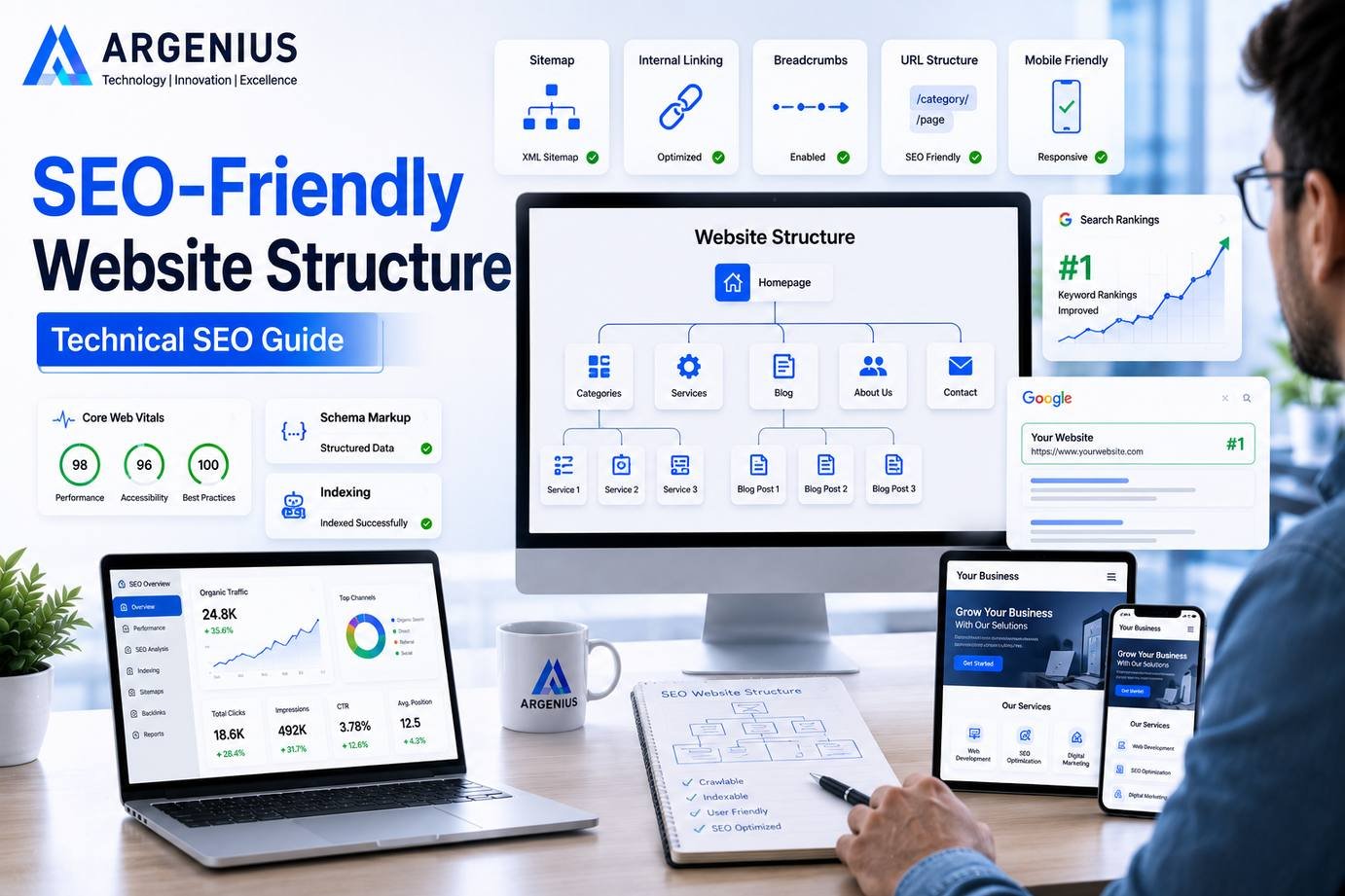
A well-structured website helps users find information easily while allowing search engines to crawl and index your pages efficiently. Learn the technical foundations of an SEO-friendly website structure in this complete guide.
Why Website Structure Is the Foundation of SEO Success
Many businesses invest in high-quality content, keyword research, and backlinks but still struggle to achieve consistent search rankings. One of the most overlooked reasons is a poorly organized website structure. Even the best content can underperform if search engines and users find it difficult to navigate your website.
A well-planned website structure helps visitors locate information quickly while enabling search engines to crawl, understand, and index your pages efficiently. It creates logical relationships between pages, improves user experience, and distributes authority across your website through strategic internal linking.
At Argenius, we believe website structure should be planned before development begins. A strong technical foundation not only supports SEO but also makes your website easier to maintain, expand, and optimize as your business grows.
What Is an SEO-Friendly Website Structure?
An SEO-friendly website structure is the logical organization of your website's pages, categories, navigation, and internal links in a way that benefits both users and search engines.
Instead of randomly adding pages over time, every section should fit into a clear hierarchy. Visitors should immediately understand where they are, while search engines should easily discover and interpret every important page.
A good structure improves usability, indexing efficiency, and long-term scalability.
Start with a Clear Website Hierarchy
Every successful website begins with a logical hierarchy.
A common structure looks like this:
- Home
- Main Service Categories
- Individual Service Pages
- Industry Pages
- Blog Categories
- Individual Blog Posts
- Contact
- About
Keeping important pages close to the homepage helps both users and search engines reach them more efficiently.
Design Navigation Around User Intent
Navigation should help visitors complete their goals with minimal effort.
Your primary menu should focus on essential pages instead of trying to display everything at once.
Good navigation includes:
- Clear menu labels
- Simple dropdowns
- Logical categories
- Mobile-friendly menus
- Consistent layout
Navigation should guide visitors naturally rather than forcing them to search for important information.
Create SEO-Friendly URLs
URLs should describe page content clearly.
Good URLs are:
- Short
- Readable
- Keyword-focused
- Consistent
- Free from unnecessary parameters
For example:
is much better than
Simple URLs improve usability and search engine understanding.
Build Strong Internal Linking
Internal links help search engines discover pages while encouraging visitors to explore additional content.
For example, a blog discussing website speed can naturally link to articles about responsive design, Core Web Vitals, or technical SEO.
At Argenius, we create topic clusters where related articles support one another through meaningful internal links. This strengthens topical authority and improves content discoverability.
Organize Content into Categories
As your website grows, organizing content becomes increasingly important.
Separate content into logical categories such as:
- Website Development
- SEO
- Digital Marketing
- E-commerce Development
- Mobile App Development
- UI/UX Design
Clear categorization improves navigation and makes your website easier to scale.
Optimize for Crawlability
Search engines must be able to access important pages without difficulty.
Good crawlability depends on:
- Clear navigation
- Internal links
- XML sitemap
- Robots.txt configuration
- Clean code
- Fast loading pages
Avoid creating isolated pages that cannot be reached through normal navigation.
Improve Website Speed
A well-structured website should also perform efficiently.
Performance improvements include:
- Optimized images
- Browser caching
- Minified CSS and JavaScript
- Reliable hosting
- Lazy loading
- Efficient code
Fast websites provide better user experiences while supporting technical SEO.
Use Responsive Design
Google primarily evaluates the mobile version of your website.
Responsive layouts ensure visitors enjoy the same experience across smartphones, tablets, laptops, and desktop computers.
Responsive design also reduces duplicate content issues because one website serves every device.
Create Logical Heading Structures
Every page should follow a clear heading hierarchy.
Since your hero section already contains the H1, blog pages should continue with:
- H2 for primary sections
- H3 for supporting topics
- H4 only when necessary
Logical headings improve readability, accessibility, and SEO.
Implement Schema Markup
Structured data helps search engines better understand website content.
Depending on the page, you may use:
- Organization Schema
- Service Schema
- FAQ Schema
- Breadcrumb Schema
- Article Schema
- Local Business Schema
Schema can improve search visibility and increase the chances of earning rich results.
Use Breadcrumb Navigation
Breadcrumbs improve both navigation and SEO.
Example:
Home → Website Development → SEO → Technical SEO
Visitors can easily return to previous sections while search engines better understand page relationships.
Keep Important Pages Within Three Clicks
Visitors should not need multiple clicks to reach valuable information.
An effective website structure allows users to access key pages within approximately three clicks from the homepage.
This improves usability while helping search engines crawl your website more efficiently.
Maintain a Scalable Website Architecture
Your website should be built for future growth.
Adding new services, blog categories, case studies, or landing pages should not require reorganizing the entire website.
Scalable architecture reduces maintenance costs while supporting long-term SEO.
Common Website Structure Mistakes
Many businesses unintentionally weaken SEO through structural problems.
Avoid:
- Broken internal links
- Deep page hierarchy
- Duplicate pages
- Confusing navigation
- Poor URL structure
- Missing XML sitemap
- Weak internal linking
- Orphan pages
- Slow page loading
Correcting these issues improves both crawlability and user experience.
Why Businesses Choose Argenius
At Argenius, we develop websites with SEO built into the foundation rather than added after launch. Every project begins with careful planning of website architecture, navigation, content hierarchy, internal linking, and technical optimization to ensure the website performs well for both users and search engines.
Our development process combines responsive design, clean coding standards, Core Web Vitals optimization, schema implementation, and scalable architecture to create websites that support long-term organic growth. Whether you're building a service website, an eCommerce platform, or a custom web application, we focus on creating structures that are easy to navigate, simple to maintain, and prepared for future expansion.
Final Thoughts
An SEO-friendly website structure is one of the most valuable long-term investments you can make for your business. While high-quality content and backlinks remain important, they are far more effective when supported by a logical website architecture that search engines can understand and users can navigate with ease.
By focusing on clear navigation, strategic internal linking, responsive design, optimized URLs, technical SEO, and scalable architecture, businesses create websites that perform better in search results while providing outstanding user experiences.
At Argenius, we help businesses build technically sound, SEO-ready websites that combine modern development practices with long-term growth strategies, ensuring every page contributes to stronger visibility and better business results.
Frequently Asked Questions
What is an SEO-friendly website structure?
An SEO-friendly website structure is a logical organization of pages, categories, navigation, and internal links that helps both users and search engines access and understand your content efficiently.
Why is website structure important for SEO?
A good structure improves crawlability, indexing, user experience, and internal link distribution, all of which contribute to stronger search visibility.
How many clicks should important pages be from the homepage?
Ideally, important pages should be reachable within two or three clicks to improve usability and make crawling easier for search engines.
Does internal linking improve SEO?
Yes. Internal linking helps search engines discover pages, understand content relationships, and distribute authority throughout your website.
Can Argenius build an SEO-friendly website?
Yes. At Argenius, we design and develop websites with SEO-friendly architecture, responsive layouts, technical optimization, structured data, and scalable navigation to help businesses achieve long-term organic growth.