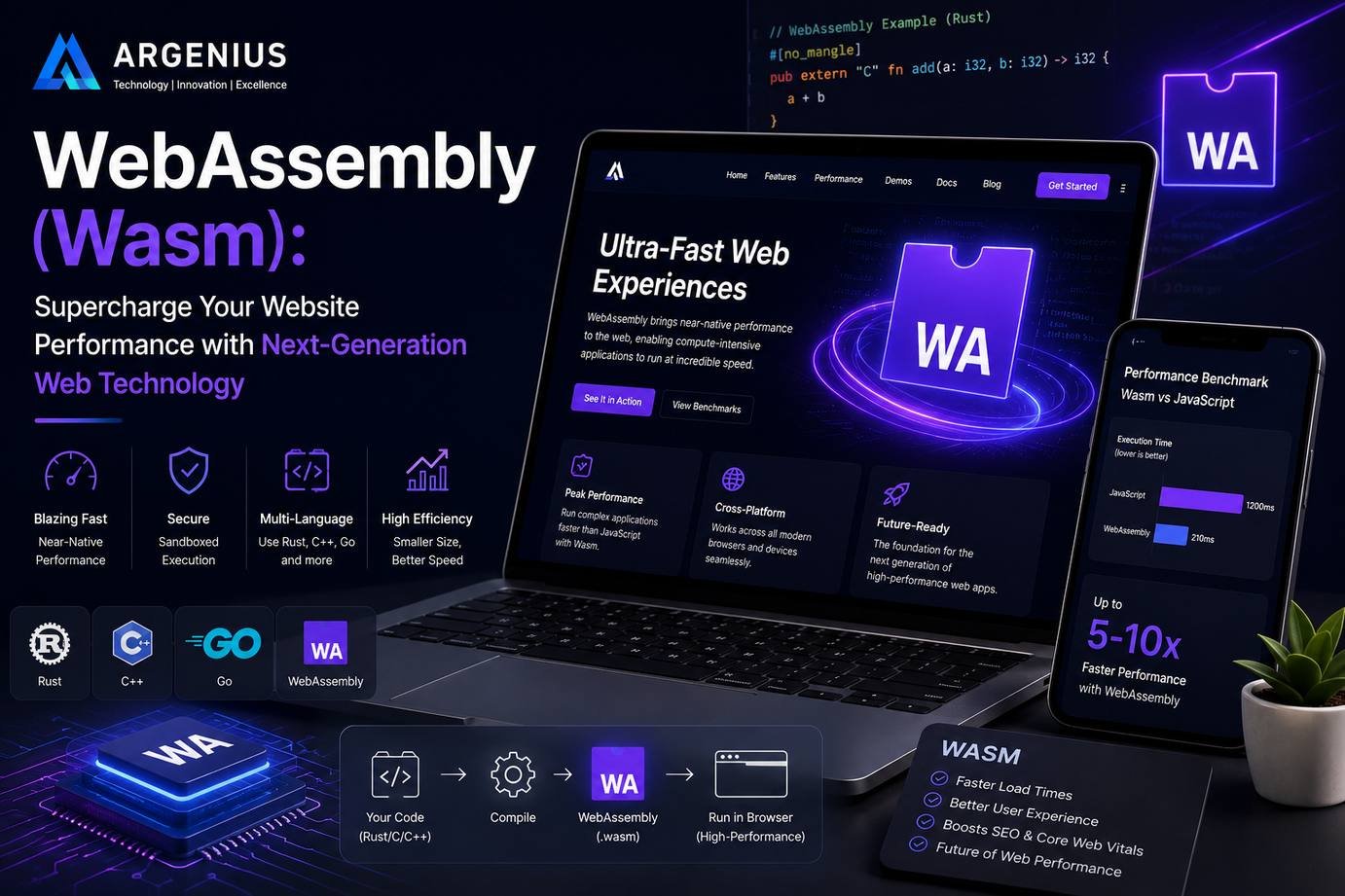
WebAssembly (Wasm) is transforming web development by enabling near-native performance directly in web browsers. Learn how it works, its benefits, real-world use cases, and why businesses are investing in WebAssembly-powered applications.
Why Website Performance Matters More Than Ever
Today's internet users expect websites and web applications to respond instantly. Whether they're shopping online, using a business dashboard, editing documents, or playing browser-based games, even a small delay can reduce user satisfaction and increase abandonment rates. Search engines also consider performance as an important ranking factor, making speed essential for both user experience and SEO.
Traditional JavaScript has powered the web for decades and continues to be the foundation of interactive websites. However, as web applications become more sophisticated, certain tasks such as image processing, video editing, scientific calculations, CAD tools, gaming, and real-time data visualization demand significantly more processing power.
This is where WebAssembly (Wasm) is changing the future of web development. It allows developers to run high-performance code directly in the browser, enabling near-native execution speeds without requiring users to install additional software.
At Argenius, we help businesses adopt modern technologies like WebAssembly to build fast, scalable, and future-ready digital products that deliver exceptional user experiences.
What Is WebAssembly?
WebAssembly (commonly called Wasm) is a low-level binary instruction format designed to run high-performance applications inside modern web browsers.
Unlike JavaScript, which is interpreted or just-in-time compiled, WebAssembly is optimized for speed and efficient execution.
Developers can write applications in languages such as:
- C++
- Rust
- C
- Go
- AssemblyScript
These applications are then compiled into WebAssembly and executed securely within supported browsers.
How WebAssembly Works
WebAssembly works alongside JavaScript rather than replacing it.
A typical workflow includes:
- Developers write performance-intensive code in a supported language.
- The code is compiled into a
.wasm file.
- The browser downloads the WebAssembly module.
- JavaScript loads and communicates with the module.
- Heavy computations are executed by WebAssembly while JavaScript manages the user interface.
This combination provides both speed and flexibility.
Why Businesses Are Adopting WebAssembly
Businesses increasingly use WebAssembly to deliver experiences that were once possible only through desktop applications.
Key advantages include:
- Faster execution
- Better application responsiveness
- Reduced processing time
- Cross-browser compatibility
- Improved scalability
- Enhanced user experience
- Efficient resource utilization
These benefits are especially valuable for businesses offering advanced web-based software.
Exceptional Performance
The biggest advantage of WebAssembly is performance.
Because Wasm is compiled into a binary format, browsers execute it much more efficiently than traditional scripting for computationally intensive tasks.
Applications benefit from:
- Faster calculations
- Lower latency
- Reduced CPU usage
- Improved rendering
- Smoother interactions
This results in applications that feel significantly more responsive.
Better User Experience
Fast applications naturally improve customer satisfaction.
Users experience:
- Smooth scrolling
- Faster page interactions
- Quicker data processing
- Reduced waiting times
- Better responsiveness
Improved performance often leads to higher engagement and increased conversion rates.
Cross-Platform Compatibility
Modern browsers support WebAssembly across multiple operating systems.
Applications work consistently on:
- Windows
- macOS
- Linux
- Android
- iOS
Businesses can deliver powerful experiences without developing separate desktop applications.
Security Benefits
WebAssembly is designed with browser security in mind.
It operates inside the browser's sandbox environment and follows the same security principles as JavaScript.
Additional security advantages include:
- Memory isolation
- Controlled execution
- Browser permission management
- Secure runtime environment
Although secure development practices remain essential, WebAssembly provides a strong foundation for modern applications.
Real-World Use Cases
WebAssembly is especially useful for applications requiring heavy processing.
Popular use cases include:
- Video editing tools
- Image processing
- Browser-based games
- CAD software
- Financial dashboards
- Data visualization
- Machine learning inference
- Scientific simulations
- Audio processing
- PDF rendering
These applications benefit from WebAssembly's ability to execute complex operations quickly.
WebAssembly and SEO
WebAssembly itself does not directly improve search engine rankings, but it contributes to several factors that influence SEO.
A well-implemented WebAssembly application can:
- Improve page responsiveness
- Reduce interaction delays
- Enhance Core Web Vitals
- Increase user engagement
- Lower bounce rates
At Argenius, we ensure that WebAssembly is integrated without compromising crawlability, accessibility, or technical SEO.
WebAssembly vs JavaScript
JavaScript remains the primary language for creating interactive websites, while WebAssembly focuses on performance-intensive operations.
JavaScript is ideal for:
- UI interactions
- Form validation
- Navigation
- DOM manipulation
- General website functionality
WebAssembly excels at:
- Complex calculations
- High-performance rendering
- Graphics processing
- Large data manipulation
- Computational workloads
In most modern applications, both technologies work together rather than competing.
Common Challenges
Although WebAssembly offers significant advantages, it is not necessary for every project.
Potential challenges include:
- Additional development complexity
- Learning curve
- Debugging compiled modules
- Browser integration planning
- Larger initial setup effort
Businesses should evaluate whether their application truly requires near-native browser performance.
When Should You Use WebAssembly?
WebAssembly is an excellent choice for projects involving:
- Enterprise software
- Browser-based design tools
- AI-powered web applications
- Financial systems
- Engineering software
- Interactive educational platforms
- Gaming platforms
- Medical imaging
- Video and photo editors
For standard business websites, blogs, or simple corporate portals, traditional web technologies are often sufficient.
Why Businesses Choose Argenius
At Argenius, we build high-performance web applications using modern technologies that align with your business objectives. When projects require advanced browser performance, we integrate WebAssembly alongside technologies such as React, Next.js, Laravel, and secure APIs to deliver responsive, scalable, and future-ready solutions.
Our development process emphasizes Core Web Vitals, responsive design, technical SEO, security, and maintainability. Rather than using emerging technologies simply because they are popular, we recommend WebAssembly only when it provides measurable benefits for your users and business goals.
Final Thoughts
WebAssembly represents one of the most significant advancements in modern web development. By enabling near-native performance within web browsers, it allows developers to build applications that were once possible only as desktop software. From real-time data processing to graphics-intensive tools and AI-powered experiences, WebAssembly opens new possibilities for creating faster and more capable web applications.
However, it is important to remember that WebAssembly is not a replacement for JavaScript. Instead, it complements existing web technologies by handling performance-critical tasks while JavaScript continues to manage user interfaces and browser interactions.
At Argenius, we help businesses determine whether WebAssembly is the right fit for their project and build high-performance web solutions that balance speed, scalability, security, and user experience for long-term success.
Frequently Asked Questions
What is WebAssembly (Wasm)?
WebAssembly is a binary instruction format that enables high-performance applications to run directly inside modern web browsers at near-native speeds.
Is WebAssembly better than JavaScript?
Not exactly. JavaScript is best for general web development and user interface interactions, while WebAssembly is designed for computationally intensive tasks that require higher performance.
Which browsers support WebAssembly?
All major modern browsers, including Google Chrome, Mozilla Firefox, Microsoft Edge, and Safari, support WebAssembly.
Is WebAssembly useful for business websites?
For standard corporate websites, WebAssembly is usually unnecessary. It provides the most value for applications involving complex calculations, graphics, media processing, simulations, or other performance-intensive features.
Can Argenius develop WebAssembly-powered applications?
Yes. At Argenius, we build modern web applications using technologies such as WebAssembly, React, Next.js, Laravel, APIs, and cloud services to create scalable, secure, and high-performance digital solutions.