Not sure whether to choose WordPress, Shopify, or Wix? This complete comparison explains the pros, cons, pricing, SEO, scalability, and ideal use cases to help you make the right decision.
Choosing the Right Website Platform Is a Long-Term Business Decision
Your website is much more than an online brochure. It represents your brand, helps you attract customers, generates leads, and often becomes the center of your digital marketing efforts. Because of this, choosing the right website platform is one of the most important decisions you'll make when starting or growing your business.
Today, three platforms are consistently among the most popular choices: WordPress, Shopify, and Wix. Each one has its own strengths, limitations, and ideal use cases. The platform that's perfect for one business may not be the best fit for another.
Instead of asking which platform is "the best," it's more useful to ask which platform best supports your business goals.
At Argenius, we've developed websites for startups, service businesses, eCommerce stores, educational organizations, and growing companies. One lesson we've learned is that choosing the right platform from the beginning can save significant time, money, and effort in the future.
Understanding the Three Platforms
Before comparing them, it's helpful to understand what each platform is designed to do.
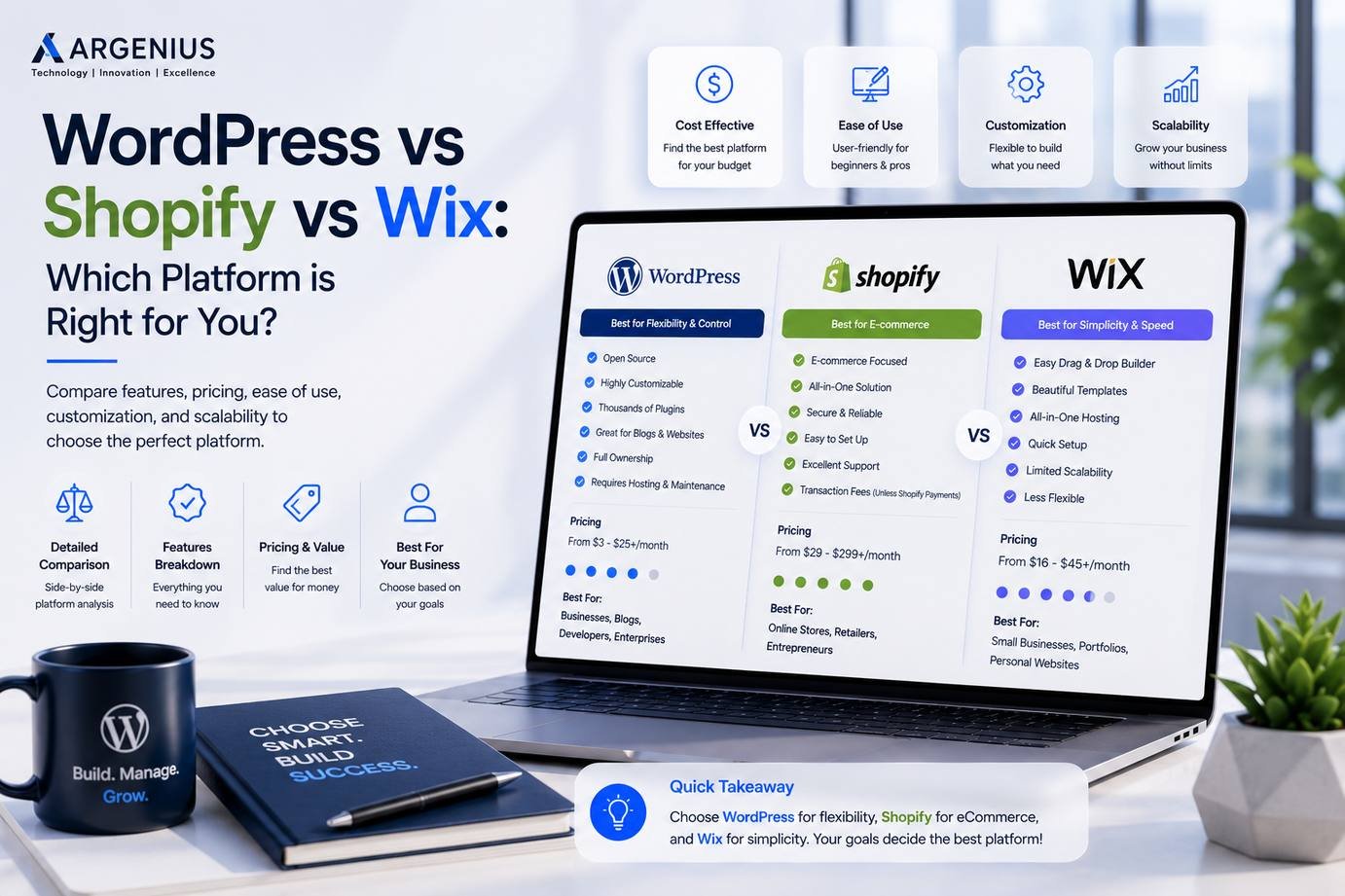
WordPress is an open-source content management system that gives you complete control over your website. It supports everything from blogs and company websites to custom portals and enterprise solutions.
Shopify is a hosted eCommerce platform created specifically for online selling. It manages hosting, security, and payment integrations, making it popular with online stores.
Wix is a drag-and-drop website builder aimed at beginners who want to create a website quickly without technical knowledge.
Although all three can build websites, they serve different business needs.
Ease of Use
If simplicity is your highest priority, Wix is usually the easiest platform to start with. Its visual editor allows users to design pages by dragging and dropping elements without writing code.
Shopify also provides a beginner-friendly experience, particularly for online stores. Product management, payments, and order processing are already built into the platform.
WordPress has a slightly steeper learning curve because it offers much greater flexibility. Once you become familiar with the dashboard, however, it provides far more control than most hosted website builders.
Businesses planning long-term growth often find that the additional flexibility of WordPress is worth the initial learning investment.
Design and Customization
Every business wants a website that reflects its brand identity rather than looking like thousands of other websites.
WordPress offers the highest level of customization. Developers can create completely custom layouts, unique features, advanced animations, customer dashboards, booking systems, learning portals, and much more.
Shopify provides attractive themes that work well for eCommerce stores but offers less flexibility outside online selling.
Wix includes many ready-made templates, but extensive customization becomes more limited as business requirements grow.
If having a unique digital identity is important, WordPress generally provides the greatest creative freedom.
SEO Performance
Search engine visibility plays an important role in generating consistent organic traffic.
WordPress is widely regarded as one of the strongest platforms for SEO because it gives complete control over technical optimization, URLs, metadata, schema markup, content structure, image optimization, and performance improvements.
Shopify includes many useful SEO features and performs well for online stores, though some technical customizations are more limited.
Wix has improved significantly in recent years, but businesses with advanced SEO requirements may eventually encounter limitations.
At Argenius, we often recommend WordPress for businesses planning long-term SEO growth because of its flexibility and extensive optimization capabilities.
Website Speed and Performance
A fast website improves both user experience and search rankings.
WordPress performance depends largely on hosting quality, theme selection, plugins, and optimization. When properly configured, it can achieve excellent loading speeds.
Shopify benefits from managed infrastructure that delivers consistent performance for online stores.
Wix performs adequately for many small websites, although larger websites with extensive content may experience performance limitations.
Regardless of the platform you choose, regular optimization remains essential.
Security
Website security should never be overlooked.
Shopify manages most security responsibilities for users, including server maintenance and PCI compliance for online payments.
Wix also handles many security updates automatically because it is a hosted platform.
WordPress requires more active management, but with regular updates, quality hosting, strong authentication, backups, and proper maintenance, it can provide excellent security.
At Argenius, security is integrated into every WordPress project through ongoing maintenance, monitoring, and proactive updates.
eCommerce Features
If your primary goal is selling products online, Shopify was specifically designed for this purpose.
It offers built-in features such as:
- Product management
- Inventory tracking
- Payment gateways
- Shipping options
- Discount codes
- Order management
WordPress, combined with WooCommerce, also provides powerful eCommerce capabilities while allowing much greater customization.
Wix supports online selling as well but is generally better suited for smaller stores with simpler requirements.
Scalability
As your business grows, your website should grow with it.
WordPress is highly scalable and can support everything from small business websites to enterprise-level platforms.
Shopify scales exceptionally well for growing online stores.
Wix works well for smaller websites but may become restrictive as advanced functionality becomes necessary.
Businesses expecting rapid growth often benefit from platforms that provide greater long-term flexibility.
Pricing
Initial pricing often influences platform selection.
Wix offers affordable entry-level plans for small websites.
Shopify operates on monthly subscription plans with additional transaction fees depending on payment methods.
WordPress software itself is free, but costs include hosting, themes, plugins, maintenance, and development if custom functionality is required.
While WordPress may require a larger initial investment for custom projects, it often provides greater long-term value because businesses have complete ownership and flexibility.
Maintenance Requirements
Hosted platforms such as Shopify and Wix automatically handle many maintenance tasks.
WordPress requires regular updates for the core software, plugins, themes, backups, and security monitoring.
Although this requires ongoing attention, it also gives businesses greater control over website performance and future development.
Many companies choose professional maintenance services so they can focus on running their business instead of managing technical updates.
Which Platform Is Best for Different Businesses?
The right platform depends on your goals rather than popularity.
Choose WordPress if you:
- Need complete customization
- Want long-term SEO growth
- Plan to expand your website
- Require custom functionality
- Want full ownership of your website
Choose Shopify if you:
- Primarily sell products online
- Want built-in eCommerce tools
- Prefer managed hosting
- Need a quick online store launch
Choose Wix if you:
- Need a simple website quickly
- Have a limited budget
- Don't require advanced functionality
- Prefer an easy drag-and-drop builder
Why Many Businesses Eventually Move to WordPress
Many companies begin with simpler platforms because they want to launch quickly.
As their business grows, they often require:
- Better SEO
- Faster performance
- Advanced integrations
- Custom workflows
- CRM connectivity
- Membership systems
- Booking functionality
- API integrations
These expanding requirements frequently lead businesses to migrate to WordPress, where they gain greater flexibility and long-term control.
Why Businesses Choose Argenius
Choosing a website platform is about more than today's requirements—it's about preparing for tomorrow's opportunities.
At Argenius, we help businesses evaluate their goals, budget, and future growth plans before recommending the most suitable platform. Whether you need a high-performance WordPress website, a scalable WooCommerce store, or a custom web application, our team focuses on building solutions that support long-term business success rather than short-term convenience.
Final Thoughts
There is no universal winner in the WordPress vs Shopify vs Wix comparison. Each platform serves different types of users and business goals.
If flexibility, SEO, customization, and long-term scalability are your priorities, WordPress remains one of the strongest choices. If your primary objective is launching an online store with minimal technical management, Shopify offers an excellent eCommerce experience. If you simply need a basic website with an easy learning curve, Wix can be a practical solution.
Before making a decision, consider where your business will be not only today but also two or three years from now. Selecting a platform that supports future growth can save significant time and redevelopment costs.
If you're unsure which option best fits your business, the team at Argenius can help you choose and build a website that aligns with your long-term goals.
Frequently Asked Questions
Which platform is best for SEO?
WordPress generally offers the greatest flexibility for technical SEO, content optimization, and long-term organic growth.
Is Shopify better than WordPress for eCommerce?
Shopify is easier to set up for online stores, while WordPress with WooCommerce provides greater customization and flexibility.
Is Wix suitable for business websites?
Yes, Wix works well for small businesses and simple websites, but growing businesses may eventually require a more flexible platform.
Can I migrate from Wix or Shopify to WordPress?
Yes. Many businesses migrate to WordPress as their website grows and they require additional features or greater SEO control.
Which platform does Argenius recommend?
The best platform depends on your business goals. At Argenius, we recommend solutions based on your requirements rather than a one-size-fits-all approach. For businesses seeking long-term scalability, strong SEO, and complete customization, WordPress is often the preferred choice.