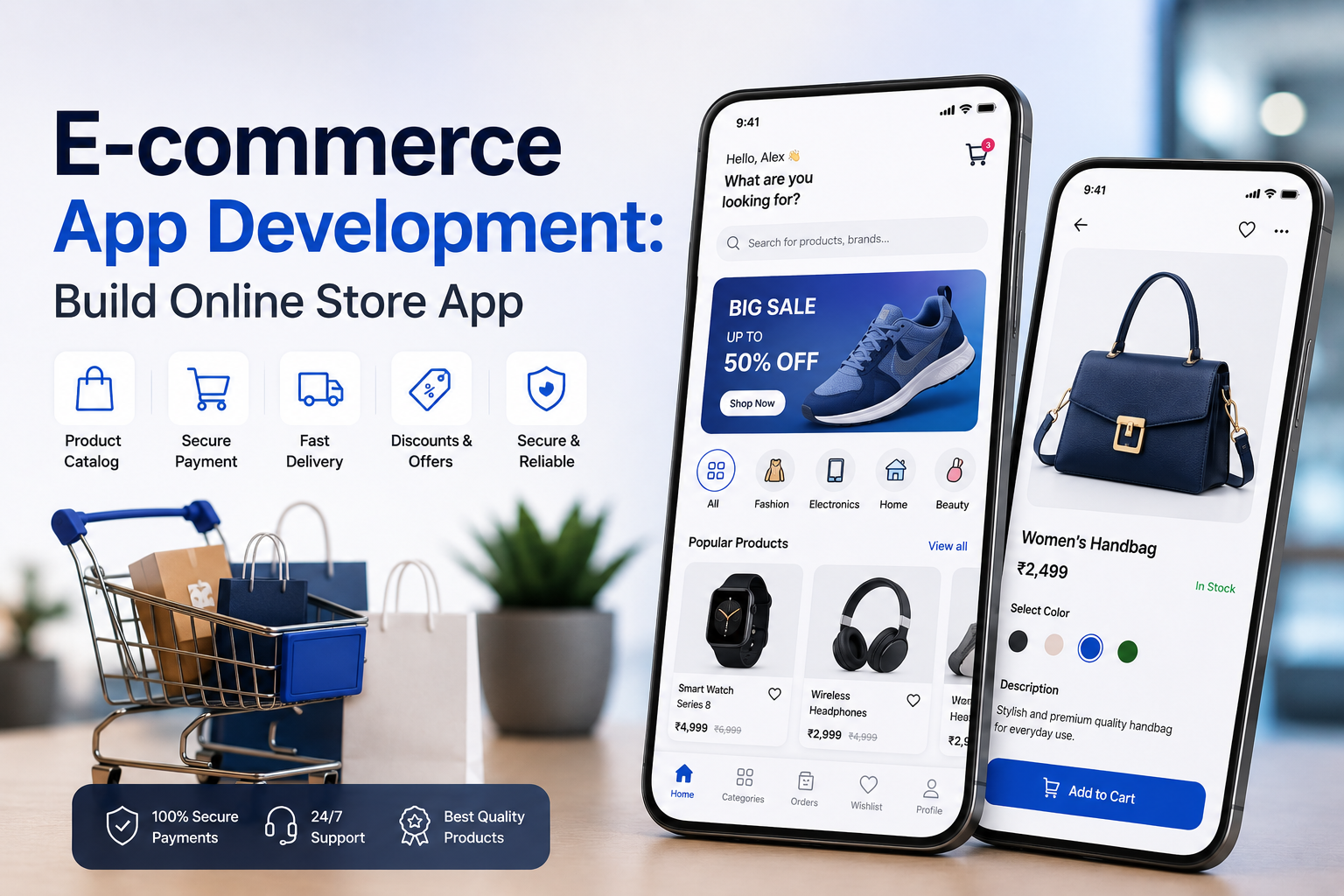
E-commerce mobile applications have transformed the way customers shop online. Whether you're launching a single-brand online store, a multi-vendor marketplace, or a D2C shopping platform, this comprehensive guide explains everything you need to know about e-commerce app development—from planning and features to technology, costs, and future trends.
Introduction
The e-commerce industry has experienced remarkable growth over the last decade, changing how people discover, compare, and purchase products. Today, customers expect a fast, secure, and personalized shopping experience directly from their smartphones. As mobile commerce continues to dominate online retail, businesses of every size are investing in dedicated e-commerce applications to increase sales and improve customer engagement.
Whether you're a startup launching a new online brand, an established retailer expanding your digital presence, or an entrepreneur building a multi-vendor marketplace similar to Amazon or Flipkart, a well-designed e-commerce app can help you reach more customers and grow your business efficiently.
However, building a successful shopping application requires much more than attractive product pages. It involves intuitive user experience, secure payment processing, inventory management, order tracking, push notifications, analytics, and scalable backend infrastructure.
In this complete guide, you'll learn everything about E-commerce App Development, including business models, must-have features, technology stack, development process, estimated costs, and emerging trends shaping the future of online shopping.
At Argenius, we develop secure, scalable, and high-performance e-commerce applications that help businesses create exceptional shopping experiences while supporting long-term growth.
What is an E-commerce App?
An e-commerce app is a mobile application that enables customers to browse products, place orders, make secure payments, and track deliveries using their smartphones.
Unlike a traditional website, an app offers a faster, more personalized shopping experience with features such as push notifications, saved preferences, loyalty programs, and one-click checkout.
A complete e-commerce platform generally includes:
- Customer Mobile App
- Vendor Dashboard
- Admin Panel
- Inventory Management System
- Payment Gateway
- Order Management System
- Shipping Integration
- Analytics Dashboard
Together, these components automate the complete online shopping process while improving customer satisfaction and operational efficiency.
Types of E-commerce Apps
Different businesses require different e-commerce solutions based on their products, target audience, and business model.
B2C (Business-to-Consumer) Apps
B2C applications allow businesses to sell products directly to consumers.
Popular examples include fashion stores, electronics retailers, grocery delivery services, and beauty brands.
Key benefits include:
- Direct customer sales
- Brand control
- Personalized shopping
- Customer loyalty programs
- Better profit margins
B2B (Business-to-Business) Apps
These applications enable wholesalers, manufacturers, and distributors to sell products in bulk to businesses.
Common features include:
- Bulk Ordering
- Custom Pricing
- Business Accounts
- Invoice Management
- Credit Payment Options
Multi-Vendor Marketplace Apps
Marketplace applications allow multiple sellers to list and sell products through a single platform.
Common features include:
- Vendor Registration
- Product Listings
- Commission Management
- Seller Dashboard
- Order Management
- Customer Reviews
This model is ideal for entrepreneurs planning to build platforms similar to Amazon, Flipkart, or Etsy.
Direct-to-Consumer (D2C) Apps
D2C apps help brands sell directly to customers without relying on third-party marketplaces.
Benefits include:
- Better customer relationships
- Higher profit margins
- Complete brand ownership
- Customer data insights
- Personalized marketing
Subscription-Based Shopping Apps
Subscription commerce is becoming increasingly popular across industries such as groceries, beauty, healthcare, and pet supplies.
Examples include:
- Monthly product boxes
- Membership-based shopping
- Auto-renewal purchases
- Scheduled deliveries
How an E-commerce App Works
Although online shopping appears simple, several interconnected systems work together behind the scenes.
A typical shopping workflow includes:
- Customer creates an account.
- Products are displayed by category.
- Customer searches or browses products.
- Items are added to the shopping cart.
- Checkout is completed.
- Payment is processed securely.
- Order is confirmed.
- Seller prepares the shipment.
- Shipping partner delivers the order.
- Customer tracks delivery.
- Ratings and reviews are submitted.
Every stage requires seamless communication between mobile applications, backend servers, payment gateways, and logistics providers.
Business Models
Choosing the right revenue model is essential for long-term business growth.
Product Sales
Businesses earn revenue by selling products directly to customers.
This model is commonly used by D2C brands and online retailers.
Marketplace Commission
Marketplace owners charge vendors a commission for every successful order.
This model supports scalable growth while attracting multiple sellers.
Subscription Model
Customers pay recurring membership fees to receive exclusive benefits such as:
- Free Shipping
- Member Discounts
- Early Product Access
- Premium Customer Support
- Exclusive Offers
Recurring subscriptions create predictable revenue streams.
Advertising Revenue
Vendors can pay to promote products through sponsored listings, featured banners, or homepage advertisements.
Advertising becomes an additional source of income for marketplace owners.
Membership Plans
Businesses may also offer premium memberships that provide loyalty rewards, cashback offers, exclusive sales, and personalized shopping benefits.
Essential Customer App Features
The customer application should deliver a smooth, engaging, and secure shopping experience.
Essential features include:
- User Registration
- Social Login
- Product Search
- Smart Filters
- Product Categories
- Wishlist
- Shopping Cart
- Secure Checkout
- Multiple Payment Methods
- Coupon Codes
- Order Tracking
- Order History
- Product Reviews
- Ratings
- Push Notifications
- Return & Refund Requests
- Customer Support
These features simplify the buying journey while increasing customer satisfaction and repeat purchases.
Vendor App Features
A dedicated vendor application helps sellers efficiently manage their products and orders.
Important features include:
- Vendor Registration
- Product Management
- Inventory Tracking
- Order Processing
- Sales Dashboard
- Offer & Discount Management
- Customer Communication
- Return Management
- Sales Reports
- Performance Analytics
These tools enable vendors to manage daily operations efficiently while improving business performance.
Admin Panel Features
The admin dashboard serves as the central control system for the entire e-commerce platform.
Core functionalities include:
- Dashboard Overview
- Customer Management
- Vendor Management
- Product Management
- Category Management
- Order Monitoring
- Payment Management
- Coupon Management
- Banner Management
- Reports & Analytics
- Complaint Resolution
- Notification Management
A powerful admin panel helps administrators maintain platform performance while supporting long-term business growth.
Recommended Technology Stack
Selecting the right technology stack is critical for building a scalable and secure e-commerce application.
Mobile Development
- Flutter
- React Native
- Kotlin
- Swift
Backend Development
Database
Cloud Infrastructure
- AWS
- Google Cloud Platform
- Microsoft Azure
Real-Time Services
Payment Integration
Shipping & Logistics
- Shiprocket
- Delhivery
- Easyship
Using modern technologies ensures faster performance, stronger security, and easier scalability as your business grows.
Why Businesses Invest in E-commerce Apps
Mobile shopping continues to grow rapidly, making e-commerce apps an essential investment for modern businesses.
Some key benefits include:
- Increased mobile sales
- Better customer engagement
- Higher conversion rates
- Personalized shopping experiences
- Secure digital payments
- Faster checkout process
- Improved customer retention
- Data-driven business insights
- Enhanced brand visibility
- Competitive advantage
Businesses with dedicated e-commerce applications are better positioned to meet evolving customer expectations while building long-term customer loyalty.
E-commerce App Development Process
Building a successful e-commerce application requires strategic planning, intuitive design, scalable architecture, and continuous optimization. A structured development process ensures that your online store app delivers a seamless shopping experience while supporting future business growth.
1. Business Analysis & Planning
Every successful e-commerce project starts with understanding business goals, customer expectations, and market competition.
This phase includes:
- Market Research
- Competitor Analysis
- Business Model Selection
- Feature Planning
- Budget Estimation
- Project Roadmap
2. UI/UX Design
A clean, user-friendly interface plays a vital role in improving conversions and customer satisfaction.
The design process includes:
- User Journey Mapping
- Wireframes
- Interactive Prototypes
- Mobile UI Design
- Vendor Dashboard Design
- Admin Panel Design
A well-designed interface helps customers browse products, complete purchases, and return for future shopping.
3. Backend Development
The backend manages the complete e-commerce ecosystem, including products, orders, payments, users, and inventory.
Core backend modules include:
- User Authentication
- Product Catalog Management
- Inventory Management
- Shopping Cart
- Order Processing
- Payment Management
- Shipping Integration
- Notification Services
- Reports & Analytics
4. Mobile App Development
Separate applications can be developed for different user roles.
- Customer App
- Vendor App
- Delivery Partner App (Optional)
Frameworks like Flutter and React Native allow businesses to launch on both Android and iOS using a shared codebase, reducing development time and cost.
5. Testing & Quality Assurance
Before launching the application, thorough testing is performed to ensure stability and performance.
Testing includes:
- Functional Testing
- UI Testing
- Performance Testing
- Security Testing
- API Testing
- Device Compatibility Testing
- Payment Flow Testing
6. Deployment
Once testing is complete, the application is deployed to production.
Deployment includes:
- Google Play Store Publishing
- Apple App Store Publishing
- Cloud Server Configuration
- SSL Certificate Setup
- Performance Monitoring
7. Maintenance & Continuous Improvement
Launching the app is just the beginning. Continuous maintenance helps keep the application secure, fast, and competitive.
Maintenance services include:
- Bug Fixes
- Feature Updates
- Performance Optimization
- Security Patches
- Server Monitoring
- Technical Support
Cost of E-commerce App Development
The cost of developing an e-commerce application depends on features, platforms, integrations, and business requirements.
| App Type |
Estimated Cost |
| Basic MVP |
$8,000 – $15,000 |
| Standard Online Store |
$15,000 – $35,000 |
| Multi-Vendor Marketplace |
$35,000 – $80,000 |
| Enterprise E-commerce Solution |
Custom Pricing |
Factors affecting development cost include:
- Android & iOS Support
- Custom UI/UX
- Number of Features
- Third-Party Integrations
- AI Capabilities
- Vendor Management
- Cloud Infrastructure
- Ongoing Maintenance
Development Timeline
The timeline varies depending on project complexity and customization.
| Development Phase |
Estimated Duration |
| Planning & Research |
1–2 Weeks |
| UI/UX Design |
2–4 Weeks |
| Backend Development |
4–8 Weeks |
| Mobile App Development |
6–10 Weeks |
| Testing |
2–3 Weeks |
| Deployment |
1 Week |
A complete production-ready e-commerce application generally takes 3–6 months to build.
Essential API Integrations
Modern e-commerce apps depend on reliable third-party integrations to provide secure and efficient shopping experiences.
Payment Gateways
Shipping & Logistics
- Shiprocket
- Delhivery
- Easyship
Authentication
- Firebase Authentication
- Google Sign-In
- Apple Sign-In
Notifications
- Firebase Cloud Messaging (FCM)
- OneSignal
Communication
Analytics
- Firebase Analytics
- Google Analytics
These APIs reduce development effort while improving reliability and scalability.
AI Features for E-commerce Apps
Artificial Intelligence is redefining online shopping by delivering highly personalized experiences.
Popular AI-powered capabilities include:
- Personalized Product Recommendations
- AI-Based Product Search
- Smart Chatbots
- Customer Behavior Analysis
- Dynamic Pricing
- Inventory Forecasting
- Fraud Detection
- Predictive Analytics
- Personalized Offers
- Smart Upselling & Cross-Selling
AI helps businesses increase conversions, improve customer retention, and optimize operations.
Security Best Practices
E-commerce applications handle sensitive customer information and payment data, making security a top priority.
Recommended security measures include:
- HTTPS Encryption
- Secure User Authentication
- Multi-Factor Authentication (MFA)
- PCI DSS-Compliant Payment Processing
- JWT Authentication
- Data Encryption
- API Rate Limiting
- Input Validation
- Secure Cloud Storage
- Regular Security Audits
Strong security practices protect both customer data and business reputation.
Common Challenges
Developing an e-commerce application comes with technical and operational challenges.
Some common challenges include:
- Managing Large Product Catalogs
- Inventory Synchronization
- Payment Failures
- High Traffic During Sales
- Shipping Delays
- Return & Refund Management
- Multi-Vendor Coordination
- Customer Support
- Scalability
- Performance Optimization
Planning for these challenges early helps ensure a smooth shopping experience.
E-commerce App vs E-commerce Website
Although both serve online shoppers, they provide different user experiences.
| Feature |
E-commerce App |
E-commerce Website |
| Installation |
Required |
Not Required |
| Performance |
Faster |
Browser Dependent |
| Push Notifications |
Yes |
Limited |
| Offline Access |
Partial |
No |
| User Experience |
Personalized |
Standard |
| Customer Retention |
Higher |
Moderate |
Many successful businesses use both an app and a website to maximize reach and customer engagement.
Benefits of Having an E-commerce App
Launching a dedicated e-commerce app offers numerous business advantages.
Key benefits include:
- Increased Mobile Sales
- Better Customer Engagement
- Faster Checkout
- Personalized Shopping
- Improved Customer Loyalty
- Higher Conversion Rates
- Secure Digital Payments
- Real-Time Order Tracking
- Better Brand Visibility
- Data-Driven Marketing Decisions
A mobile app creates a more convenient shopping experience, encouraging repeat purchases and long-term customer relationships.
Future Trends in E-commerce App Development
The future of mobile commerce is driven by innovation and evolving customer expectations.
Emerging trends include:
- AI Shopping Assistants
- Voice Commerce
- Augmented Reality (AR) Product Previews
- Social Commerce
- One-Click Checkout
- Headless Commerce
- Omnichannel Shopping
- Blockchain for Secure Transactions
- Live Shopping Experiences
- Sustainable E-commerce Solutions
Businesses that embrace these technologies will be better positioned to compete in the evolving digital marketplace.
Why Businesses Choose Argenius
Building a successful e-commerce application requires expertise in mobile development, secure payment systems, cloud infrastructure, and scalable architecture.
At Argenius, we specialize in creating custom e-commerce solutions for startups, retailers, wholesalers, D2C brands, and multi-vendor marketplaces. Our services include UI/UX design, Android and iOS app development, backend development, payment gateway integration, inventory management, shipping integrations, AI-powered features, cloud deployment, and ongoing maintenance.
Whether you're launching a niche online store or building a marketplace similar to Amazon or Flipkart, our team delivers scalable, secure, and future-ready solutions designed to support long-term business growth.
Final Thoughts
E-commerce applications have become a powerful tool for businesses looking to increase sales, strengthen customer relationships, and build a sustainable digital presence.
From intuitive product browsing and secure payments to AI-powered recommendations and real-time order tracking, modern e-commerce apps offer customers a seamless shopping experience while helping businesses streamline operations.
Choosing the right technology stack, development strategy, and experienced partner can make a significant difference in your project's success.
At Argenius, we transform innovative e-commerce ideas into high-performance mobile applications that are secure, scalable, and built to grow alongside your business.
Frequently Asked Questions
How much does it cost to develop an e-commerce app?
The cost varies based on features and complexity. A basic MVP may cost $8,000–$15,000, while advanced multi-vendor platforms can exceed $80,000.
How long does it take to build an e-commerce app?
A production-ready application generally takes 3–6 months, depending on features, integrations, and customization.
Which technology is best for e-commerce app development?
Flutter and React Native are popular choices for cross-platform development, while Laravel or Node.js provide scalable backend solutions. Firebase, MySQL, and AWS are commonly used for real-time services and cloud hosting.
What features are essential for an e-commerce app?
Core features include user registration, product catalog, search and filters, shopping cart, secure checkout, payment gateway integration, order tracking, reviews, wishlist, push notifications, and an admin dashboard.
Can I build a marketplace like Amazon or Flipkart?
Yes. A custom multi-vendor marketplace can include vendor onboarding, commission management, product catalogs, order processing, analytics, and secure payment systems tailored to your business model.
Is AI useful for e-commerce applications?
Yes. AI enhances customer experience through personalized product recommendations, intelligent search, chatbots, demand forecasting, fraud detection, and dynamic pricing.
Can Argenius develop a custom e-commerce application?
Yes. Argenius offers end-to-end e-commerce app development services, including UI/UX design, Android and iOS development, backend systems, payment integration, shipping solutions, cloud deployment, testing, and long-term maintenance.