Not sure whether to launch your mobile app on Android or iOS first? This comprehensive guide compares both platforms based on users, development cost, revenue potential, security, performance, and business goals to help you make the right decision.
Introduction
Launching a mobile application is one of the most important decisions a business can make in today's digital landscape. Whether you're building an e-commerce app, healthcare platform, food delivery service, fintech solution, education portal, or social networking application, one question always comes first:
Should you launch on Android or iOS first?
There isn't a universal answer because the right platform depends on your target audience, budget, business model, market location, and long-term growth strategy. Choosing the wrong platform can delay your launch, increase development costs, or limit your ability to reach the right users.
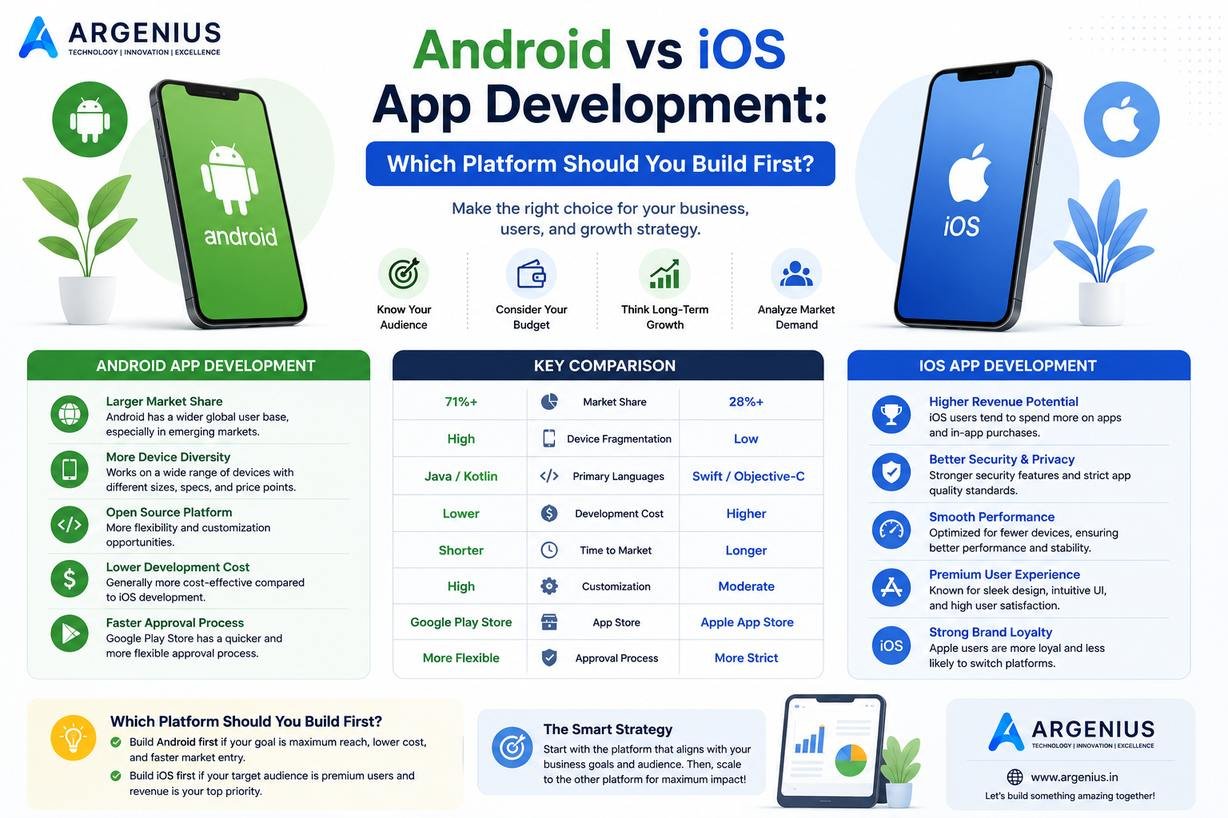
Android dominates the global smartphone market with billions of active devices, while iOS users generally spend more on apps and digital services. Both ecosystems offer unique opportunities and challenges. Understanding these differences before investing in development helps businesses maximize their return on investment.
In this guide, we'll compare Android and iOS app development across every important factor—including development cost, market share, user behavior, security, monetization, maintenance, performance, and scalability—so you can confidently decide which platform is the best fit for your business.
At Argenius, we help startups, enterprises, and growing businesses develop high-performance mobile applications for Android, iOS, and cross-platform frameworks like Flutter, ensuring every project aligns with business objectives and future growth.
Android vs iOS: A Quick Overview
Although both Android and iOS serve the same purpose, they are built on different ecosystems.
Android
Android is Google's mobile operating system and powers smartphones from brands like Samsung, OnePlus, Xiaomi, Vivo, Oppo, Motorola, Realme, and many others.
Key advantages include:
- Largest global market share
- Wide variety of devices
- Flexible customization
- Lower entry barrier
- Massive user base
- Ideal for global expansion
iOS
iOS is Apple's mobile operating system available exclusively on iPhones.
Key advantages include:
- Premium user experience
- Strong security
- High-paying customer base
- Consistent hardware
- Better app optimization
- Faster software adoption
Market Share Comparison
One of the biggest factors when choosing a platform is your target audience.
Android dominates worldwide
Android holds the majority of the global smartphone market, making it ideal for businesses targeting:
- India
- Southeast Asia
- Africa
- South America
- Middle East
If your goal is maximum reach, Android is usually the stronger choice.
iOS dominates premium markets
iOS performs exceptionally well in:
- United States
- Canada
- Australia
- United Kingdom
- Japan
- Western Europe
Businesses targeting premium customers often prioritize iOS because Apple users generally spend more on apps and subscriptions.
Development Cost Comparison
Budget is often one of the first considerations.
Android Development
Android development can require more testing because there are thousands of different devices, screen sizes, and manufacturers.
This may increase:
- Testing effort
- UI optimization
- Quality assurance
- Maintenance
iOS Development
Apple devices are limited in number, making testing simpler.
Advantages include:
- Faster testing
- Easier optimization
- Predictable performance
- Lower maintenance complexity
For many projects, iOS development can require fewer testing resources than Android.
Which Platform Generates More Revenue?
This surprises many business owners.
Although Android has more users, iOS users generally spend more money.
Revenue sources include:
- Paid apps
- Subscriptions
- In-app purchases
- Premium memberships
- Digital services
If your business model depends on subscriptions or premium purchases, iOS often delivers higher revenue per user.
Which Platform Has More Users?
Android
Perfect for:
- Large customer base
- Emerging markets
- Budget smartphones
- Maximum downloads
iOS
Perfect for:
- High-income users
- Business professionals
- Premium customers
- Enterprise applications
Choose based on your customers—not global statistics.
Performance Comparison
Both platforms provide excellent performance when developed correctly.
Android Performance
Modern Android devices offer excellent speed, but performance varies depending on hardware.
Developers must optimize apps for multiple processors and screen sizes.
iOS Performance
Apple controls both hardware and software.
Benefits include:
- Smooth animations
- Better optimization
- Faster updates
- Consistent experience
- Excellent battery optimization
Security Comparison
Security is critical for industries like banking, healthcare, fintech, education, and enterprise software.
Android
Android has improved significantly over the years, but because it supports many manufacturers and allows app installations from different sources, developers must pay extra attention to security best practices.
iOS
Apple maintains strict control over its ecosystem.
Advantages include:
- Strong privacy controls
- Secure App Store review
- Faster security updates
- Better malware protection
For highly sensitive applications, iOS is often considered the more secure platform.
App Store Approval Process
Google Play Store
Publishing is generally faster.
Benefits:
- Quicker approvals
- Easier updates
- Flexible policies
Apple App Store
Apple performs detailed manual reviews.
Advantages:
- Higher app quality
- Better user trust
- Strong ecosystem standards
However, approval may take longer than Android.
Design Guidelines
Each platform has its own design language.
Android
Uses Material Design principles.
Focuses on:
- Flexibility
- Personalization
- Rich interactions
iOS
Uses Apple's Human Interface Guidelines.
Focuses on:
- Simplicity
- Consistency
- Smooth navigation
- Premium user experience
Following platform-specific guidelines improves usability and customer satisfaction.
Maintenance and Updates
Every mobile application requires continuous updates.
Maintenance includes:
- Bug fixes
- OS compatibility
- Security patches
- Performance optimization
- Feature improvements
Android generally requires more testing because of device diversity, while iOS updates are easier to manage due to Apple's controlled ecosystem.
Should You Build Native or Cross-Platform?
Many startups now choose Flutter or React Native to launch Android and iOS apps simultaneously.
Native Development
Advantages:
- Maximum performance
- Better hardware integration
- Platform-specific experience
Best for:
- Gaming apps
- Banking apps
- Enterprise software
- AR/VR applications
Cross-Platform Development
Advantages:
- Faster development
- Lower cost
- Single codebase
- Simultaneous Android & iOS launch
- Easier maintenance
Ideal for:
- Startups
- MVPs
- Business apps
- E-commerce
- Healthcare
- Education
- Food Delivery
- Booking platforms
Android vs iOS Comparison Table
| Feature |
Android |
iOS |
| Global Users |
Very High |
High |
| Revenue Per User |
Medium |
High |
| Development Cost |
Medium |
Medium |
| Device Variety |
Very High |
Limited |
| Security |
High |
Very High |
| Performance |
Excellent |
Excellent |
| App Approval |
Faster |
Stricter |
| Maintenance |
Higher |
Lower |
| Testing |
More Complex |
Simpler |
| Premium Audience |
Medium |
Very High |
Which Platform Should You Choose?
Choose Android if you want:
- Maximum market reach
- Users in India and emerging markets
- Lower-cost smartphones
- Higher download volume
Choose iOS if you want:
- Premium customers
- Subscription-based revenue
- Enterprise users
- High-income markets
Choose Flutter if you want:
- Android + iOS together
- Faster launch
- Lower development cost
- Single codebase
- Easier long-term maintenance
Common Mistakes Businesses Make
Many startups waste time and money because they choose a platform based on assumptions rather than business goals.
Avoid these common mistakes:
- Choosing a platform only because it's popular
- Ignoring target audience location
- Underestimating maintenance costs
- Skipping market research
- Building without an MVP
- Ignoring App Store guidelines
- Overlooking scalability
- Not planning future updates
- Choosing the wrong technology stack
- Ignoring user experience
A clear mobile strategy helps reduce development costs and improves your chances of success.
Why Businesses Choose Argenius
At Argenius, we help startups, enterprises, and growing businesses choose the right mobile app strategy based on their industry, target audience, and long-term goals. Whether you need a native Android app, an iOS application, or a cross-platform solution using Flutter, our team delivers scalable, secure, and high-performance mobile applications tailored to your business needs.
Our services include UI/UX design, mobile app development, API integration, cloud backend development, payment gateway integration, app testing, deployment, ongoing maintenance, and performance optimization. Every application is built with a strong focus on user experience, security, speed, and future scalability.
Final Thoughts
Choosing between Android and iOS isn't about deciding which platform is better—it's about determining which platform is better for your business. Android offers unmatched reach and flexibility, making it ideal for businesses targeting large and diverse audiences. iOS provides access to premium users who are often more willing to spend on digital products and services.
If your budget allows only one platform initially, let your target audience, market location, and monetization strategy guide your decision. If you want to launch quickly while reducing development costs, a cross-platform framework like Flutter can help you reach both Android and iOS users with a single codebase.
At Argenius, we help businesses evaluate their goals and develop mobile applications that deliver exceptional performance, user satisfaction, and measurable business growth. Whether you're launching your first app or scaling an existing product, our team ensures your mobile solution is built for long-term success.
Frequently Asked Questions
Which platform should I launch first, Android or iOS?
It depends on your audience. If you target emerging markets like India, Android is often the better choice. If your focus is on premium users in countries like the US, UK, Canada, or Australia, iOS may deliver better results.
Is Android app development cheaper than iOS?
The overall development cost is often similar, but Android may require additional testing because of the wide variety of devices and screen sizes.
Which platform generates more revenue?
Although Android has more users worldwide, iOS users typically spend more on subscriptions, premium apps, and in-app purchases, resulting in higher average revenue per user.
Should startups choose Flutter instead of native development?
For many startups, Flutter is an excellent option because it allows you to build Android and iOS apps from a single codebase, reducing development time and maintenance costs.
Can Argenius develop apps for both Android and iOS?
Yes. Argenius specializes in Android, iOS, and Flutter app development, delivering secure, scalable, and high-performance mobile applications tailored to your business goals.