Choosing the right app development stack isn't just a technical decision—it impacts your budget, scalability, security, speed, and future business growth. This complete guide explains everything you need to know before building your next mobile or web application.
Introduction
One of the biggest mistakes businesses make isn't choosing the wrong developer—it's choosing the wrong technology stack.
Many startups spend months and thousands of dollars building an application, only to discover later that it can't scale, becomes expensive to maintain, or struggles to support new features. In most cases, the problem isn't the idea itself; it's the technology decisions made at the beginning of the project.
Whether you're planning an eCommerce app, food delivery platform, healthcare solution, fintech application, CRM system, ERP software, social networking platform, or SaaS product, your technology stack forms the foundation of everything that follows. It influences development speed, performance, security, scalability, maintenance costs, hiring, and future upgrades.
The challenge is that there isn't a single "best" technology stack. The right choice depends on your business goals, expected users, feature requirements, budget, timeline, and long-term vision. A startup building an MVP has very different priorities from an enterprise handling millions of users.
This guide explains how to choose the right app development stack, compares the major technologies used today, highlights common mistakes businesses make, and provides a practical framework for making informed technology decisions.
At Argenius, we help businesses choose technology based on business outcomes—not trends—so every application is built for performance, growth, and long-term success.
What Is an App Development Stack?
An App Development Stack is the complete collection of technologies used to build, deploy, and maintain an application.
It usually includes:
- Frontend
- Backend
- Database
- APIs
- Authentication
- Cloud Hosting
- Storage
- DevOps
- Analytics
- Security Tools
- CI/CD Pipeline
Every layer works together to create a complete application.
Think of it like building a house.
- Frontend = Interior Design
- Backend = Foundation
- Database = Storage Room
- APIs = Roads
- Cloud = Land
- Security = Locks & CCTV
If one layer is weak, the entire application suffers.
Why Choosing the Right Tech Stack Matters
A technology stack affects far more than coding.
It determines:
- Development speed
- Initial project cost
- Future maintenance
- Security
- Performance
- Hiring developers
- Scalability
- Cloud expenses
- User experience
- Long-term ROI
Many companies rebuild their applications within a few years simply because they selected technologies without considering future growth.
The Core Components of a Modern App Stack
1. Frontend
The frontend is everything users interact with.
Popular choices include:
| Technology |
Best For |
| React |
Complex Web Apps |
| Next.js |
SEO-Friendly Applications |
| Vue.js |
Lightweight Projects |
| Angular |
Enterprise Software |
| Flutter |
Cross-Platform Mobile Apps |
| Swift |
Native iOS |
| Kotlin |
Native Android |
2. Backend
The backend manages business logic, authentication, APIs, notifications, and data processing.
Popular backend technologies include:
- Laravel
- Node.js
- ASP.NET
- Django
- Spring Boot
- Express.js
The best backend depends on your application's complexity and expected traffic.
3. Database
Your application's data needs a secure and scalable storage system.
Popular databases:
| Database |
Ideal Use |
| MySQL |
Business Applications |
| PostgreSQL |
Enterprise Systems |
| MongoDB |
Flexible Data |
| Firebase |
Real-time Apps |
| Redis |
Caching |
| Elasticsearch |
Search Systems |
4. Cloud Infrastructure
Modern applications rarely run on a single physical server.
Cloud platforms provide:
- Scalability
- Automatic backups
- Global availability
- Security
- Disaster recovery
Popular cloud providers include:
- AWS
- Microsoft Azure
- Google Cloud
5. API Layer
APIs allow different systems to communicate.
Examples include:
- Payment Gateway
- SMS
- WhatsApp
- Google Maps
- Authentication
- Shipping
- AI Services
A well-designed API architecture ensures flexibility and easier integrations in the future.
How to Choose the Right Tech Stack
Rather than selecting technologies based on popularity, evaluate these factors:
Business Goals
Ask yourself:
- Is this an MVP?
- A startup product?
- Enterprise software?
- Internal business tool?
- Consumer mobile app?
The purpose of the application should guide technology decisions.
Expected User Base
Estimate how many users your application will serve.
- Hundreds
- Thousands
- Millions
Higher traffic requires technologies that scale efficiently.
Budget
Every technology has different development and maintenance costs.
Consider:
- Initial development
- Hosting
- Updates
- Security
- Infrastructure
- Licensing (if applicable)
Development Speed
Some technologies enable faster development than others.
For example:
- Flutter accelerates cross-platform mobile development.
- Next.js improves SEO and frontend performance.
- Laravel speeds up backend development with built-in features.
Security Requirements
Applications handling sensitive information should prioritize:
- Encryption
- Multi-factor authentication
- Secure APIs
- Compliance standards
- Role-based access control
Future Scalability
Think beyond launch day.
Ask questions like:
- Will we add new features?
- Will we expand globally?
- Will third-party integrations increase?
- Will traffic grow significantly?
Choosing scalable technologies early prevents costly migrations later.
Recommended Tech Stacks for Different Business Types
| Business Type |
Recommended Stack |
| Startup MVP |
Flutter + Laravel + MySQL |
| SaaS Platform |
React + Laravel + PostgreSQL |
| E-commerce |
Next.js + Laravel + MySQL |
| Healthcare |
Flutter + ASP.NET + PostgreSQL |
| FinTech |
Native Apps + Spring Boot + PostgreSQL |
| Enterprise CRM |
React + Laravel + MySQL |
| Booking Platform |
Flutter + Laravel + Redis |
| Marketplace |
Next.js + Laravel + MySQL |
Common Mistakes Businesses Make
Avoid these costly errors:
- Choosing technology because it's trending.
- Ignoring future scalability.
- Prioritizing low development cost over maintainability.
- Selecting too many technologies.
- Skipping architecture planning.
- Ignoring API-first design.
- Not considering developer availability.
- Underestimating cloud costs.
- Choosing a database without understanding data requirements.
- Forgetting about long-term maintenance.
Build vs Buy: Which Is Better?
Some businesses wonder whether to build everything from scratch or use existing platforms.
Build From Scratch
Best when you need:
- Custom workflows
- Unique business logic
- Long-term scalability
- Full ownership
Buy or Customize
Suitable when:
- Requirements are standard
- Budget is limited
- Time-to-market is critical
Choosing between these options depends on your business priorities.
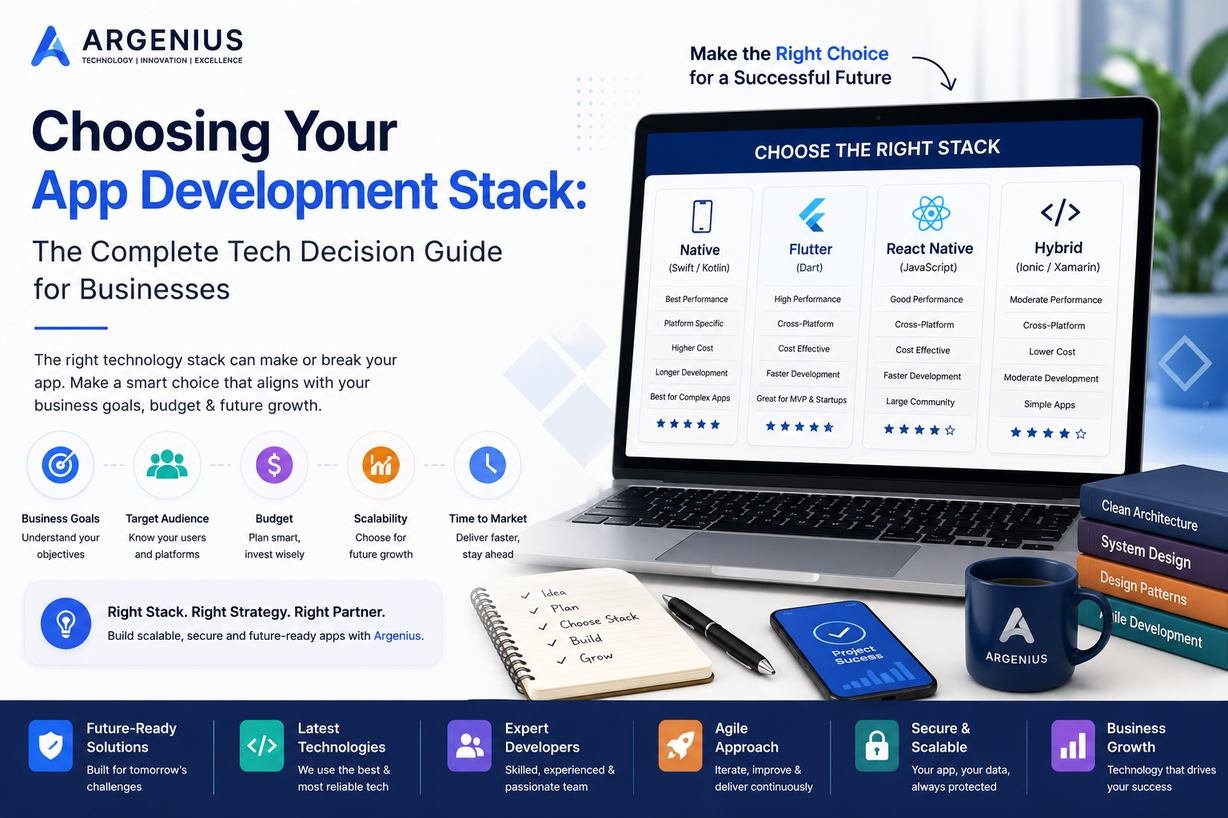
Should You Choose Native or Cross-Platform?
For mobile applications, another important decision is whether to build native apps or use a cross-platform framework.
Native (Swift/Kotlin) is ideal when your app requires maximum performance, advanced hardware integration, or platform-specific features.
Cross-platform (Flutter) works well when you want a single codebase for Android and iOS, faster development, and lower maintenance costs.
The right approach depends on your feature requirements, budget, and long-term roadmap.
Future-Proofing Your Technology Stack
Technology evolves rapidly, but your application should remain adaptable.
Choose technologies that offer:
- Active community support
- Regular updates
- Strong documentation
- Scalable architecture
- Cloud compatibility
- Easy integration with emerging technologies such as AI and automation
Planning for future growth reduces technical debt and extends the lifespan of your application.
Why Businesses Choose Argenius
Choosing the right technology stack is one of the most important decisions in any software project, and that's where Argenius adds value. Instead of recommending technologies based on trends, our team evaluates your business model, target audience, scalability requirements, budget, timeline, and long-term product vision.
We design complete technology architectures covering frontend, backend, databases, APIs, cloud infrastructure, security, DevOps, and deployment. Whether you're building a startup MVP, an enterprise platform, or a large-scale marketplace, we recommend the most efficient stack to maximize performance, reduce maintenance costs, and support future growth.
Final Thoughts
Your app's success doesn't depend solely on great design or innovative features—it begins with a solid technology foundation. The right app development stack can reduce costs, speed up development, simplify maintenance, improve security, and prepare your business for future expansion.
There is no universal technology stack that fits every project. A startup validating an idea may prioritize rapid development and affordability, while an enterprise application may require advanced security, scalability, and complex integrations.
The smartest approach is to align technology decisions with business objectives rather than following industry trends. By carefully evaluating your requirements and selecting technologies that support both current needs and future growth, you can build an application that delivers long-term value.
At Argenius, we help businesses make informed technology decisions and build secure, scalable, and high-performing applications that are ready for the future.
Frequently Asked Questions
What is an app development stack?
An app development stack is the combination of frontend, backend, database, cloud infrastructure, APIs, and other technologies used to build and run an application.
Which tech stack is best for a startup?
For many startups, a stack such as Flutter + Laravel + MySQL offers a good balance of development speed, cost-effectiveness, and scalability. However, the ideal choice depends on your product and business goals.
Should I choose Flutter or native development?
Flutter is a strong choice for cross-platform apps with a single codebase, while native development (Swift and Kotlin) is better for applications requiring maximum performance or deep hardware integration.
How important is cloud infrastructure?
Cloud infrastructure is essential for modern applications because it enables scalability, reliability, automated backups, security, and high availability.
Can Argenius help me choose the right technology stack?
Yes. Argenius provides technology consulting, architecture planning, and end-to-end web and mobile app development, helping businesses select the most suitable stack for their requirements.