Looking for the best cross-platform framework for your mobile app? Compare Flutter, React Native, and Xamarin based on performance, UI, development speed, scalability, cost, and business use cases to make an informed decision.
Introduction
The mobile app industry has changed dramatically over the last decade. Earlier, businesses had to build separate applications for Android and iOS, which meant maintaining two different codebases, hiring separate development teams, and investing significantly more time and money.
Today, cross-platform app development has transformed how mobile applications are built. Developers can now create Android and iOS apps from a single codebase, reducing development costs while accelerating time to market.
Among the many cross-platform technologies available, Flutter, React Native, and Xamarin have emerged as the most recognized frameworks. Each offers unique advantages depending on your project's goals, budget, technical requirements, and expected scale.
While Flutter is known for its beautiful UI and outstanding performance, React Native is favored for JavaScript-based development and large community support. Xamarin, backed by Microsoft, has long been a reliable option for enterprise applications built on the .NET ecosystem.
However, choosing the right framework isn't simply about popularity. It requires evaluating performance, user experience, development speed, maintenance, scalability, security, and long-term business needs.
In this complete guide, we'll compare Flutter, React Native, and Xamarin across every important aspect to help you select the ideal framework for your next mobile application.
At Argenius, we build scalable cross-platform mobile applications using modern frameworks that deliver excellent performance, lower development costs, and exceptional user experiences for startups, SMEs, and enterprises.
What Is Cross-Platform App Development?
Cross-platform app development is the process of building a mobile application using a single codebase that works on multiple operating systems, primarily Android and iOS.
Instead of developing two independent applications, developers write the code once and deploy it across multiple platforms.
Benefits include:
- Lower development cost
- Faster launch
- Single codebase
- Easier maintenance
- Simultaneous Android & iOS release
- Consistent user experience
- Faster feature updates
This approach is ideal for businesses looking to reach a wider audience while optimizing development resources.
What Is Flutter?
Flutter is Google's open-source UI toolkit that allows developers to create high-performance applications for Android, iOS, web, desktop, and embedded platforms from a single codebase.
Flutter uses the Dart programming language and includes its own rendering engine, allowing developers to create visually rich interfaces with smooth animations and near-native performance.
Key Features of Flutter
- Single Codebase
- Beautiful UI Components
- Hot Reload
- Native Performance
- Custom Widgets
- Strong Community
- Google Support
- Web & Desktop Support
Flutter has become one of the most preferred frameworks for startups and businesses because of its speed, flexibility, and excellent UI capabilities.
What Is React Native?
React Native is an open-source framework developed by Meta that enables developers to build mobile applications using JavaScript and React.
Instead of rendering everything from scratch, React Native uses native UI components, providing users with an experience that feels close to a fully native application.
Key Features of React Native
- JavaScript-Based Development
- Reusable Components
- Fast Development
- Large Ecosystem
- Strong Community Support
- Third-Party Plugin Support
- Hot Reloading
- Native Module Integration
React Native is particularly attractive for businesses with existing React web development teams.
What Is Xamarin?
Xamarin is Microsoft's cross-platform development framework built on the .NET ecosystem.
Developers create applications using C# and share a significant portion of the code across Android and iOS.
Although newer technologies like .NET MAUI are gradually replacing Xamarin for future development, many enterprises still maintain and support Xamarin-based applications, especially those deeply integrated with Microsoft technologies.
Key Features of Xamarin
- C# Programming
- .NET Integration
- Native API Access
- Enterprise Security
- Microsoft Ecosystem
- Shared Codebase
- Visual Studio Support
Xamarin remains relevant for organizations already invested in Microsoft infrastructure.
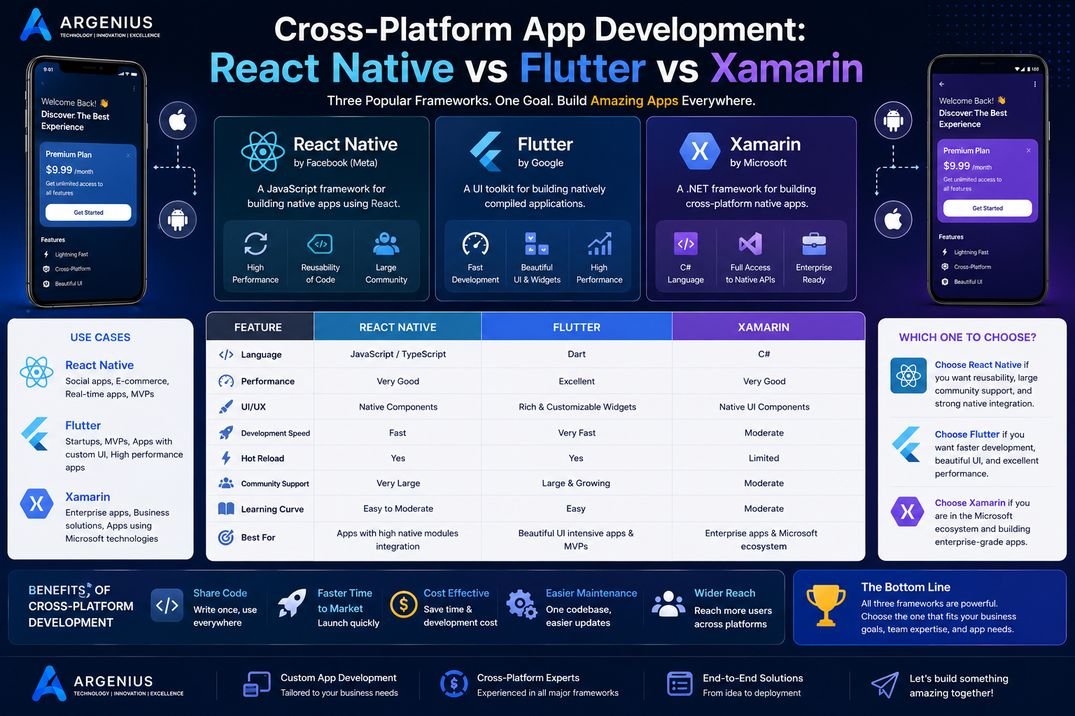
Flutter vs React Native vs Xamarin Comparison
| Feature |
Flutter |
React Native |
Xamarin |
| Developer |
Google |
Meta |
Microsoft |
| Programming Language |
Dart |
JavaScript |
C# |
| Performance |
Excellent |
Very Good |
Good |
| UI Flexibility |
Excellent |
Very Good |
Good |
| Native Feel |
Excellent |
Excellent |
Good |
| Development Speed |
Fast |
Fast |
Moderate |
| Learning Curve |
Moderate |
Easy (for JS developers) |
Moderate |
| Community Support |
Excellent |
Excellent |
Moderate |
| Enterprise Support |
High |
High |
High |
| Long-Term Popularity |
Very High |
High |
Declining (moving toward .NET MAUI) |
Performance Comparison
Performance is one of the biggest considerations when selecting a framework.
Flutter
Flutter delivers excellent performance because it uses its own rendering engine rather than relying on native UI components.
Benefits include:
- Smooth animations
- Fast rendering
- Consistent performance
- Better graphics handling
- Excellent responsiveness
Flutter is particularly well-suited for applications with custom interfaces and animation-heavy designs.
React Native
React Native performs well for most business applications by leveraging native UI components.
Advantages include:
- Native-like experience
- Good responsiveness
- Mature ecosystem
- Strong plugin support
However, highly graphics-intensive apps may require additional native optimizations.
Xamarin
Xamarin offers good performance, especially for enterprise applications integrated with Microsoft's ecosystem.
It works well for:
- Internal business apps
- Enterprise tools
- Corporate solutions
- Business management systems
For modern consumer-facing applications, Flutter and React Native are generally preferred.
User Interface and Design
User experience often determines whether users continue using an application.
Flutter
Flutter gives developers complete control over the UI.
Advantages include:
- Rich animations
- Beautiful widgets
- Highly customizable layouts
- Consistent design across platforms
React Native
React Native relies on native components, allowing applications to feel familiar on both Android and iOS.
It is ideal for apps that closely follow platform-specific design guidelines.
Xamarin
Xamarin provides native UI capabilities but offers fewer modern UI customization options compared to Flutter.
Development Speed
Launching quickly is often a business priority.
Flutter
Development is fast because:
- Hot Reload
- Rich widget library
- Single codebase
- Extensive documentation
React Native
React Native also supports rapid development through reusable components and JavaScript's extensive ecosystem.
Xamarin
Development can be slightly slower due to additional configuration and enterprise-focused workflows.
Maintenance
Maintenance costs continue long after launch.
Flutter
- Single codebase
- Easy updates
- Faster bug fixes
- Lower maintenance cost
React Native
- Shared code
- Large plugin ecosystem
- Efficient updates
Xamarin
- Stable maintenance
- Enterprise-friendly support
- Best suited for organizations using Microsoft technologies
Security
Security is essential for every mobile application.
All three frameworks support:
- SSL Encryption
- Secure Authentication
- API Security
- Biometric Login
- Secure Storage
- Token-Based Authentication
For enterprise environments, additional backend security architecture is often more important than the framework itself.
Which Framework Is Best for Startups?
For startups, priorities usually include:
- Lower cost
- Faster launch
- MVP development
- Easier maintenance
- Scalability
Flutter often stands out because it combines high performance, modern UI, and rapid development from a single codebase.
React Native is also an excellent choice, especially if your development team already has experience with JavaScript and React.
Which Framework Is Best for Enterprises?
Enterprise applications often require:
- Security
- Scalability
- Long-term support
- Backend integrations
- Business process automation
Flutter and React Native are increasingly being adopted for enterprise-grade applications, while organizations already invested in Microsoft's ecosystem may benefit from .NET MAUI as the modern successor to Xamarin.
When Should You Choose Flutter?
Flutter is ideal for:
- Startup Apps
- E-commerce
- Food Delivery
- Healthcare
- Education
- Fintech
- Travel Apps
- Booking Platforms
- Custom UI Applications
- MVP Development
When Should You Choose React Native?
Choose React Native when:
- Your team already uses React
- You need faster web-to-mobile development
- You want strong community support
- Your app relies heavily on existing JavaScript libraries
- You need a mature ecosystem with many third-party packages
When Should You Consider Xamarin or .NET MAUI?
Consider Xamarin (or preferably .NET MAUI for new Microsoft-based projects) when:
- Your business uses Microsoft technologies extensively
- Your backend is built on .NET
- Your team specializes in C#
- You're developing enterprise or internal business applications
- You require seamless integration with Microsoft services
For brand-new projects, .NET MAUI is generally the recommended path over Xamarin.
Common Mistakes Businesses Make
Selecting the wrong framework can lead to unnecessary expenses and technical challenges.
Avoid these common mistakes:
- Choosing a framework based only on popularity
- Ignoring long-term maintenance costs
- Overlooking developer expertise
- Building without scalability planning
- Prioritizing initial cost over future growth
- Ignoring user experience
- Not considering ecosystem support
- Skipping performance testing
- Choosing outdated technologies without evaluating newer alternatives
- Failing to define business requirements before development
A thoughtful evaluation helps ensure your app remains maintainable and scalable for years to come.
Why Businesses Choose Argenius
At Argenius, we help businesses select the right cross-platform technology based on their product vision, budget, target audience, and long-term roadmap. Our team has experience building high-performance mobile applications using Flutter, React Native, and modern .NET technologies, ensuring every solution is scalable, secure, and future-ready.
Our services include product strategy, UI/UX design, cross-platform development, backend APIs, cloud infrastructure, payment gateway integration, testing, deployment, and post-launch maintenance. We focus on delivering mobile applications that not only look great but also perform reliably as your business grows.
Final Thoughts
Cross-platform app development has become the preferred choice for many businesses because it reduces development costs, accelerates launch timelines, and simplifies long-term maintenance. However, the best framework depends on your specific business goals rather than a one-size-fits-all recommendation.
Flutter excels in performance, beautiful user interfaces, and rapid development, making it an excellent choice for startups and modern consumer applications. React Native offers a mature ecosystem and is a strong option for teams already working with JavaScript and React. Xamarin has served enterprise developers well, but for new Microsoft-based projects, .NET MAUI is generally the recommended evolution of the platform.
At Argenius, we help businesses evaluate their technical requirements and choose the framework that delivers the best balance of performance, scalability, development speed, and return on investment—ensuring your mobile application is built for long-term success.
Frequently Asked Questions
What is cross-platform app development?
Cross-platform app development allows developers to build a single application that runs on multiple platforms, such as Android and iOS, using one shared codebase.
Which is better: Flutter or React Native?
Flutter generally offers better UI customization and performance, while React Native is an excellent choice for teams already experienced with JavaScript and React. The best option depends on your project requirements.
Is Xamarin still a good choice?
Xamarin is still used to maintain many enterprise applications, but for new Microsoft-based projects, .NET MAUI is the recommended successor with ongoing development and support.
Which framework is best for startups?
Flutter is a popular choice for startups because it combines fast development, a single codebase, strong performance, and an attractive user interface.
Can Argenius develop apps using Flutter and React Native?
Yes. Argenius develops secure, scalable, and high-performance cross-platform applications using Flutter, React Native, and modern .NET technologies based on your business requirements.