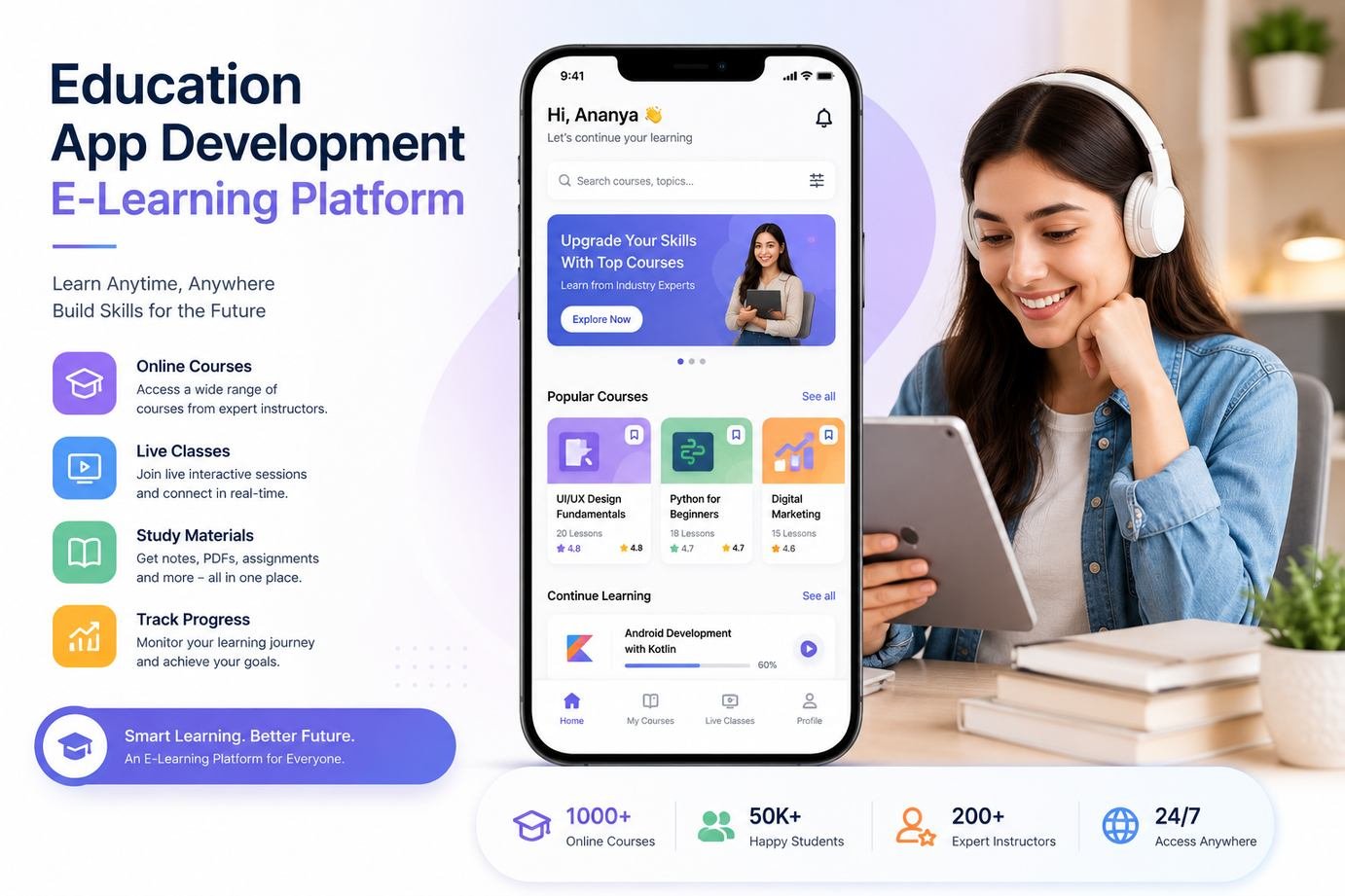
Education apps are transforming the way people learn by making high-quality education accessible anytime and anywhere. Whether you're planning an online learning platform, a virtual classroom, a corporate training solution, or a Learning Management System (LMS), this complete guide covers everything you need to know about education app development, including features, AI capabilities, technology stack, development costs, and future trends.
The education industry has undergone a remarkable digital transformation over the last decade. Students no longer rely solely on traditional classrooms to gain knowledge. Instead, they use smartphones, tablets, and laptops to access online courses, attend live classes, complete assignments, and collaborate with instructors from anywhere in the world.
The rapid growth of online education has encouraged schools, universities, coaching institutes, corporate training providers, and EdTech startups to invest in digital learning platforms. From self-paced video courses and virtual classrooms to AI-powered tutoring systems and Learning Management Systems (LMS), education applications are reshaping how knowledge is delivered and consumed.
Building a successful education app involves much more than uploading video lectures. Modern learners expect interactive content, live sessions, quizzes, assignments, certificates, progress tracking, personalized recommendations, offline learning, and seamless communication with instructors. To meet these expectations, businesses need scalable cloud infrastructure, secure payment systems, AI-driven personalization, and an intuitive user experience.
In this comprehensive guide, you'll learn everything about Education App Development, including different types of education apps, business models, essential features, recommended technology stacks, AI capabilities, development processes, and future industry trends.
At Argenius, we develop secure, scalable, and feature-rich education platforms that help schools, universities, training institutes, and EdTech startups deliver engaging digital learning experiences.
What is Education App Development?
Education app development is the process of designing, developing, testing, and deploying mobile or web applications that help students, teachers, educational institutions, and organizations deliver and access learning resources digitally.
Modern education platforms allow users to:
- Enroll in Online Courses
- Attend Live Classes
- Watch Video Lectures
- Download Study Materials
- Complete Assignments
- Take Online Exams
- Track Learning Progress
- Earn Certificates
- Communicate with Instructors
- Access Learning Anytime
A complete education platform generally includes:
- Student Mobile App
- Instructor Dashboard
- Admin Panel
- Learning Management System (LMS)
- Video Streaming Platform
- Assessment Module
- Notification System
- Analytics Dashboard
Together, these components create a comprehensive digital learning ecosystem that improves accessibility, engagement, and educational outcomes.
Why E-Learning Apps Are Growing Rapidly
The demand for digital education continues to increase as learners seek flexible, affordable, and personalized learning experiences.
Several factors are driving this growth:
- Increasing Internet Accessibility
- Smartphone Adoption
- Remote Learning
- Corporate Upskilling
- Government Digital Education Initiatives
- AI-Powered Learning
- Demand for Skill-Based Courses
- Flexible Learning Schedules
- Affordable Online Education
- Global Reach
These trends make education app development one of the fastest-growing opportunities in the technology industry.
Types of Education Apps
Different education businesses require different types of applications based on their audience and objectives.
E-Learning Platforms
These platforms provide structured online courses that learners can access at their own pace.
Popular features include:
- Video Courses
- Assignments
- Quizzes
- Certificates
- Progress Tracking
This model is ideal for businesses offering professional courses or skill development programs.
Online Course Apps
Online course applications allow instructors to publish and sell digital courses directly to students.
Key features include:
- Course Catalog
- Video Lessons
- Downloads
- Student Reviews
- Course Completion Certificates
Live Class Apps
Live learning platforms enable instructors to conduct real-time online classes.
Essential features include:
- Live Video Sessions
- Screen Sharing
- Chat
- Attendance
- Session Recording
- Interactive Whiteboard
School Management Apps
Schools use dedicated mobile applications to simplify communication between students, parents, and teachers.
Common modules include:
- Attendance
- Homework
- Timetable
- Notices
- Fee Management
- Exam Results
College & University Apps
Higher education institutions use mobile platforms to manage academic activities.
Typical features include:
- Student Portal
- Course Registration
- Examination Schedule
- Library Access
- Assignment Submission
- Notifications
Language Learning Apps
Language learning applications help users improve speaking, reading, writing, and listening skills.
Popular features include:
- Interactive Lessons
- Pronunciation Practice
- Vocabulary Exercises
- Speech Recognition
- Daily Challenges
Skill Development Apps
Professional learning platforms focus on career-oriented skills.
Examples include:
- Programming
- Graphic Design
- Digital Marketing
- Business Skills
- Data Science
- Finance
Exam Preparation Apps
These applications help students prepare for competitive exams through structured practice.
Common features include:
- Mock Tests
- Question Banks
- Performance Analytics
- Daily Practice
- Previous Year Papers
Corporate Training Apps
Organizations use learning platforms to train employees and improve workforce productivity.
Features include:
- Employee Learning Paths
- Certification Programs
- Assessments
- Reports
- Progress Tracking
Kids Learning Apps
Educational applications for children combine learning with engaging visuals and interactive activities.
Popular features include:
- Educational Games
- Storytelling
- Alphabet Learning
- Mathematics Practice
- Animated Lessons
- Parent Dashboard
How an E-Learning Platform Works
Although users experience a simple interface, multiple systems work together behind the scenes.
A typical workflow includes:
- Students register and create an account.
- Users browse or search available courses.
- Courses are purchased or enrolled in.
- Students watch video lessons and attend live classes.
- Assignments and quizzes are completed.
- Progress is automatically tracked.
- Certificates are issued after successful completion.
- Students interact with instructors through discussions or chat.
- Analytics help instructors improve course quality.
This workflow creates an engaging and personalized digital learning experience.
Business Models
Selecting the right monetization strategy is essential for building a profitable education platform.
Course Sales
Students purchase individual courses based on their interests.
This model works well for professional training and certification platforms.
Subscription Plans
Monthly or annual memberships provide unlimited access to multiple courses.
Subscription-based learning offers predictable recurring revenue.
Freemium Model
Basic educational content is available for free, while premium lessons, certificates, and advanced features require payment.
This approach encourages user acquisition while increasing conversion opportunities.
Certification Fees
Many platforms charge separately for verified certificates upon course completion.
Certification adds value for learners while generating additional revenue.
Corporate Training Plans
Organizations subscribe to enterprise learning solutions for employee training and development.
This creates stable, long-term business relationships.
Advertisement Revenue
Free learning platforms can generate income by displaying relevant advertisements or sponsored educational content.
Marketplace Commission
If multiple instructors sell courses on your platform, you can earn a commission from each successful enrollment.
Essential Student App Features
An effective education app should provide an engaging, user-friendly, and interactive learning experience.
Core features include:
- User Registration & Login
- Course Catalog
- Video Lessons
- Live Classes
- Assignments
- Online Quizzes
- Progress Tracking
- Certificates
- Notes & Bookmarks
- Discussion Forum
- Offline Downloads
- Push Notifications
- Secure Payments
These features improve student engagement, learning outcomes, and course completion rates.
Instructor App Features
Instructors need powerful tools to create, manage, and monitor educational content.
Key features include:
- Instructor Registration
- Course Creation
- Video Upload
- Live Class Management
- Student Management
- Assignment Creation
- Quiz Builder
- Earnings Dashboard
- Course Analytics
- Notifications
These capabilities help instructors deliver high-quality learning experiences while managing their courses efficiently.
Admin Panel Features
The admin dashboard serves as the central control system for the entire education platform.
Core functionalities include:
- Dashboard Overview
- User Management
- Instructor Verification
- Course Management
- Payment Management
- Coupon Management
- Content Management System (CMS)
- Reports & Analytics
- Notification Management
- Role & Permission Management
A comprehensive admin panel helps ensure smooth platform operations, content quality, and business growth.
Recommended Technology Stack
Choosing the right technology stack is essential for building a scalable and secure education platform.
Mobile Development
- Flutter
- React Native
- Kotlin
- Swift
Backend Development
Database
Cloud Infrastructure
- AWS
- Google Cloud Platform
- Microsoft Azure
Video & Live Classes
Storage
A modern technology stack ensures reliable video streaming, secure payments, high performance, and long-term scalability.
Education App Development Process
Building a successful education app requires more than just creating video lessons and adding user accounts. A modern e-learning platform should provide a seamless learning experience, support thousands of users simultaneously, ensure secure payments, and deliver engaging educational content across multiple devices.
Whether you're building an online learning platform, a virtual classroom, or a corporate Learning Management System (LMS), following a structured development process is essential.
1. Requirement Analysis & Planning
Every successful education app begins with understanding the target audience, business goals, and learning objectives.
This phase includes:
- Market Research
- Competitor Analysis
- Business Requirement Gathering
- User Persona Development
- Feature Planning
- Monetization Strategy
- Technical Architecture
2. UI/UX Design
Students expect modern, intuitive, and distraction-free learning experiences.
The design phase focuses on:
- User Journey Mapping
- Wireframes
- Interactive Prototypes
- Student App Design
- Instructor Dashboard
- Admin Panel Design
- Responsive Interface
A well-designed interface improves student engagement and course completion rates.
3. Backend Development
The backend powers the entire education platform by managing users, courses, payments, and analytics.
Core backend modules include:
- Authentication
- Course Management
- Student Management
- Instructor Management
- Assignments
- Quizzes
- Certificates
- Payment Management
- Notifications
- Analytics Dashboard
4. Mobile App Development
Most education platforms are launched on both Android and iOS.
Popular technologies include:
- Flutter
- React Native
- Kotlin
- Swift
Cross-platform frameworks help reduce development costs while providing a consistent user experience.
5. API Integration
Third-party integrations enhance platform functionality and improve the overall learning experience.
Popular integrations include:
- Payment Gateway
- Video Streaming
- Push Notifications
- Authentication
- Analytics
- Cloud Storage
- Email Services
6. Testing & Quality Assurance
Before launch, the application should be thoroughly tested to ensure stability and performance.
Testing includes:
- Functional Testing
- UI/UX Testing
- API Testing
- Performance Testing
- Security Testing
- Device Compatibility Testing
- Load Testing
7. Deployment
After successful testing, the application is deployed to production.
Deployment includes:
- Google Play Store
- Apple App Store
- Cloud Hosting
- CDN Configuration
- Monitoring Tools
8. Maintenance & Continuous Improvement
Launching the app is only the beginning. Continuous updates are essential for long-term success.
Post-launch services include:
- Bug Fixes
- Performance Optimization
- New Feature Development
- Security Updates
- Cloud Monitoring
- Technical Support
Education App Development Cost
The cost of building an education app depends on platform complexity, live streaming capabilities, AI features, integrations, and scalability.
Estimated Pricing (INR)
| Platform Type |
Estimated Cost |
| Basic Learning App |
₹5,00,000 – ₹10,00,000 |
| Standard E-Learning Platform |
₹10,00,000 – ₹20,00,000 |
| Advanced Platform (Like Udemy/Coursera) |
₹20,00,000 – ₹45,00,000 |
| Enterprise LMS |
₹45,00,000+ (Custom Pricing) |
Factors Affecting Development Cost
The final project budget depends on several factors:
- Android & iOS Development
- UI/UX Design Complexity
- Live Video Classes
- AI Features
- Video Streaming Infrastructure
- Cloud Hosting
- Third-Party APIs
- Payment Gateway Integration
- Offline Learning
- Maintenance & Support
Development Timeline
The estimated timeline varies based on features and customization.
| Development Phase |
Estimated Duration |
| Planning & Research |
1–2 Weeks |
| UI/UX Design |
2–4 Weeks |
| Backend Development |
5–8 Weeks |
| Mobile App Development |
8–12 Weeks |
| Testing & QA |
2–4 Weeks |
| Deployment |
1 Week |
A production-ready education app generally takes 4–6 months to design, develop, test, and launch.
Essential API Integrations
Modern education platforms rely on third-party APIs to provide secure and feature-rich learning experiences.
Authentication
- Firebase Authentication
- Google Sign-In
- Apple Sign-In
Payments
Video & Live Classes
Notifications
- Firebase Cloud Messaging (FCM)
- OneSignal
Video Hosting
Cloud Storage
Analytics
- Firebase Analytics
- Google Analytics
AI Features for Education Apps
Artificial Intelligence is revolutionizing digital learning by making education more personalized, interactive, and efficient.
Popular AI-powered features include:
- AI Learning Assistant
- AI Course Recommendations
- AI Quiz Generator
- AI Assignment Evaluation
- AI Content Summarization
- AI Doubt Resolution Chatbot
- AI Learning Path Recommendations
- AI Performance Analytics
- AI Speech-to-Text
- AI Language Translation
AI enables educators to deliver personalized learning experiences while helping students achieve better outcomes.
Security Best Practices
Education platforms manage sensitive student information, payment details, and premium learning content, making security a top priority.
Recommended security measures include:
- Secure Authentication
- Multi-Factor Authentication (MFA)
- DRM Video Protection
- Secure APIs
- HTTPS Communication
- Role-Based Access Control
- Data Encryption
- Cloud Backup & Disaster Recovery
- Secure Payment Processing
- Audit Logs
Implementing these practices protects user data and builds trust with students and educational institutions.
Common Challenges
Developing and managing an education platform comes with several technical and operational challenges.
Common challenges include:
- Student Engagement
- Content Security & Piracy
- Video Streaming Performance
- Live Class Stability
- Course Completion Rates
- Platform Scalability
- Payment Management
- Multi-Device Compatibility
- Instructor Onboarding
- Ongoing Maintenance
Addressing these challenges early helps create a reliable and scalable learning platform.
E-Learning Platform vs Learning Management System (LMS)
| Feature |
E-Learning Platform |
Learning Management System (LMS) |
| Primary Users |
Public Learners |
Schools, Universities & Companies |
| Course Sales |
✅ Yes |
Limited |
| Live Classes |
✅ Yes |
✅ Yes |
| Certificates |
✅ Yes |
✅ Yes |
| Employee Training |
Limited |
✅ Yes |
| Learning Analytics |
Advanced |
Advanced |
| Monetization |
Subscription, Course Sales |
Subscription / Enterprise Licensing |
| Scalability |
High |
High |
An e-learning platform is designed to reach a broad audience and generate revenue through course sales, while an LMS is typically used by educational institutions and businesses to manage structured learning programs.
Benefits of Education App Development
Education apps offer significant benefits for students, educators, institutions, and businesses.
Key advantages include:
- Learn Anytime, Anywhere
- Global Student Reach
- Better Learning Experience
- Personalized Learning Paths
- Student Progress Tracking
- Passive Income Through Digital Courses
- Improved Instructor Productivity
- Corporate Employee Training
- Higher Student Engagement
- Scalable Education Business
These benefits make education apps a valuable investment for organizations looking to expand their digital learning services.
Future Trends
The EdTech industry continues to evolve with emerging technologies that improve engagement and learning outcomes.
Key trends include:
- AI-Powered Tutors
- Adaptive Learning Platforms
- AR/VR-Based Education
- Gamification
- Personalized Learning
- Voice-Based Learning Assistants
- Blockchain-Based Certificates
- Microlearning
- Virtual Classrooms
- Learning Analytics & Predictive Insights
Organizations adopting these innovations will be better positioned to deliver future-ready learning experiences.
Why Businesses Choose Argenius
At Argenius, we build secure, scalable, and feature-rich education applications tailored to schools, universities, coaching institutes, corporate training organizations, and EdTech startups.
Our education app development services include:
- Custom E-Learning Platform Development
- Learning Management System (LMS) Development
- Virtual Classroom Solutions
- Online Course Marketplace Development
- AI-Powered Learning Platforms
- Flutter & React Native App Development
- Secure Cloud Infrastructure
- API Integration
- Long-Term Maintenance & Support
Whether you're launching an online course platform, a corporate training portal, or a complete digital learning ecosystem, Argenius delivers innovative solutions that help your business grow.
Final Thoughts
Education technology is redefining how knowledge is delivered and consumed. Modern learners expect flexible, engaging, and personalized experiences that go beyond traditional classrooms. From AI-powered tutoring and live virtual classrooms to certification programs and adaptive learning paths, education apps are creating new opportunities for educators and businesses alike.
Building a successful education platform requires the right technology stack, an intuitive user experience, scalable infrastructure, and continuous innovation. By focusing on learner engagement, security, and performance, businesses can create platforms that deliver long-term value.
If you're planning to build an education app or e-learning platform, partnering with an experienced development company like Argenius can help you transform your vision into a scalable, secure, and future-ready digital learning solution.
Frequently Asked Questions
How much does education app development cost?
A basic education app typically costs ₹5 lakh–₹10 lakh, while advanced e-learning platforms with live classes, AI features, and LMS functionality generally range from ₹20 lakh–₹45 lakh or more, depending on the project scope.
How long does it take to develop an education app?
A production-ready education application generally takes 4–6 months, depending on the number of features, integrations, and customizations.
Which technologies are best for education app development?
Flutter and React Native are excellent for cross-platform mobile apps, while Laravel, Node.js, and Django are widely used for backend development. AWS, Firebase, PostgreSQL, and WebRTC are commonly used for hosting, databases, and real-time communication.
What are the must-have features of an e-learning platform?
Essential features include course management, video lessons, live classes, quizzes, assignments, progress tracking, certificates, secure payments, notifications, and analytics.
How does AI improve education apps?
AI personalizes learning paths, recommends courses, generates quizzes, evaluates assignments, summarizes content, translates lessons, and provides instant assistance through intelligent chatbots.
Can education apps support offline learning?
Yes. Offline downloads allow students to access course materials and videos without an internet connection, making learning more flexible and accessible.
Can Argenius build a custom education platform?
Yes. Argenius develops custom education apps, LMS platforms, virtual classrooms, online course marketplaces, AI-powered learning systems, and enterprise training solutions with end-to-end development and ongoing support.