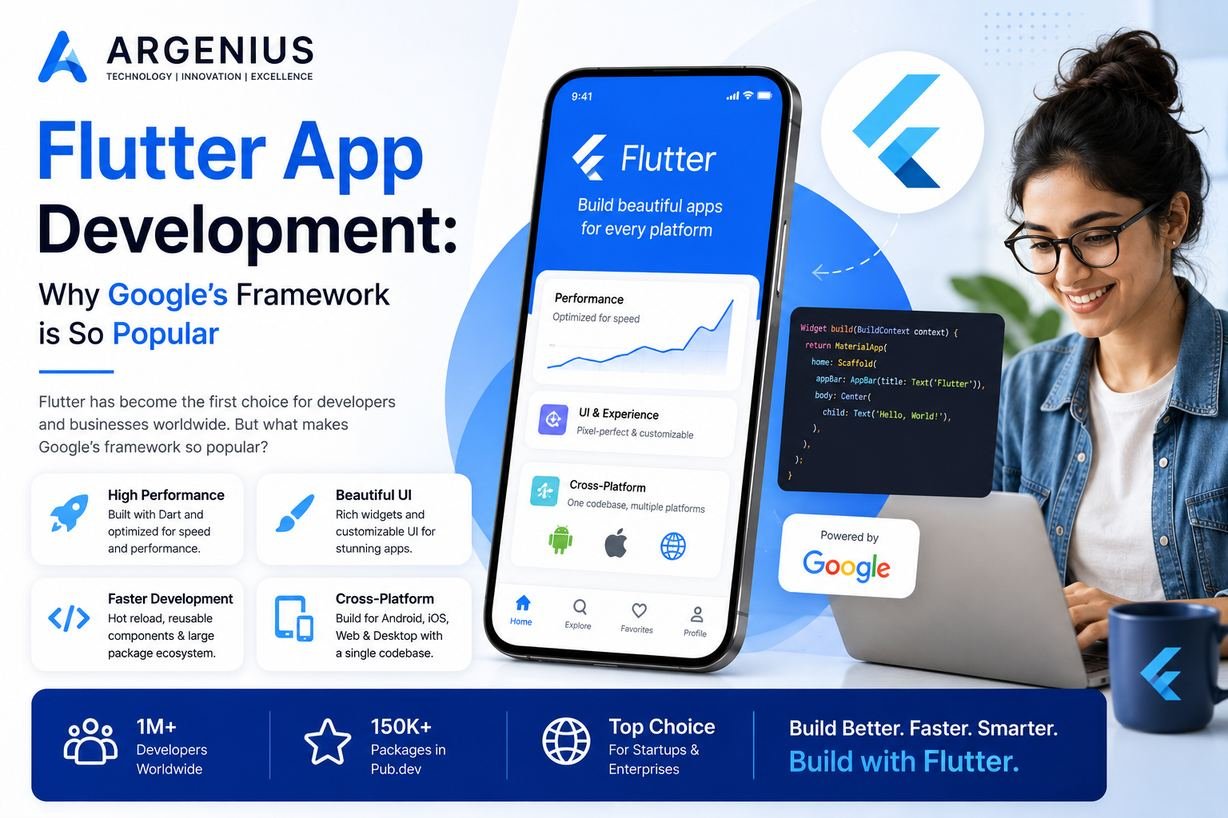
Flutter has transformed cross-platform app development by enabling businesses to build Android, iOS, web, desktop, and embedded applications from a single codebase. Discover why Google's Flutter framework has become a top choice for startups and enterprises worldwide.
Introduction
Building a mobile application for both Android and iOS traditionally required two separate development teams, two codebases, and significantly higher costs. While this approach delivers excellent performance, it also increases development time, maintenance efforts, and long-term expenses.
To solve this challenge, Google introduced Flutter, an open-source UI toolkit that allows developers to build beautiful, high-performance applications for multiple platforms using a single codebase.
Since its release, Flutter has become one of the fastest-growing frameworks for app development. Thousands of startups, enterprises, and global brands use Flutter to create applications that work across Android, iOS, Web, Windows, macOS, Linux, and even embedded devices.
The framework has gained widespread popularity because it combines native-like performance with rapid development, attractive user interfaces, and excellent scalability. Instead of writing separate applications for every platform, businesses can launch products faster while reducing development and maintenance costs.
However, Flutter isn't the perfect solution for every project. Like every technology, it has strengths, limitations, and ideal use cases.
In this complete guide, we'll explore Flutter App Development, explain why Google's framework has become so popular, compare it with other technologies, discuss real-world business applications, and help you decide whether Flutter is the right choice for your next project.
At Argenius, we build scalable Flutter applications that help businesses launch faster, reduce costs, and deliver exceptional user experiences across multiple platforms.
What Is Flutter?
Flutter is Google's open-source UI toolkit for developing applications from a single codebase.
Unlike traditional cross-platform frameworks, Flutter doesn't rely on native UI components. Instead, it renders everything using its own high-performance rendering engine called Skia, allowing developers to create consistent user interfaces across different operating systems.
Flutter supports development for:
- Android
- iOS
- Web
- Windows
- macOS
- Linux
- Embedded Devices
This flexibility makes Flutter a powerful solution for businesses looking to reach users across multiple platforms.
Why Flutter Has Become So Popular
Flutter has gained significant adoption because it solves several common development challenges.
Businesses choose Flutter because it offers:
- Single codebase
- Faster development
- Native-like performance
- Beautiful UI
- Lower development costs
- Faster product launches
- Easier maintenance
- Excellent scalability
- Strong Google support
- Growing developer community
These advantages make Flutter attractive for startups, SMEs, and enterprise organizations alike.
How Flutter Works
Flutter applications are built using the Dart programming language.
A typical Flutter application includes:
- UI Layer
- Business Logic
- State Management
- APIs
- Database
- Native Platform Services
Flutter communicates directly with the rendering engine, allowing applications to maintain consistent visuals regardless of the operating system.
Unlike frameworks that wrap web applications inside a browser, Flutter compiles directly into native machine code, improving speed and responsiveness.
Flutter Architecture
Flutter follows a layered architecture.
Framework Layer
Provides widgets, animations, navigation, and application structure.
Engine Layer
Handles rendering, graphics, text layout, accessibility, and platform integration.
Embedder Layer
Connects Flutter applications with Android, iOS, Windows, macOS, Linux, and other supported platforms.
This architecture enables Flutter to deliver smooth animations and responsive interfaces.
Key Features of Flutter
Single Codebase
One of Flutter's biggest advantages is code sharing.
Developers write the application once and deploy it across multiple platforms.
Benefits include:
- Lower development costs
- Faster releases
- Easier maintenance
- Consistent features
Beautiful User Interfaces
Flutter includes hundreds of customizable widgets.
Developers can create:
- Modern dashboards
- E-commerce apps
- Healthcare apps
- Educational platforms
- Finance applications
- Social networking apps
without relying heavily on platform-specific UI components.
Hot Reload
Flutter's Hot Reload feature allows developers to see code changes almost instantly.
Benefits include:
- Faster debugging
- Quicker UI updates
- Improved developer productivity
- Reduced development time
Native-Like Performance
Flutter compiles directly into native code.
Advantages include:
- Fast startup
- Smooth animations
- Better responsiveness
- High frame rates
For most business applications, Flutter delivers performance that closely matches native apps.
Rich Widget Library
Flutter provides extensive built-in widgets for:
- Navigation
- Forms
- Charts
- Animations
- Buttons
- Lists
- Cards
- Responsive layouts
This reduces reliance on third-party libraries and speeds up development.
Flutter vs Native Development
| Feature |
Flutter |
Native Development |
| Codebase |
Single |
Separate |
| Development Cost |
Lower |
Higher |
| Development Speed |
Faster |
Slower |
| Performance |
Excellent |
Best |
| Maintenance |
Easier |
More Complex |
| UI Consistency |
Excellent |
Platform Specific |
| Time to Market |
Faster |
Longer |
| Hardware Access |
Very Good |
Complete |
For many business applications, Flutter offers an excellent balance between cost, speed, and performance.
Flutter vs React Native
Businesses often compare Flutter with React Native.
| Feature |
Flutter |
React Native |
| Programming Language |
Dart |
JavaScript |
| UI Rendering |
Own Rendering Engine |
Native Components |
| Performance |
Excellent |
Excellent |
| Hot Reload |
Yes |
Yes |
| UI Customization |
Excellent |
Very Good |
| Learning Curve |
Moderate |
Easier for React Developers |
| Google Support |
Yes |
No |
| Meta Support |
No |
Yes |
Flutter is particularly strong for applications that require highly customized interfaces and consistent visuals across platforms.
Flutter Performance
Performance is one of Flutter's biggest strengths.
Flutter performs exceptionally well for:
- E-commerce
- Healthcare
- Education
- Finance
- CRM
- ERP
- Booking Platforms
- Social Media
- Food Delivery
- Marketplace Applications
Because Flutter compiles directly into native code, users experience fast loading times and smooth interactions.
Flutter for Business Applications
Flutter has become a preferred framework for businesses because it helps reduce both development costs and operational complexity.
Ideal business use cases include:
- Startup MVPs
- Enterprise Apps
- Internal Business Tools
- Customer Portals
- E-commerce Platforms
- Logistics Systems
- Healthcare Solutions
- Education Platforms
- FinTech Applications
- SaaS Products
Advantages of Flutter
Businesses gain several benefits from Flutter.
These include:
- Faster development cycles
- Lower overall costs
- Consistent UI across platforms
- Easy maintenance
- Large widget ecosystem
- Strong community support
- Excellent documentation
- High developer productivity
- Faster product launches
- Long-term scalability
Challenges of Flutter
Although Flutter is highly capable, businesses should understand its limitations.
Common challenges include:
- Learning Dart for new developers
- Larger application size compared to some native apps
- Some advanced platform-specific features may require native code
- Limited availability of certain specialized libraries compared to long-established ecosystems
- Dependency management during major framework updates
An experienced Flutter team can address these challenges effectively.
When Should You Choose Flutter?
Flutter is an excellent choice if you:
- Need Android and iOS apps
- Want a faster launch
- Have a limited budget
- Need a consistent user interface
- Plan to support Web or Desktop in the future
- Want lower maintenance costs
- Need rapid feature development
Flutter is particularly valuable for startups and growing businesses that need to maximize return on investment.
When Flutter May Not Be the Best Choice
Consider native development if your application requires:
- High-end gaming
- Intensive 3D graphics
- AR/VR experiences
- Advanced hardware integration
- Extremely platform-specific functionality
Native development remains the better option for these specialized scenarios.
Common Mistakes Businesses Make
Avoid these common mistakes:
- Choosing Flutter solely because it's popular
- Ignoring long-term architecture planning
- Hiring developers without Flutter experience
- Neglecting performance optimization
- Overusing unnecessary plugins
- Failing to design responsive layouts
- Skipping proper testing
- Ignoring future scalability
- Not planning backend architecture
- Underestimating ongoing maintenance
Selecting the right framework should always align with business requirements rather than industry trends.
Why Businesses Choose Argenius
At Argenius, we develop high-performance Flutter applications that combine speed, scalability, and exceptional user experiences. Before recommending Flutter, our experts carefully analyze your business objectives, target audience, expected traffic, feature requirements, and long-term growth plans.
Our end-to-end Flutter development services include product strategy, UI/UX design, custom application development, backend APIs, cloud integration, testing, deployment, App Store and Google Play publishing, performance optimization, and ongoing support. Whether you're building an MVP, an enterprise solution, or a large-scale customer application, we ensure your Flutter app is secure, future-ready, and built for sustainable growth.
Final Thoughts
Flutter has fundamentally changed the way businesses approach mobile application development. By enabling developers to build applications for multiple platforms from a single codebase, it reduces development costs, shortens launch timelines, and simplifies long-term maintenance without compromising user experience.
Its modern architecture, rich widget library, native compilation, and strong ecosystem make it one of the best choices for startups, SMEs, and enterprises seeking scalable cross-platform solutions. However, the right technology should always be selected based on your business goals, performance requirements, and future roadmap.
At Argenius, we help businesses choose the right technology stack and develop high-quality Flutter applications that deliver outstanding performance, beautiful user experiences, and long-term business value.
Frequently Asked Questions
What is Flutter?
Flutter is Google's open-source UI toolkit that enables developers to build Android, iOS, Web, Desktop, and Embedded applications from a single codebase using the Dart programming language.
Is Flutter good for enterprise applications?
Yes. Flutter is widely used for enterprise software, customer-facing apps, internal business tools, healthcare systems, fintech platforms, and e-commerce applications due to its scalability and performance.
Is Flutter better than React Native?
Both frameworks are excellent for cross-platform development. Flutter is often preferred for highly customized user interfaces and consistent rendering, while React Native is a strong choice for teams with React and JavaScript expertise.
Can Flutter build apps for both Android and iOS?
Yes. Flutter enables developers to create Android and iOS applications from a shared codebase, reducing development time and maintenance costs.
Can Argenius develop Flutter applications?
Yes. Argenius provides complete Flutter app development services, including consulting, UI/UX design, backend integration, testing, deployment, maintenance, and ongoing support.