GraphQL has transformed how mobile applications communicate with backend servers by allowing clients to request exactly the data they need. Discover how GraphQL improves performance, reduces network usage, and enables scalable Android and iOS application development.
Introduction
Modern mobile applications exchange massive amounts of data every second. Whether users are browsing products, reading news, booking rides, chatting with friends, or tracking deliveries, the mobile app constantly communicates with backend servers through APIs.
Traditional REST APIs have powered mobile applications for years, but as applications become more complex, developers often face challenges such as over-fetching data, under-fetching resources, multiple API requests, and increased network latency. These issues not only affect application performance but also impact user experience, especially on slower internet connections.
To overcome these limitations, Facebook introduced GraphQL, a modern API query language and runtime that gives mobile applications complete control over the data they request. Instead of receiving fixed responses from multiple endpoints, GraphQL allows developers to fetch exactly the information required through a single query.
This approach significantly reduces unnecessary data transfer, improves application performance, minimizes network requests, and simplifies frontend development.
Today, GraphQL is widely adopted by startups, enterprise software companies, eCommerce platforms, fintech applications, healthcare systems, and social media platforms because it enables faster, more efficient communication between mobile applications and backend services.
In this guide, you'll learn everything about GraphQL in Mobile Apps, including its architecture, queries, mutations, subscriptions, performance benefits, security practices, and why it has become one of the most important technologies in modern mobile app development.
At Argenius, we build scalable GraphQL APIs that help businesses deliver faster, more responsive, and future-ready mobile applications.
What is GraphQL?
GraphQL is an open-source query language for APIs and a runtime that allows clients to request exactly the data they need from the server.
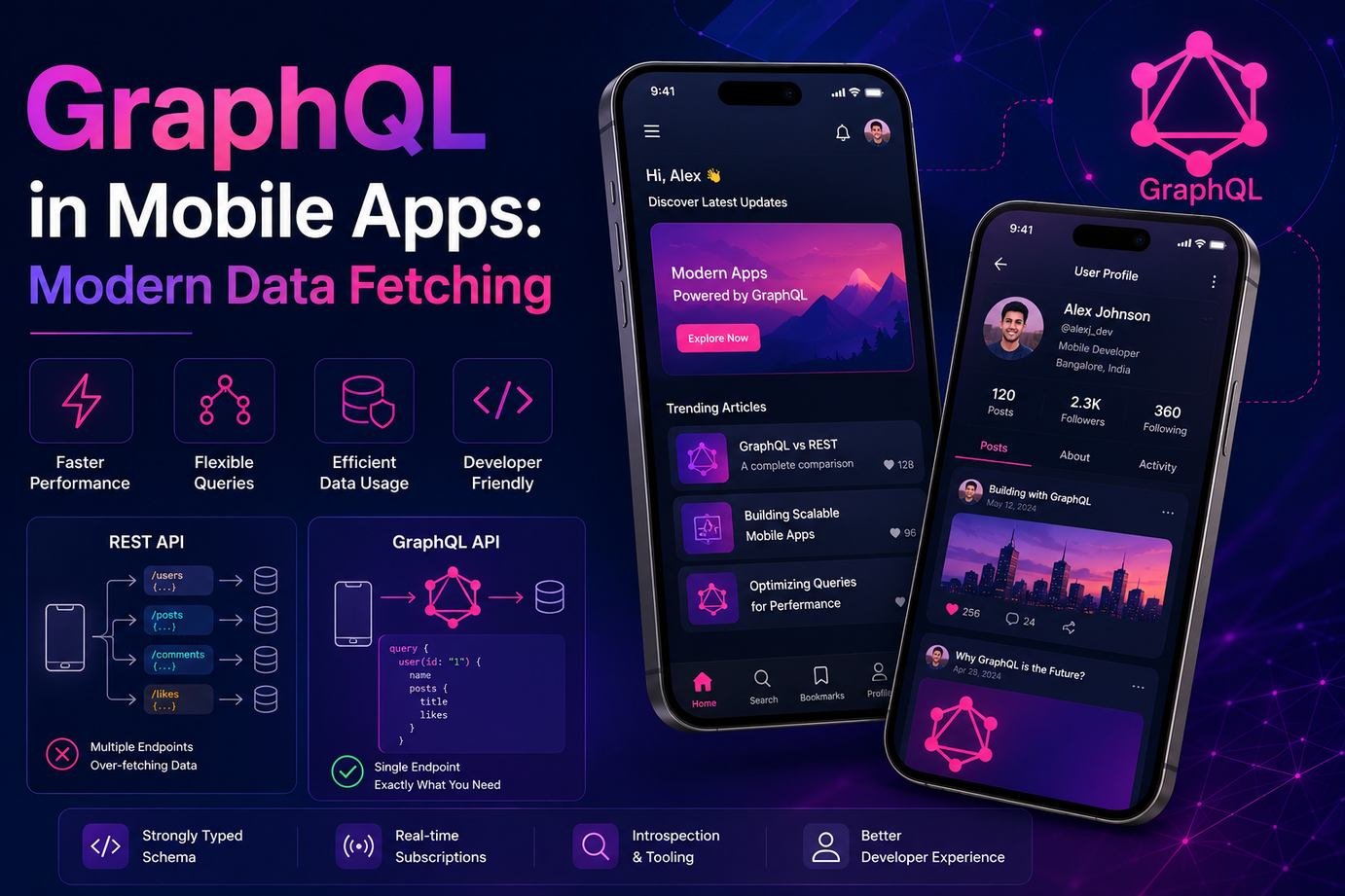
Unlike REST APIs, where multiple endpoints often return fixed data structures, GraphQL exposes a single endpoint that enables clients to define the structure of the response.
This means mobile applications receive only the required information, reducing unnecessary network traffic and improving efficiency.
GraphQL is commonly used for:
- Mobile Applications
- Web Applications
- Enterprise Software
- eCommerce Platforms
- Social Media Apps
- SaaS Products
- IoT Platforms
- Content Management Systems
Its flexibility makes it suitable for applications with complex data relationships and dynamic user interfaces.
Why GraphQL is Ideal for Mobile Apps
Mobile users expect applications to load quickly and respond instantly, regardless of network quality.
GraphQL helps achieve this by reducing the amount of data transferred between the client and the server.
Some key advantages include:
- Single API endpoint
- Reduced network requests
- Faster loading times
- Lower bandwidth consumption
- Flexible data fetching
- Better frontend performance
- Improved developer productivity
These benefits are especially valuable for mobile users on slower or unstable internet connections.
How GraphQL Works
GraphQL acts as an intelligent communication layer between the mobile application and the backend.
Instead of calling multiple REST endpoints, the mobile app sends a single GraphQL query specifying exactly what information it requires.
The GraphQL server processes the request, retrieves data from one or more sources, and returns a structured JSON response.
A typical workflow looks like this:
- The mobile app sends a GraphQL query.
- The GraphQL server validates the request.
- Resolvers fetch data from databases or external APIs.
- The requested data is combined.
- A single JSON response is returned to the mobile application.
This approach minimizes unnecessary API calls while improving response times.
GraphQL Architecture
A scalable GraphQL backend typically consists of several layers.
These include:
- Mobile Application
- GraphQL Client
- GraphQL Server
- Schema Layer
- Resolver Layer
- Business Logic
- Database
- Third-Party APIs
- Authentication Layer
- Cache Layer
This architecture separates responsibilities clearly, making applications easier to maintain, test, and scale.
GraphQL Schema
The GraphQL Schema defines the structure of the API.
It specifies:
- Available data types
- Fields
- Relationships
- Queries
- Mutations
- Subscriptions
Because every request is validated against the schema, developers gain strong type safety and improved API consistency.
A well-designed schema also makes frontend development faster by providing clear documentation for available operations.
GraphQL Queries
Queries are used to retrieve data from the server.
Unlike REST APIs, where fixed responses are returned, GraphQL queries allow developers to request only the fields they actually need.
For example, instead of receiving complete user information, a mobile application can request only:
- Name
- Profile Picture
- Email Address
This significantly reduces payload size and improves application performance.
Queries are particularly useful for:
- User Profiles
- Product Listings
- News Feeds
- Dashboard Data
- Search Results
GraphQL Mutations
Mutations are used whenever an application needs to create, update, or delete data.
Common examples include:
- User Registration
- Login
- Profile Updates
- Product Orders
- Reviews
- Payments
- Wishlist Updates
- Address Management
Mutations provide a structured way to modify backend data while maintaining schema validation and predictable responses.
GraphQL Subscriptions
Subscriptions enable real-time communication between the server and connected clients.
Instead of repeatedly requesting updates, mobile applications receive changes automatically whenever new data becomes available.
Popular use cases include:
- Live Chat
- Stock Prices
- Sports Scores
- Ride Tracking
- Delivery Status
- Multiplayer Games
- Notification Systems
Subscriptions improve user experience by delivering real-time updates without unnecessary polling.
Apollo GraphQL
Apollo is one of the most widely used GraphQL ecosystems for mobile and web development.
It provides tools for both client-side and server-side GraphQL implementation.
Apollo offers features such as:
- Client-side caching
- Query optimization
- State management
- Error handling
- Performance monitoring
- Developer tools
Its mature ecosystem makes GraphQL development faster and more efficient for enterprise applications.
Why Businesses Choose GraphQL
Businesses increasingly adopt GraphQL because it solves many limitations of traditional API architectures.
Some major business advantages include:
- Faster mobile applications
- Reduced API requests
- Lower bandwidth usage
- Improved frontend flexibility
- Better developer productivity
- Easier API evolution
- Improved scalability
- Simplified maintenance
These benefits help businesses deliver better user experiences while reducing development and infrastructure costs.
GraphQL vs REST API
GraphQL and REST are both widely used for API development, but they differ significantly in how data is requested and delivered.
REST relies on multiple endpoints, each returning a fixed response structure. GraphQL, on the other hand, uses a single endpoint where the client specifies exactly what data it needs.
| Feature |
GraphQL |
REST API |
| API Endpoint |
Single |
Multiple |
| Data Fetching |
Client Controlled |
Server Controlled |
| Over-fetching |
No |
Possible |
| Under-fetching |
No |
Common |
| Real-Time Support |
Built-in with Subscriptions |
Requires Additional Setup |
| Flexibility |
Excellent |
Moderate |
| Mobile Performance |
Excellent |
Good |
Choose GraphQL When
- Building feature-rich mobile apps
- Data comes from multiple sources
- Frontend flexibility is important
- Network optimization is required
- Real-time functionality is needed
Choose REST When
- APIs are simple
- Existing REST infrastructure already exists
- Teams are familiar with REST architecture
- Backend requirements are straightforward
GraphQL vs gRPC
Both GraphQL and gRPC offer high-performance communication, but they are designed for different use cases.
| Feature |
GraphQL |
gRPC |
| Protocol |
HTTP |
HTTP/2 |
| Data Format |
JSON |
Protocol Buffers |
| Human Readable |
Yes |
No |
| Browser Friendly |
Yes |
Limited |
| Mobile APIs |
Excellent |
Very Good |
| Microservices |
Good |
Excellent |
GraphQL is better suited for frontend applications, while gRPC is often preferred for internal communication between backend services.
GraphQL vs Firebase
Although both technologies are used in modern application development, they solve different problems.
| Feature |
GraphQL |
Firebase |
| API Layer |
Yes |
No |
| Backend Service |
Custom |
Managed |
| Database |
External |
Built-in |
| Authentication |
Custom |
Built-in |
| Flexibility |
High |
Moderate |
| Best For |
Custom Backend APIs |
Rapid Mobile Development |
In many enterprise projects, GraphQL is combined with Firebase to create flexible, scalable architectures.
Caching in GraphQL
Efficient caching significantly improves application performance by reducing repeated API requests.
Popular caching strategies include:
- Apollo Client Cache
- Persistent Local Storage
- CDN Caching
- Server-side Caching
- Redis Integration
- Query Result Caching
Proper caching reduces bandwidth usage while improving loading speed.
Pagination
Large datasets should never be loaded in a single request.
GraphQL supports efficient pagination techniques such as:
- Cursor-Based Pagination
- Offset Pagination
- Infinite Scrolling
- Lazy Loading
Pagination improves performance, reduces server load, and enhances the user experience.
Offline Support
Modern mobile applications often need to function even when internet connectivity is unavailable.
GraphQL clients such as Apollo support offline capabilities through local caching and synchronization.
Benefits include:
- Faster application startup
- Offline browsing
- Local data persistence
- Automatic synchronization when connectivity returns
- Improved user experience
Offline functionality is especially valuable for travel, healthcare, logistics, and field-service applications.
Performance Optimization
Although GraphQL is highly efficient, proper optimization ensures maximum performance as applications scale.
Best practices include:
- Design efficient schemas
- Optimize resolvers
- Prevent N+1 query problems using DataLoader
- Implement server-side caching
- Compress API responses
- Use persisted queries
- Enable query batching
- Monitor API performance
These techniques reduce response times and improve scalability.
Security Best Practices
Security should be a priority when exposing GraphQL APIs.
Recommended practices include:
Authentication
Use JWT, OAuth, or secure session management to verify users.
Authorization
Ensure users can access only the data they are permitted to view or modify.
Query Depth Limiting
Prevent excessively nested queries that may overload the server.
Rate Limiting
Protect APIs against brute-force attacks and abuse.
Input Validation
Validate all user input before processing requests.
Disable Introspection in Production
Restrict schema introspection in production environments where appropriate to reduce unnecessary exposure.
Logging & Monitoring
Monitor GraphQL operations to detect unusual traffic and performance issues.
Advantages of GraphQL
GraphQL offers numerous benefits for both developers and businesses.
Key advantages include:
- Single API endpoint
- Faster mobile applications
- Reduced bandwidth usage
- No over-fetching
- No under-fetching
- Flexible queries
- Strong type system
- Excellent developer experience
- Real-time subscriptions
- Easier frontend development
- Better scalability
- Improved API evolution
These capabilities make GraphQL an excellent choice for modern mobile app development.
Limitations of GraphQL
Despite its strengths, GraphQL is not the perfect solution for every project.
Some limitations include:
- Higher learning curve than REST
- More complex backend implementation
- Advanced caching requires careful planning
- Security configuration is essential
- Query optimization becomes important as APIs grow
- Small projects may not benefit from its full capabilities
With proper architecture and experienced developers, these challenges can be effectively managed.
Best Use Cases
GraphQL is especially valuable for applications with dynamic data requirements.
Popular use cases include:
- Social Media Apps
- E-commerce Platforms
- Food Delivery Applications
- Healthcare Systems
- Banking Applications
- News Platforms
- Travel Booking Apps
- SaaS Products
- Enterprise Dashboards
- CRM & ERP Solutions
- Educational Platforms
- Real-Time Mobile Applications
Its flexibility enables developers to build highly responsive and scalable applications.
Industries Using GraphQL
GraphQL is widely adopted across multiple industries.
Common examples include:
- E-commerce
- Healthcare
- Banking & Finance
- Education
- Logistics
- Real Estate
- Travel
- Entertainment
- SaaS
- Manufacturing
As digital products become more complex, GraphQL continues to gain popularity across enterprise applications.
Common Mistakes Businesses Make
Many GraphQL implementations fail to deliver optimal performance due to poor planning.
Avoid these mistakes:
- Creating overly complex schemas
- Ignoring authorization rules
- Skipping query optimization
- Loading unnecessary nested data
- Not implementing caching
- Ignoring pagination
- Poor resolver design
- Lack of API monitoring
- Exposing sensitive fields
- Choosing GraphQL for projects that don't require its flexibility
Following best practices from the beginning helps create maintainable and high-performing APIs.
Future of GraphQL
GraphQL continues to evolve as businesses demand faster and more flexible APIs.
Key trends shaping its future include:
- Wider enterprise adoption
- Improved federation architecture
- Better serverless integration
- AI-assisted API development
- Enhanced security tooling
- Faster client libraries
- Better edge computing support
- Stronger cloud-native integrations
As mobile applications become increasingly data-driven, GraphQL is expected to remain a leading technology for API development.
Why Businesses Choose Argenius
Building an efficient GraphQL API requires thoughtful schema design, secure authentication, optimized resolvers, and scalable backend architecture.
At Argenius, we develop high-performance GraphQL solutions tailored to your business goals. Our expertise includes GraphQL API architecture, Apollo Server implementation, mobile API integration, authentication, caching strategies, performance optimization, cloud deployment, and ongoing support.
Whether you're developing a startup MVP or an enterprise-grade mobile application, we ensure your GraphQL backend is secure, scalable, and optimized for exceptional performance.
Final Thoughts
GraphQL has redefined how modern mobile applications communicate with backend services. By allowing clients to request exactly the data they need, it eliminates unnecessary network requests, reduces bandwidth consumption, and delivers faster user experiences.
Its support for flexible queries, mutations, subscriptions, and strong type safety makes it a powerful alternative to traditional REST APIs, especially for feature-rich mobile applications.
While GraphQL introduces additional architectural considerations, its long-term benefits in scalability, maintainability, and developer productivity make it an excellent investment for businesses building modern digital products.
At Argenius, we help businesses design and implement secure, scalable GraphQL APIs that power fast, reliable, and future-ready Android and iOS applications.
Frequently Asked Questions
What is GraphQL in mobile app development?
GraphQL is a query language and runtime for APIs that allows mobile applications to request only the data they need, improving performance and reducing unnecessary network traffic.
Is GraphQL better than REST?
GraphQL is often better for complex, data-driven applications because it reduces over-fetching and under-fetching. REST remains a good choice for simpler APIs and traditional architectures.
Can GraphQL work with existing REST APIs?
Yes. GraphQL can act as a unified API layer that aggregates data from existing REST APIs, databases, and third-party services.
What is Apollo GraphQL?
Apollo is a popular GraphQL ecosystem that provides client and server libraries, caching, developer tools, and performance optimization for GraphQL applications.
Does GraphQL support real-time updates?
Yes. GraphQL Subscriptions enable real-time communication, making them ideal for chat applications, live tracking, notifications, and collaborative platforms.
Is GraphQL secure?
Yes. When implemented with authentication, authorization, query validation, rate limiting, and proper monitoring, GraphQL is suitable for enterprise-grade applications.
Which industries benefit most from GraphQL?
Industries such as eCommerce, healthcare, fintech, education, logistics, SaaS, and social media benefit from GraphQL because of its flexibility and efficient data fetching.
Can Argenius build GraphQL APIs for mobile apps?
Yes. Argenius provides end-to-end GraphQL development services, including API architecture, Apollo implementation, authentication, caching, cloud deployment, optimization, and long-term maintenance.