Choosing between hybrid and native app development can significantly impact your app's cost, performance, and user experience. Learn the key differences, advantages, disadvantages, and use cases to make the right decision for your business.
Introduction
Every business planning to launch a mobile application faces one important question before development begins:
Should we build a Hybrid App or a Native App?
The answer isn't as simple as choosing the cheaper option or the newest technology. Your decision affects everything—from development cost and launch time to performance, scalability, maintenance, and long-term business growth.
Today, companies like startups, e-commerce brands, healthcare providers, logistics businesses, educational platforms, and fintech companies all rely on mobile apps to connect with customers. However, every business has different goals. Some need the fastest possible launch, while others require enterprise-level performance and security.
Hybrid app development has gained popularity because it allows developers to build Android and iOS applications from a single codebase, reducing both cost and development time. On the other hand, native app development remains the preferred choice for businesses that need maximum performance, seamless user experiences, and deep hardware integration.
The right choice depends on factors such as your target audience, budget, expected traffic, required features, and future scalability. Choosing the wrong approach can increase costs, delay product launches, and make future upgrades more complicated.
In this complete guide, we'll compare hybrid and native app development across every major aspect—including performance, cost, user experience, maintenance, security, scalability, and business suitability—so you can confidently choose the right solution.
At Argenius, we help startups, SMEs, and enterprises select the most suitable mobile app development strategy based on their business objectives, ensuring they invest in technology that delivers long-term value.
What Is Hybrid App Development?
Hybrid app development is the process of building a mobile application using a single codebase that works on both Android and iOS.
Instead of creating two separate applications, developers write the code once and deploy it across multiple platforms.
Popular hybrid frameworks include:
- Flutter
- React Native
- Ionic
- .NET MAUI
Hybrid development significantly reduces development time and cost while maintaining a near-native user experience for most business applications.
What Is Native App Development?
Native app development involves creating separate applications specifically for Android and iOS using each platform's official programming languages and tools.
For Android:
- Kotlin
- Java
- Android Studio
For iOS:
Since native apps are designed exclusively for one operating system, they offer superior performance, deeper hardware integration, and platform-specific user experiences.
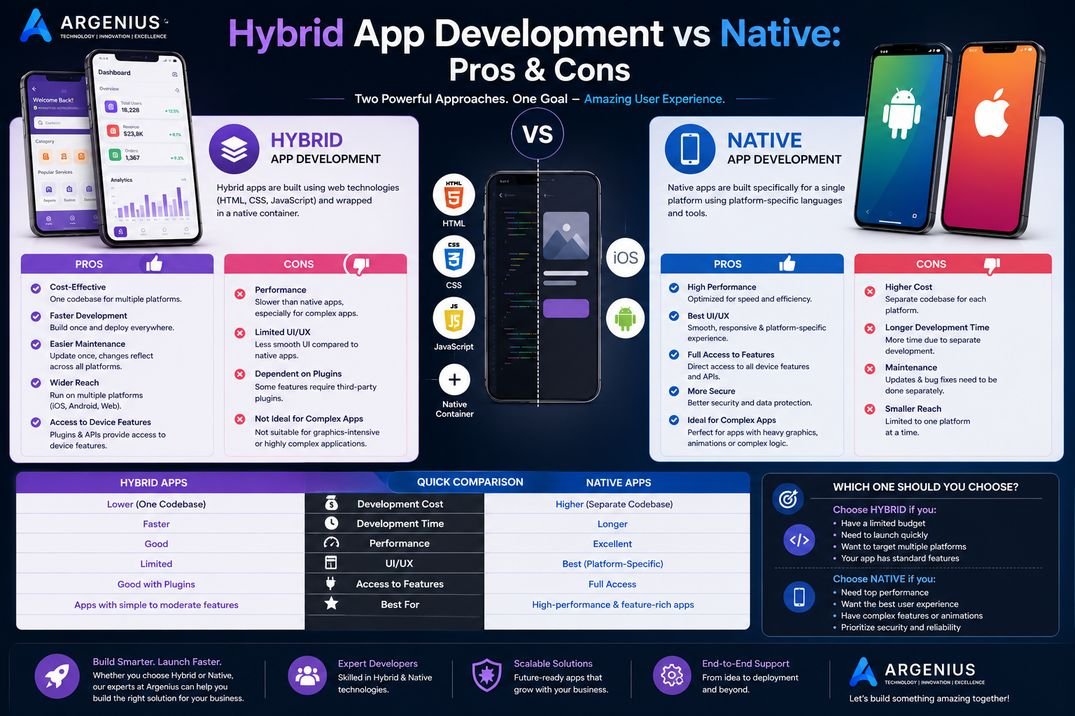
Hybrid vs Native: Key Differences
| Feature |
Hybrid App |
Native App |
| Codebase |
Single |
Separate |
| Development Time |
Faster |
Longer |
| Initial Cost |
Lower |
Higher |
| Maintenance |
Easier |
Separate Updates |
| Performance |
Very Good |
Excellent |
| UI Experience |
Very Good |
Excellent |
| Hardware Access |
Good |
Full Access |
| Security |
High |
Very High |
| Scalability |
High |
Excellent |
| Time to Market |
Fast |
Moderate |
Performance Comparison
Performance is one of the biggest differences between hybrid and native applications.
Hybrid Apps
Modern frameworks like Flutter provide excellent performance for most applications.
Suitable for:
- E-commerce
- Healthcare
- CRM
- Booking
- Food Delivery
- Education
- Business Apps
- Service Platforms
Most users won't notice any performance difference in everyday applications.
Native Apps
Native apps communicate directly with the operating system without any additional abstraction layer.
Advantages include:
- Faster rendering
- Better animations
- Lower latency
- Higher frame rates
- Improved battery optimization
- Better memory management
Native development is the preferred option for graphics-intensive or performance-critical applications.
Development Cost
Budget plays a significant role in technology selection.
Hybrid Development
Hybrid development is generally more affordable because:
- One development team
- One codebase
- Faster development
- Shared business logic
- Easier testing
- Lower maintenance costs
This makes hybrid apps ideal for startups and businesses with limited budgets.
Native Development
Native development usually requires:
- Android developers
- iOS developers
- Separate QA testing
- Individual deployments
- Independent maintenance
As a result, the overall project cost is typically higher.
Development Time
Speed to market is essential for many businesses.
Hybrid Apps
Since developers build one application for both platforms, development is significantly faster.
Benefits include:
- Faster MVP launch
- Simultaneous Android & iOS release
- Quicker feature updates
- Reduced development cycles
Native Apps
Developing Android and iOS separately takes more time because every feature must be implemented and tested independently.
User Experience (UI/UX)
User experience directly impacts app ratings and customer retention.
Hybrid Apps
Modern frameworks support beautiful interfaces with smooth animations and responsive layouts.
For most users, hybrid apps feel almost identical to native apps.
Native Apps
Native applications follow official platform design guidelines:
- Material Design (Android)
- Human Interface Guidelines (iOS)
This results in the most natural and platform-consistent user experience.
Security Comparison
Security is crucial for applications that handle sensitive user information.
Hybrid Apps
Hybrid applications support:
- Secure APIs
- SSL encryption
- Authentication
- Biometrics
- Secure storage
These capabilities are sufficient for most commercial applications.
Native Apps
Native apps provide additional security benefits through direct access to operating system security features, making them ideal for:
- Banking
- Healthcare
- Government
- Fintech
- Enterprise Software
Hardware Integration
Modern mobile applications often require access to device hardware.
Hybrid Apps Support
- Camera
- GPS
- Notifications
- Bluetooth
- Microphone
- File Storage
- Biometrics
Native Apps Support
Everything available in Hybrid plus:
- Advanced Sensors
- ARKit
- Core ML
- Android Neural APIs
- Low-level Bluetooth
- Background Services
- NFC
- Wearables
- Platform-specific capabilities
Maintenance and Updates
Maintaining a mobile application is easier when updates are efficient.
Hybrid
Benefits include:
- Single update
- Faster bug fixes
- Easier feature rollout
- Lower maintenance costs
Native
Each platform requires:
- Separate updates
- Individual testing
- Independent deployment
- Platform-specific maintenance
Scalability
As businesses grow, applications need to scale.
Hybrid applications are highly scalable for:
- Startups
- SMEs
- Growing businesses
- SaaS platforms
- E-commerce
Native applications provide maximum flexibility for:
- Large enterprises
- AI applications
- High-performance platforms
- Real-time systems
- Advanced enterprise software
When Should You Choose Hybrid App Development?
Hybrid development is an excellent choice if you:
- Want to launch quickly
- Have a limited budget
- Need Android and iOS together
- Want a single codebase
- Plan to validate an MVP
- Need easier maintenance
- Build standard business applications
- Expect moderate to high traffic
Most startups and growing businesses can achieve outstanding results with hybrid development.
When Should You Choose Native App Development?
Native development is recommended when you need:
- Maximum performance
- Advanced graphics
- Gaming applications
- Banking platforms
- Healthcare systems
- AI-powered apps
- AR/VR experiences
- Enterprise-grade security
- Deep hardware integration
These applications benefit significantly from native architecture.
Common Mistakes Businesses Make
Many companies choose a development approach without considering their long-term business strategy.
Avoid these common mistakes:
- Choosing native for a simple MVP
- Selecting hybrid solely because it's cheaper
- Ignoring future scalability
- Underestimating maintenance costs
- Focusing only on initial development cost
- Skipping user research
- Not planning for app updates
- Choosing the wrong technology stack
- Ignoring performance requirements
- Overlooking security needs
Evaluating your business goals before development begins can save significant time and money.
Why Businesses Choose Argenius
At Argenius, we don't recommend technologies based on trends—we recommend them based on your business objectives. Our mobile app development experts analyze your project requirements, target audience, expected traffic, feature complexity, budget, and long-term growth plans before suggesting the ideal development approach.
Whether you need a high-performance native application or a cost-effective hybrid app built with Flutter or React Native, we deliver scalable, secure, and feature-rich mobile solutions. Our services include UI/UX design, API integration, backend development, cloud infrastructure, quality assurance, App Store deployment, ongoing maintenance, and performance optimization to ensure your application succeeds in the competitive mobile market.
Final Thoughts
There is no universal winner in the Hybrid App Development vs Native debate. The right choice depends on your business priorities rather than the technology itself.
If your goal is to launch quickly, minimize costs, and maintain a single codebase for Android and iOS, hybrid development offers outstanding value and is more than capable of powering most modern business applications.
If your application requires exceptional performance, advanced hardware integration, enterprise-level security, or platform-specific experiences, native development remains the gold standard.
The best decision is one that aligns with your users' expectations, your budget, and your long-term product roadmap.
At Argenius, we help businesses choose the right development strategy from the start, ensuring they invest in technology that supports sustainable growth, delivers an exceptional user experience, and maximizes return on investment.
Frequently Asked Questions
What is the difference between hybrid and native app development?
Hybrid app development uses a single codebase to build apps for both Android and iOS, while native development creates separate applications optimized specifically for each platform.
Which is better, hybrid or native?
Neither is universally better. Hybrid is ideal for faster development and lower costs, while native offers better performance, security, and platform-specific features.
Is Flutter considered hybrid development?
Flutter is a cross-platform framework commonly grouped with hybrid development because it allows developers to create Android and iOS apps from a single codebase.
Are hybrid apps slower than native apps?
Modern frameworks like Flutter deliver near-native performance for most business applications. However, native apps still have an advantage in graphics-intensive, gaming, and hardware-heavy applications.
Can Argenius develop both hybrid and native mobile apps?
Yes. Argenius specializes in both hybrid (Flutter and React Native) and native Android/iOS app development, helping businesses choose the most suitable technology based on their goals and budget.