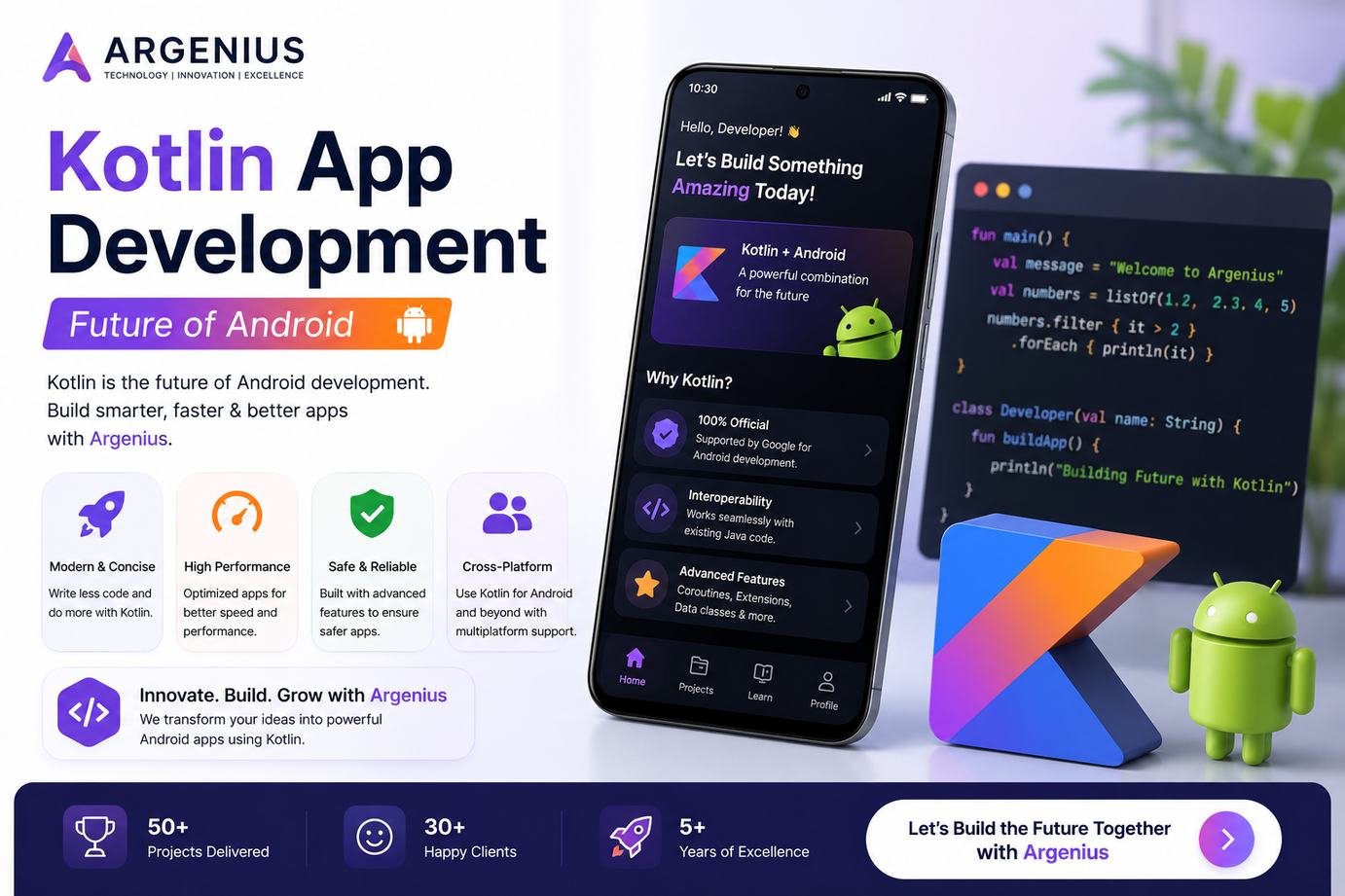
Kotlin has revolutionized Android app development with its concise syntax, improved safety, excellent performance, and developer-friendly features. Discover why businesses worldwide are choosing Kotlin to build secure, scalable, and future-ready Android applications.
Introduction
Android powers more smartphones than any other mobile operating system in the world, making it one of the most important platforms for businesses investing in digital products. From startups building their first MVP to enterprises managing millions of users, Android applications have become essential for reaching customers, improving operations, and driving business growth.
For many years, Java was the primary language for Android development. Although Java remains reliable, developers often struggled with verbose code, frequent null pointer exceptions, and longer development cycles. As mobile applications became more sophisticated, the need for a modern programming language became increasingly clear.
Google addressed this challenge by officially supporting Kotlin for Android development in 2017 and later declaring it the preferred language for building Android applications. Since then, Kotlin has rapidly gained adoption across the Android ecosystem because it enables developers to write cleaner code, build applications faster, and create more reliable software.
Today, Kotlin is used to develop everything from eCommerce platforms and banking apps to healthcare solutions, logistics systems, education platforms, and enterprise applications. Its modern syntax, built-in safety features, seamless Java interoperability, and excellent performance make it one of the strongest choices for Android development in 2026 and beyond.
In this guide, you'll learn what Kotlin is, why Google recommends it, its architecture, key features, business advantages, and why many experts consider Kotlin the future of Android app development.
At Argenius, we use Kotlin to build scalable, secure, and high-performance Android applications that help businesses launch faster while ensuring long-term maintainability.
What is Kotlin?
Kotlin is a modern, statically typed programming language developed by JetBrains. It was designed to improve developer productivity while remaining fully compatible with Java.
Unlike many programming languages that require businesses to rewrite existing projects, Kotlin works seamlessly alongside Java. This allows companies to gradually modernize their Android applications without rebuilding everything from scratch.
Today, Kotlin supports multiple platforms, including:
- Android Development
- Backend Development
- JVM Applications
- Web Development
- Desktop Applications
- Kotlin Multiplatform Projects
Although Kotlin can be used across different technologies, Android remains its strongest and fastest-growing ecosystem.
Why Google Chose Kotlin
Google evaluated multiple modern programming languages before officially supporting Kotlin. The decision was based on Kotlin's ability to solve several long-standing challenges in Android development while improving developer productivity and application reliability.
Cleaner Code
One of Kotlin's biggest strengths is its concise syntax.
Compared to Java, developers can accomplish the same functionality using significantly fewer lines of code.
This leads to:
- Faster development
- Better readability
- Easier maintenance
- Reduced chances of coding errors
Smaller codebases are also easier to review, debug, and scale over time.
Built-in Null Safety
Application crashes caused by NullPointerException have historically been one of the biggest challenges in Java-based Android applications.
Kotlin addresses this problem with built-in null safety, requiring developers to explicitly define whether a variable can contain a null value.
This simple improvement results in:
- More stable applications
- Fewer runtime crashes
- Better user experience
- Improved code quality
Higher Developer Productivity
Modern businesses expect mobile applications to evolve quickly with regular feature updates.
Kotlin includes several features that significantly speed up development, such as:
- Type Inference
- Data Classes
- Smart Casts
- Extension Functions
- Coroutines
These capabilities reduce repetitive coding and allow developers to focus more on solving business problems rather than writing boilerplate code.
Complete Java Compatibility
Many organizations already have large Android projects built in Java.
Kotlin allows developers to reuse existing Java code and libraries without major modifications.
This makes migration practical, cost-effective, and low-risk for businesses planning long-term modernization.
Evolution of Kotlin
Kotlin has evolved rapidly over the past decade and has become one of the most trusted programming languages for Android development.
2011 – Kotlin is Introduced
JetBrains announced Kotlin as a modern language designed to simplify JVM development and improve productivity.
2016 – Open Source Release
Kotlin became open source, attracting developers worldwide and encouraging community contributions.
2017 – Google Announces Official Support
Google officially introduced Kotlin as a supported language for Android development during Google I/O, marking a major milestone for the Android ecosystem.
2019 – Kotlin Becomes Google's Preferred Language
Google declared Kotlin the preferred language for Android development, encouraging developers to use Kotlin-first APIs and modern development practices.
2020–2026 – Continuous Innovation
Kotlin has continued to evolve with major improvements, including:
- Kotlin Coroutines
- Kotlin Multiplatform
- Jetpack Compose integration
- Improved compiler performance
- Better Android Studio support
- Enhanced developer tooling
These advancements have strengthened Kotlin's position as the future of Android development.
Kotlin Architecture
Modern Android applications built with Kotlin generally follow a clean and scalable architecture that separates different responsibilities within the application.
A typical Kotlin application consists of:
- Presentation Layer
- ViewModel Layer
- Business Logic Layer
- Repository Layer
- API Layer
- Local Database Layer
This architecture offers several advantages:
- Better code organization
- Easier testing
- Improved scalability
- Simplified maintenance
- Faster feature development
Because each layer has a clearly defined responsibility, development teams can work more efficiently while reducing long-term technical debt.
Key Features of Kotlin
Kotlin includes several modern programming features that improve both developer productivity and application quality.
Concise Syntax
Kotlin eliminates much of the repetitive code required in Java.
Benefits include:
- Shorter code
- Faster development
- Improved readability
- Easier maintenance
Developers spend less time writing repetitive code and more time building valuable features.
Type Inference
Kotlin automatically identifies variable types without requiring developers to explicitly declare them in many situations.
This keeps code clean while reducing unnecessary complexity.
Data Classes
Most Android applications work with structured data such as:
- Customer Profiles
- Products
- Orders
- Payments
- Addresses
- Notifications
Kotlin's Data Classes simplify model creation by automatically generating commonly used methods such as constructors, equality checks, and string representations.
This reduces development effort and improves code consistency.
Extension Functions
Extension Functions allow developers to extend existing classes without modifying their original source code.
Advantages include:
- Cleaner architecture
- Better code reuse
- Improved project organization
This feature is particularly useful in large enterprise applications where reusable utilities are essential.
Smart Casts
Traditional programming often requires repeated type checking before using objects.
Kotlin automatically performs safe type casting whenever possible, making code shorter, cleaner, and less error-prone.
Coroutines
Modern Android applications frequently communicate with APIs, databases, cloud services, and background tasks.
Kotlin Coroutines simplify asynchronous programming while improving application responsiveness.
Some key benefits include:
- Faster API handling
- Smooth user experience
- Better memory efficiency
- Simplified background processing
- Improved performance
Coroutines have become one of Kotlin's most valuable features for building responsive Android applications.
Why Businesses Prefer Kotlin
Choosing a programming language is no longer just a technical decision—it directly impacts project costs, product quality, scalability, and long-term maintenance.
Businesses increasingly prefer Kotlin because it enables teams to build reliable Android applications faster while reducing development complexity.
Some of the biggest business advantages include:
- Faster development cycles
- Lower maintenance costs
- Improved application stability
- Better integration with Android Jetpack
- Strong long-term support from Google
- Reduced development errors
- Improved developer productivity
- Easier scalability for growing businesses
For startups, Kotlin helps accelerate MVP development and reduce time-to-market. For enterprises, it provides a secure and maintainable foundation capable of supporting complex Android applications over the long term.
Kotlin vs Java
One of the most common questions businesses ask is whether they should continue building Android applications with Java or switch to Kotlin.
While Java remains a powerful programming language, Kotlin introduces several improvements that make Android development faster, safer, and more efficient.
| Feature |
Kotlin |
Java |
| Code Length |
Concise |
More Boilerplate |
| Null Safety |
Built-in |
Manual |
| Coroutines |
Native Support |
Complex |
| Smart Casts |
Yes |
No |
| Extension Functions |
Yes |
No |
| Google Recommendation |
Preferred |
Supported |
| Developer Productivity |
Higher |
Moderate |
For new Android projects, Kotlin has become the recommended choice because it aligns with Google's latest Android development practices while helping teams deliver applications more efficiently.
Kotlin vs Flutter
Businesses often confuse Kotlin with Flutter because both are used for mobile app development. However, they serve different purposes.
Kotlin is a native Android programming language, whereas Flutter is Google's cross-platform UI framework that allows developers to build Android and iOS applications using a single codebase.
The right choice depends on your project requirements, budget, timeline, and target audience.
| Feature |
Kotlin |
Flutter |
| Type |
Native Android |
Cross-Platform Framework |
| Programming Language |
Kotlin |
Dart |
| Platforms |
Android Only |
Android, iOS, Web & Desktop |
| Performance |
Excellent |
Excellent |
| Development Cost |
Higher (Two Apps Required) |
Lower (Single Codebase) |
| UI Consistency |
Android Native |
Same Across Platforms |
| Hardware Integration |
Best |
Very Good |
| Time to Market |
Moderate |
Faster |
Choose Kotlin When:
- You are building only an Android application.
- Performance is your highest priority.
- Deep hardware integration is required.
- You need complete access to Android APIs.
- You want long-term native Android support.
Choose Flutter When:
- You need Android and iOS applications.
- Budget is limited.
- Faster launch is important.
- A shared codebase will reduce maintenance costs.
- UI consistency across platforms is required.
Kotlin vs React Native
React Native is another popular framework for cross-platform development, but unlike Kotlin, it focuses on building Android and iOS applications using JavaScript.
| Feature |
Kotlin |
React Native |
| Development Type |
Native |
Cross-Platform |
| Language |
Kotlin |
JavaScript |
| Performance |
Excellent |
Very Good |
| UI Experience |
Native Android |
Near Native |
| Hardware Access |
Full |
Very Good |
| Development Speed |
Moderate |
Faster |
| Maintenance |
Android Only |
Android & iOS Together |
Businesses looking for the best Android experience usually prefer Kotlin, while startups building applications for multiple platforms often consider React Native.
Performance and Speed
Performance is one of Kotlin's strongest advantages.
Because Kotlin compiles directly into native Android code, applications benefit from:
- Faster startup time
- Smooth animations
- Better battery optimization
- Lower memory usage
- Improved responsiveness
- Faster screen rendering
This makes Kotlin an excellent choice for applications where performance directly impacts user experience.
Examples include:
- Banking Apps
- Trading Platforms
- Healthcare Applications
- Ride Booking Apps
- Video Streaming Platforms
- Enterprise Applications
Security Features
Security is critical for every Android application.
Kotlin includes several modern features that help developers build secure applications.
Some important security advantages include:
Null Safety
Reduces unexpected crashes caused by null references.
Immutable Objects
Encourages safer programming practices.
Strong Type System
Prevents many common programming errors before runtime.
Android Security APIs
Kotlin works seamlessly with Android's security framework, including:
- Biometric Authentication
- Secure Storage
- Encrypted Shared Preferences
- Keystore System
- SSL Pinning
- OAuth Authentication
- JWT Authentication
When combined with secure backend architecture, Kotlin applications provide enterprise-grade security.
Jetpack Compose: The Future of Android UI
Jetpack Compose is Google's modern toolkit for building Android user interfaces.
Instead of writing XML layouts, developers can create UI entirely using Kotlin.
Benefits include:
- Less code
- Faster UI development
- Better animations
- Easier maintenance
- Improved testing
- Modern design approach
Google continues investing heavily in Jetpack Compose, making it the future of Android interface development.
Best Use Cases for Kotlin
Kotlin is suitable for almost every type of Android application.
Popular use cases include:
- E-commerce Applications
- Food Delivery Apps
- Taxi Booking Apps
- Healthcare Solutions
- Banking Applications
- FinTech Apps
- Educational Platforms
- CRM Applications
- ERP Systems
- Logistics Software
- Social Networking Apps
- Enterprise Mobility Solutions
Its flexibility makes it suitable for both startups and large enterprises.
Industries Using Kotlin
Many industries rely on Kotlin to build modern Android applications.
These include:
- Healthcare
- Banking & Finance
- Retail & E-commerce
- Education
- Travel & Hospitality
- Logistics
- Manufacturing
- Insurance
- Real Estate
- Media & Entertainment
As Android adoption continues to grow, Kotlin's importance across these industries is expected to increase further.
Advantages of Kotlin
Businesses choose Kotlin because it delivers both technical and commercial benefits.
Some major advantages include:
- Officially supported by Google
- Native Android performance
- Clean and concise syntax
- Reduced development time
- Improved code quality
- Fewer application crashes
- Easier maintenance
- Excellent IDE support
- Full Java interoperability
- Large developer community
- Modern programming features
- Long-term scalability
These advantages make Kotlin one of the strongest choices for Android development in 2026.
Limitations of Kotlin
While Kotlin is highly capable, businesses should also understand its limitations.
Some challenges include:
- Android only (for native apps)
- Learning curve for developers new to Kotlin
- Slightly slower compilation in some large projects
- Smaller talent pool compared to Java in certain regions
- Cross-platform support requires Kotlin Multiplatform, which may not suit every project
Most of these limitations can be addressed with experienced developers and proper project planning.
Common Mistakes Businesses Make
Many organizations select technologies without evaluating their long-term requirements.
Avoid these common mistakes:
- Choosing Kotlin simply because Google recommends it
- Ignoring future iOS requirements
- Building without proper architecture
- Not using Jetpack libraries
- Skipping performance optimization
- Delaying testing until the end of development
- Writing business logic directly inside Activities
- Ignoring security best practices
- Poor API design
- Choosing technology before defining business goals
Planning your architecture before development begins significantly reduces future costs.
Future of Kotlin
Kotlin continues to evolve rapidly.
Google's ongoing investment in Android development strongly indicates that Kotlin will remain the preferred language for years to come.
Several trends are shaping Kotlin's future:
- Wider adoption of Jetpack Compose
- Growth of Kotlin Multiplatform
- Better AI integration
- Improved compiler performance
- Enhanced cloud compatibility
- Stronger enterprise adoption
- Continued Android ecosystem improvements
As businesses demand faster, more secure, and scalable applications, Kotlin is expected to play an even larger role in Android development.
Why Businesses Choose Argenius
Choosing the right technology is only the first step. The real success of an Android application depends on how well it is planned, designed, developed, tested, and maintained.
At Argenius, we specialize in building modern Android applications using Kotlin that combine outstanding performance, security, scalability, and exceptional user experiences.
Our development process includes business analysis, UI/UX design, clean architecture, API development, cloud integration, quality assurance, performance optimization, Play Store deployment, and long-term maintenance.
Whether you're launching a startup MVP or building an enterprise-grade Android solution, our team ensures your application is ready for today's users and tomorrow's growth.
Final Thoughts
Kotlin has fundamentally transformed Android development by offering a modern, safe, and highly productive programming language that aligns with Google's vision for the future of Android.
Its concise syntax, built-in null safety, seamless Java interoperability, Coroutines, and excellent support for modern Android development tools make it a powerful choice for businesses of all sizes.
While Java continues to be relevant, Kotlin has become the preferred language for new Android projects because it enables faster development, better maintainability, and improved application quality.
If your goal is to build a high-performance Android application that is secure, scalable, and future-ready, Kotlin remains one of the best investments you can make.
At Argenius, we help businesses leverage Kotlin to build Android applications that deliver exceptional user experiences while supporting long-term business growth.
Frequently Asked Questions
Is Kotlin better than Java for Android development?
For most new Android projects, Kotlin is considered the better choice because it offers cleaner syntax, built-in null safety, improved developer productivity, and official support from Google.
Is Kotlin only used for Android development?
No. Kotlin also supports backend development, desktop applications, web development, and Kotlin Multiplatform projects. However, Android remains its most popular use case.
Can existing Java applications be migrated to Kotlin?
Yes. Kotlin is fully interoperable with Java, allowing businesses to migrate applications gradually without rebuilding everything from scratch.
Does Kotlin improve app performance?
Kotlin compiles into native Android code and provides excellent runtime performance. Features like Coroutines also improve responsiveness by simplifying asynchronous programming.
Is Kotlin suitable for enterprise applications?
Yes. Kotlin is widely used for enterprise-grade Android applications because it offers scalability, maintainability, security, and excellent support for modern Android architecture.
What industries benefit most from Kotlin?
Healthcare, banking, eCommerce, education, logistics, travel, manufacturing, real estate, insurance, and enterprise software are among the industries that commonly use Kotlin.
Does Kotlin work with Jetpack Compose?
Yes. Kotlin is the primary language for Jetpack Compose, Google's modern toolkit for building Android user interfaces.
Can Argenius develop Kotlin-based Android applications?
Yes. Argenius provides end-to-end Kotlin app development services, including consulting, UI/UX design, backend integration, API development, testing, deployment, and ongoing maintenance.