Choosing between Kotlin and Java for Android development? Compare syntax, performance, security, development speed, scalability, and real-world use cases to determine which programming language best suits your Android application.
Introduction
Android powers billions of smartphones worldwide, making it one of the most popular platforms for mobile application development. Whether you're building a startup MVP, an enterprise solution, an e-commerce platform, or a social networking app, one of the first technical decisions you'll face is selecting the right programming language.
For years, Java was the official language for Android development and became the foundation of thousands of successful mobile applications. In 2017, Google officially announced Kotlin as a supported language for Android development, and in 2019, Kotlin became Google's preferred language for Android app development.
Today, both Kotlin and Java remain widely used, but they serve different development needs. Kotlin introduces modern programming features, concise syntax, improved safety, and faster development, while Java continues to be a reliable and mature language with a vast ecosystem and decades of enterprise adoption.
So, which language should you choose?
The answer depends on your project requirements, development team, existing infrastructure, long-term maintenance plans, and business goals.
In this comprehensive guide, we'll compare Kotlin vs Java across every important factor—including performance, syntax, security, development speed, scalability, community support, learning curve, and real-world use cases—to help you make the right decision for your Android application.
At Argenius, we build scalable Android applications using modern technologies and help businesses choose the right programming language based on their technical and commercial objectives.
What Is Kotlin?
Kotlin is a modern, statically typed programming language developed by JetBrains and officially supported by Google for Android development.
It is fully interoperable with Java, meaning developers can use Kotlin and Java together within the same Android project.
Key Features of Kotlin
- Concise syntax
- Null safety
- Coroutines for asynchronous programming
- Extension functions
- Smart type inference
- Data classes
- Higher productivity
- Full Java interoperability
Today, Kotlin is the preferred language for most new Android applications.
What Is Java?
Java is one of the world's most widely used programming languages and has powered Android development since the platform's early days.
Because of its maturity and extensive ecosystem, Java remains popular for enterprise software, backend systems, and Android applications.
Key Features of Java
- Platform independence
- Object-oriented programming
- Large developer community
- Extensive libraries
- Stable ecosystem
- Strong documentation
- Excellent backward compatibility
Java continues to be a dependable option for maintaining legacy Android applications and enterprise systems.
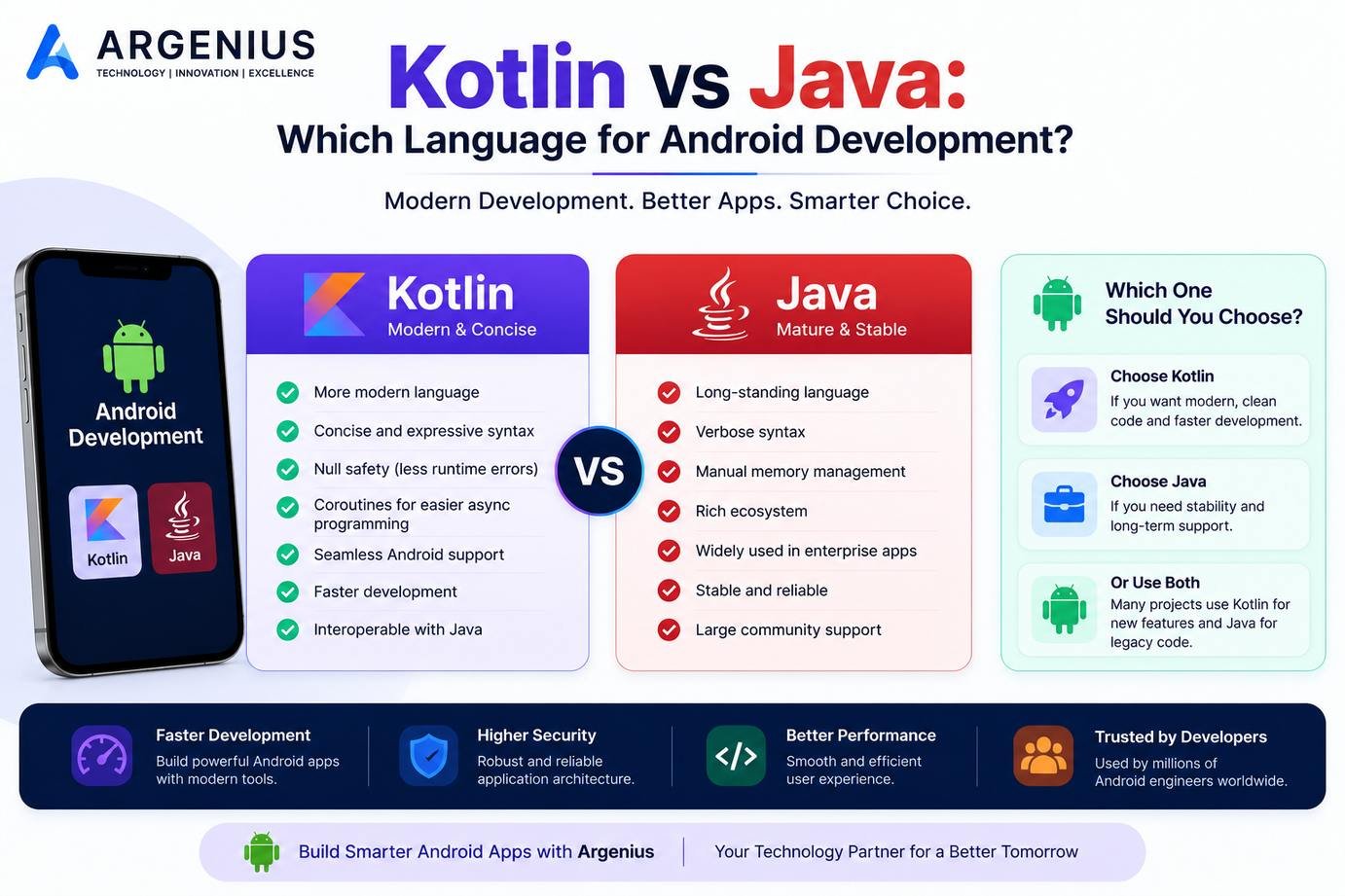
Kotlin vs Java: Quick Comparison
| Feature |
Kotlin |
Java |
| Official Android Preference |
✅ Yes |
Supported |
| Syntax |
Modern & Concise |
More Verbose |
| Learning Curve |
Easy for modern developers |
Easy but more code |
| Null Safety |
Built-in |
Manual handling |
| Performance |
Excellent |
Excellent |
| Boilerplate Code |
Very Low |
Higher |
| Coroutines |
Built-in |
Requires additional libraries |
| Community |
Growing Rapidly |
Very Large |
| Enterprise Adoption |
High |
Extremely High |
| Best for New Projects |
✅ Yes |
Legacy & Enterprise |
Syntax Comparison
One of the biggest differences between Kotlin and Java is readability.
Kotlin
Kotlin removes much of the repetitive code required in Java.
Advantages include:
- Cleaner syntax
- Less boilerplate
- Better readability
- Faster development
Developers often write significantly fewer lines of code compared to Java.
Java
Java uses more explicit syntax, which can make programs longer but also very structured.
Advantages include:
- Familiar structure
- Strong readability for experienced developers
- Well-established coding standards
Performance Comparison
Performance is often a concern for businesses developing Android applications.
Kotlin
Kotlin compiles to Java Virtual Machine (JVM) bytecode, allowing it to perform very similarly to Java in most Android applications.
Performance advantages include:
- Efficient execution
- Optimized compiler
- Modern language features
- Better asynchronous programming with Coroutines
Java
Java has been optimized over decades.
Benefits include:
- Stable runtime
- Mature JVM optimization
- Reliable memory management
- Excellent performance
For most business applications, users are unlikely to notice a significant performance difference between Kotlin and Java.
Development Speed
Faster development often means lower project costs.
Kotlin
Kotlin helps developers build applications more quickly because of:
- Less repetitive code
- Smart type inference
- Data classes
- Extension functions
- Coroutines
- Improved IDE support
These features reduce development effort and simplify maintenance.
Java
Java development is generally slower because developers often write more code to accomplish the same tasks.
However, experienced Java teams can still deliver robust applications efficiently.
Code Safety
Application stability depends heavily on code quality.
Kotlin
Kotlin was designed to eliminate many common programming errors.
Built-in safety features include:
- Null safety
- Smart casting
- Immutable collections
- Safer type system
These features reduce runtime crashes caused by null pointer exceptions.
Java
Java requires developers to manually handle null values and other safety concerns.
Although robust coding practices can minimize errors, Java generally requires more defensive programming.
Learning Curve
Choosing a language also depends on your development team's expertise.
Kotlin
Ideal for:
- Modern Android developers
- Developers familiar with Java
- Teams adopting Google's latest Android recommendations
Most Java developers can transition to Kotlin relatively quickly.
Java
Ideal for:
- Beginners learning programming fundamentals
- Enterprise developers
- Teams maintaining older Android projects
Java remains one of the most widely taught programming languages.
Community and Ecosystem
A strong community makes development easier through libraries, tutorials, and support.
Kotlin
The Kotlin community continues to grow rapidly due to Google's endorsement and increasing industry adoption.
Benefits include:
- Active open-source community
- Frequent updates
- Excellent Android documentation
- Growing third-party libraries
Java
Java has one of the largest programming communities in the world.
Advantages include:
- Extensive documentation
- Millions of developers
- Large ecosystem
- Enterprise support
- Thousands of libraries
Security
Both Kotlin and Java support enterprise-grade security when implemented correctly.
Common security features include:
- Secure authentication
- Encryption
- API security
- Secure networking
- Role-based access
- Secure local storage
Kotlin's null safety helps reduce certain categories of runtime errors, but overall application security depends more on architecture and implementation than on the programming language alone.
Scalability
Both languages are suitable for scalable Android applications.
Kotlin
Well-suited for:
- Startup apps
- E-commerce
- Healthcare
- Fintech
- SaaS products
- Enterprise applications
Java
Ideal for:
- Legacy Android projects
- Enterprise software
- Banking systems
- Government applications
- Large-scale backend integration
When Should You Choose Kotlin?
Choose Kotlin if you:
- Are building a new Android app
- Want faster development
- Prefer modern syntax
- Need better code safety
- Want long-term Android support
- Need cleaner and more maintainable code
- Plan to scale your application
Kotlin is the recommended choice for most new Android projects.
When Should You Choose Java?
Java remains a good choice when:
- Maintaining an existing Java-based Android app
- Your development team specializes in Java
- Your project relies heavily on legacy Java libraries
- Your organization has an established Java ecosystem
- You require compatibility with existing enterprise systems
Can Kotlin and Java Be Used Together?
Yes.
One of Kotlin's biggest advantages is its interoperability with Java.
This means you can:
- Add Kotlin to existing Java projects
- Gradually migrate applications
- Reuse Java libraries
- Share business logic
- Modernize legacy applications without rebuilding everything
This flexibility makes Kotlin adoption much easier for businesses with existing Android applications.
Common Mistakes Businesses Make
Many businesses select a programming language based solely on popularity.
Avoid these common mistakes:
- Choosing Java for every new project without evaluating Kotlin
- Migrating legacy apps without a proper strategy
- Ignoring developer expertise
- Underestimating long-term maintenance
- Focusing only on learning curve
- Overlooking scalability requirements
- Ignoring Google's Android recommendations
- Writing inconsistent code across teams
- Neglecting testing during migration
- Prioritizing familiarity over project needs
Selecting the right language should always align with your business goals and technical roadmap.
Why Businesses Choose Argenius
At Argenius, we develop secure, scalable, and high-performance Android applications using modern development practices. Our experts evaluate your business requirements, existing technology stack, budget, and long-term roadmap before recommending Kotlin, Java, or a combination of both.
From product strategy and UI/UX design to backend development, API integration, cloud deployment, testing, and ongoing maintenance, we deliver Android applications that are built for performance, scalability, and future growth.
Final Thoughts
Both Kotlin and Java are excellent programming languages for Android development, but they serve different purposes.
For most new Android applications, Kotlin is the preferred choice because of its modern syntax, improved safety, reduced boilerplate code, and official support from Google. It enables faster development, easier maintenance, and a better developer experience.
Java, however, remains a reliable and powerful language, especially for organizations maintaining legacy Android applications or leveraging an established Java ecosystem.
Rather than choosing based on popularity alone, businesses should evaluate their project requirements, team expertise, long-term maintenance plans, and scalability goals.
At Argenius, we help businesses make informed technology decisions and build Android applications that combine outstanding performance, excellent user experiences, and long-term business value.
Frequently Asked Questions
Which is better for Android development: Kotlin or Java?
Kotlin is generally recommended for new Android projects because of its modern features, concise syntax, built-in null safety, and official support from Google. Java remains an excellent choice for maintaining legacy applications and enterprise systems.
Is Kotlin faster than Java?
In terms of runtime performance, Kotlin and Java are very similar because both compile to JVM bytecode. However, Kotlin often enables faster development through cleaner syntax and modern language features.
Can Java developers learn Kotlin easily?
Yes. Kotlin was designed to be interoperable with Java, making it relatively easy for Java developers to transition without rewriting existing projects.
Is Java still used for Android development?
Yes. Many Android applications are still built with Java, especially older or enterprise projects. However, Kotlin has become the preferred language for new Android development.
Can Argenius build Android apps using Kotlin and Java?
Yes. Argenius develops custom Android applications using Kotlin, Java, and modern Android technologies, helping businesses choose the most suitable approach based on their project requirements.