Discover whether native app development is the right choice for your business. Learn its benefits, limitations, use cases, costs, technologies, and how it compares with cross-platform development.
Introduction
As businesses increasingly rely on mobile applications to engage customers and streamline operations, one of the biggest technical decisions is choosing the right development approach. Among the available options, Native App Development continues to be the preferred choice for organizations that prioritize performance, security, reliability, and the best possible user experience.
From banking applications and healthcare platforms to gaming apps and enterprise solutions, many of the world's most successful mobile applications are built using native technologies. While cross-platform frameworks like Flutter and React Native have become popular, native development still offers significant advantages for projects where speed, stability, and deep hardware integration are essential.
However, native development is not always the best option for every business. It generally requires a larger budget, separate development teams, and longer development timelines. Understanding its strengths and limitations helps businesses make informed technology decisions that align with their goals.
In this comprehensive guide, we'll explore what native app development is, its advantages and disadvantages, how it compares with cross-platform development, and the situations where choosing native development makes the most sense.
At Argenius, we help startups, enterprises, and growing businesses build secure, scalable, and high-performance native applications for both Android and iOS, ensuring exceptional user experiences and long-term scalability.
What Is Native App Development?
Native app development is the process of building mobile applications specifically for a single operating system using its official programming languages, development tools, and software development kits (SDKs).
Instead of writing one codebase for multiple platforms, developers create separate applications for Android and iOS.
For Android:
- Kotlin
- Java
- Android Studio
For iOS:
Since native applications are designed specifically for one operating system, they take full advantage of platform capabilities, resulting in excellent performance, smoother interactions, and deeper integration with device hardware.
How Native Apps Work
Native applications communicate directly with the operating system using official APIs and SDKs.
This allows them to access:
- Camera
- GPS
- Bluetooth
- NFC
- Biometrics
- Push Notifications
- Sensors
- Microphone
- Contacts
- File Storage
- Background Services
Because there is no additional abstraction layer, native apps generally perform faster and more efficiently than cross-platform alternatives.
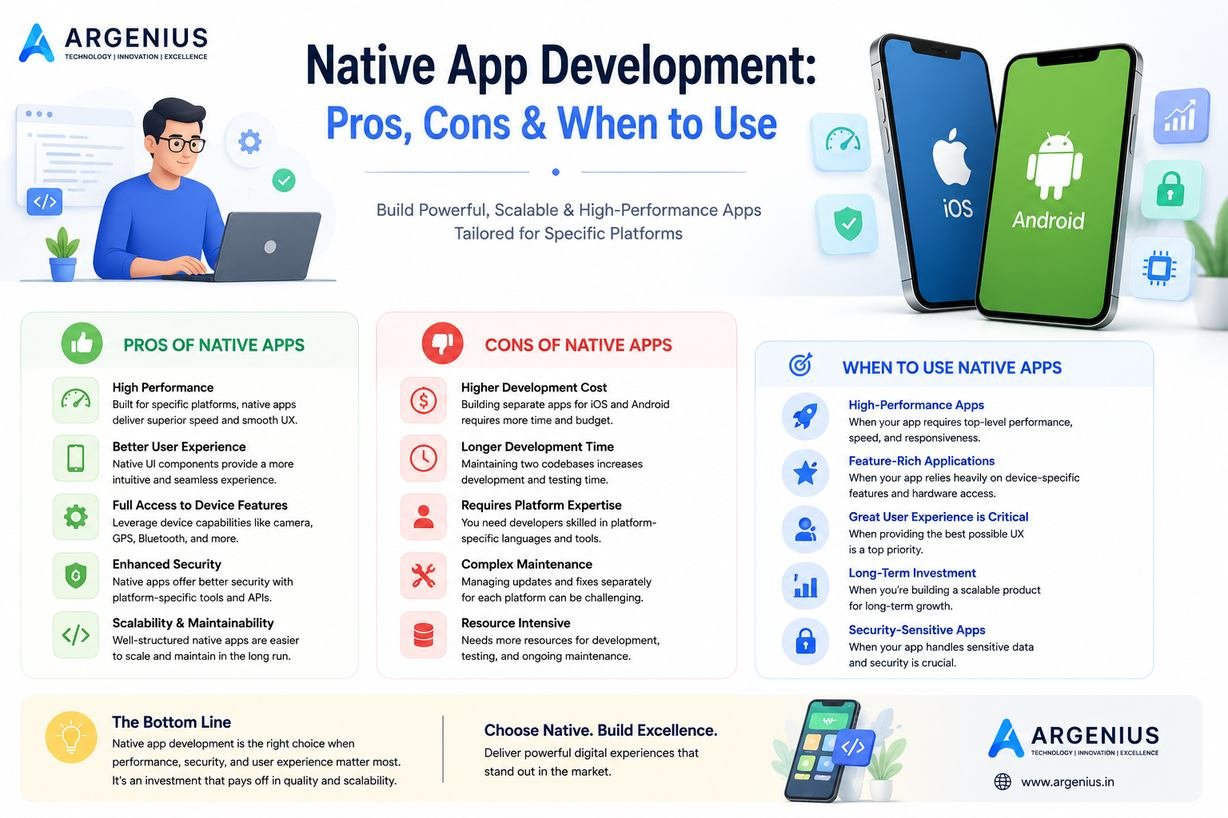
Advantages of Native App Development
Native development remains the preferred approach for businesses that require premium-quality mobile applications.
Major benefits include:
Superior Performance
Native apps are optimized specifically for the target operating system.
Benefits include:
- Faster loading
- Smooth animations
- Better responsiveness
- Lower memory usage
- Faster processing
Performance is particularly important for gaming, financial services, healthcare, and enterprise applications.
Better User Experience
Every operating system has its own design principles.
Native development follows:
- Material Design (Android)
- Human Interface Guidelines (iOS)
Users receive interfaces that feel natural because every interaction matches platform expectations.
Maximum Security
Native applications offer stronger security through platform-specific protection mechanisms.
Security advantages include:
- Biometric authentication
- Secure data storage
- Encrypted communication
- Hardware-backed security
- Secure payment integration
These capabilities make native apps ideal for industries handling sensitive information.
Full Hardware Integration
Native apps can fully utilize device capabilities.
Examples include:
- Face ID
- Touch ID
- GPS
- NFC
- Bluetooth
- Camera
- Accelerometer
- Gyroscope
- AR features
- Background processing
This level of integration is often difficult to achieve with other development approaches.
Better Stability
Because native apps are built using official SDKs and development tools, they tend to be more stable after operating system updates.
Users experience:
- Fewer crashes
- Better compatibility
- Improved reliability
- Faster OS support
Disadvantages of Native App Development
Although native apps offer many advantages, they also have certain limitations.
Higher Development Cost
Separate applications require:
- Android developers
- iOS developers
- Independent testing
- Separate maintenance
This generally increases the project budget.
Longer Development Time
Since Android and iOS apps are developed independently, building both platforms typically takes more time than developing a single cross-platform application.
Separate Codebases
Every feature must usually be implemented twice.
Examples include:
- Login
- Payment systems
- Notifications
- User profiles
- Settings
- Dashboards
Managing two codebases requires more resources over time.
Higher Maintenance Effort
Updates must be tested and released separately for Android and iOS.
This includes:
- Bug fixes
- New features
- Security patches
- OS compatibility updates
Native vs Cross-Platform Development
| Feature |
Native Apps |
Cross-Platform Apps |
| Performance |
Excellent |
Very Good |
| User Experience |
Excellent |
Very Good |
| Development Cost |
Higher |
Lower |
| Development Time |
Longer |
Faster |
| Maintenance |
Separate |
Single Codebase |
| Hardware Access |
Full |
Very Good |
| Security |
Excellent |
High |
| Scalability |
Excellent |
Excellent |
| Best for Complex Apps |
Yes |
Sometimes |
| Time to Market |
Slower |
Faster |
When Should You Choose Native App Development?
Native development is the right choice when your application demands exceptional performance, advanced hardware access, or enterprise-grade reliability.
Choose native development if you're building:
- Banking applications
- Healthcare apps
- Fintech platforms
- Enterprise software
- Gaming applications
- Video editing apps
- AR/VR applications
- Navigation apps
- High-performance e-commerce platforms
- AI-powered mobile applications
These applications benefit from the speed, security, and deep system integration that native development provides.
When Cross-Platform Development Is a Better Choice
Not every project requires native development.
Cross-platform solutions like Flutter are ideal for:
- Startups
- MVP development
- Business apps
- Education apps
- Food delivery apps
- Booking platforms
- CRM applications
- Social networking apps
- Internal business tools
They reduce costs while allowing businesses to launch on Android and iOS simultaneously.
Native App Development Process
A successful native application typically follows these stages:
1. Requirement Analysis
Understand business goals, target audience, and feature requirements.
2. UI/UX Design
Design platform-specific user interfaces that follow Android and iOS design guidelines.
3. App Architecture
Plan backend systems, APIs, databases, authentication, and integrations.
4. Development
Build Android and iOS applications separately using native technologies.
5. Testing
Perform extensive testing across supported devices and operating system versions.
6. Deployment
Publish the apps on Google Play Store and Apple App Store.
7. Maintenance
Release updates, fix bugs, improve security, and add new features over time.
Best Technologies for Native App Development
Android
- Kotlin
- Java
- Android Studio
- Jetpack Compose
iOS
- Swift
- SwiftUI
- Objective-C
- Xcode
Backend
Database
- MySQL
- PostgreSQL
- Firebase
Cloud
- AWS
- Google Cloud
- Microsoft Azure
Common Mistakes Businesses Make
Many organizations invest in native development without evaluating whether it matches their business objectives.
Avoid these mistakes:
- Choosing native for a simple MVP
- Ignoring long-term maintenance costs
- Building without scalability planning
- Skipping UX research
- Underestimating testing time
- Ignoring App Store guidelines
- Weak API architecture
- Poor security implementation
- No analytics integration
- Delaying post-launch updates
Planning your app strategy carefully helps reduce costs and improve long-term success.
Why Businesses Choose Argenius
At Argenius, we specialize in building secure, scalable, and high-performance native mobile applications for Android and iOS. Our experienced development team creates apps that combine premium UI/UX, robust backend architecture, seamless API integrations, enterprise-grade security, and optimized performance.
Whether you're launching a fintech platform, healthcare application, e-commerce solution, logistics app, enterprise software, or customer-facing mobile product, we deliver custom native applications tailored to your business goals. From strategy and design to deployment and ongoing maintenance, we provide end-to-end development services that help businesses achieve long-term digital success.
Final Thoughts
Native app development remains the gold standard for businesses that demand exceptional performance, security, and user experience. While it typically requires a larger investment than cross-platform development, the long-term benefits often outweigh the additional cost for complex or mission-critical applications.
If your app depends on advanced device features, maximum speed, or enterprise-level reliability, native development is often the best choice. On the other hand, startups and businesses looking for faster launches with limited budgets may find cross-platform development more suitable.
At Argenius, we help businesses evaluate their technical requirements and recommend the most effective development approach based on performance needs, budget, scalability, and future growth plans. Whether you choose Android, iOS, Flutter, or a hybrid strategy, our team ensures your mobile application is built to deliver lasting value.
Frequently Asked Questions
What is native app development?
Native app development is the process of creating mobile applications specifically for Android or iOS using official programming languages like Kotlin for Android and Swift for iOS.
Is native development better than Flutter?
Native development offers better performance and deeper hardware integration, while Flutter provides faster development and lower costs. The right choice depends on your business goals and application requirements.
Is native app development more expensive?
Yes. Since Android and iOS require separate codebases and development teams, native development generally costs more than cross-platform development.
Which businesses should choose native apps?
Businesses developing banking, healthcare, gaming, fintech, enterprise, logistics, or other high-performance applications often benefit most from native development.
Can Argenius build native Android and iOS apps?
Yes. Argenius provides custom native Android and iOS app development services, delivering secure, scalable, and high-performance mobile applications tailored to your business needs.