Node.js has become one of the most popular technologies for building fast, scalable, and real-time mobile application backends. Discover how Node.js powers APIs, authentication, databases, cloud services, and enterprise-grade mobile applications.
Introduction
Every successful mobile application relies on more than just an attractive user interface. Behind every login screen, payment gateway, chat system, push notification, or product catalog is a powerful backend that processes data, manages users, stores information, and ensures smooth communication between the app and the server.
As mobile applications become more feature-rich and data-driven, choosing the right backend technology becomes one of the most important decisions during development. Businesses need a backend that can handle thousands of simultaneous users, process requests quickly, integrate with third-party services, and scale as the application grows.
Among the many backend technologies available today, Node.js has emerged as one of the most trusted solutions for mobile application development. Built on Google's V8 JavaScript engine, Node.js enables developers to create fast, lightweight, and highly scalable server-side applications capable of handling real-time communication and high traffic efficiently.
Whether you're building an eCommerce app, food delivery platform, healthcare solution, ride-booking application, fintech product, or enterprise management system, Node.js provides the flexibility and performance required to support modern mobile experiences.
In this guide, you'll learn everything about Node.js mobile backend development, including server architecture, API development, authentication, databases, scalability, security, and why businesses worldwide continue to choose Node.js for mobile applications.
At Argenius, we develop secure, scalable, and high-performance Node.js backends that power Android and iOS applications with reliable APIs, cloud integration, and enterprise-level architecture.
What is Node.js?
Node.js is an open-source JavaScript runtime environment that allows developers to execute JavaScript outside the browser.
Unlike traditional backend technologies that rely on multi-threaded request handling, Node.js uses an event-driven, non-blocking I/O architecture, allowing it to process thousands of concurrent requests efficiently.
Because JavaScript can now be used for both frontend and backend development, development teams can work faster while maintaining consistency across the entire application stack.
Node.js is commonly used for:
- Mobile App Backends
- REST APIs
- Real-Time Applications
- Chat Systems
- Payment Processing
- Authentication Services
- Microservices
- Streaming Applications
- Cloud Applications
- Enterprise Software
Its speed, scalability, and vast ecosystem have made it one of the most widely adopted backend technologies in modern software development.
Why Node.js is Ideal for Mobile App Backends
Modern mobile applications constantly exchange data with servers. Every user action—such as logging in, placing an order, sending a message, or receiving a notification—requires fast communication between the app and the backend.
Node.js is particularly well-suited for these scenarios because it offers:
- High-speed request processing
- Real-time communication
- Efficient memory usage
- Non-blocking architecture
- Easy API development
- Excellent scalability
- Strong cloud compatibility
These advantages enable businesses to deliver responsive mobile experiences even under heavy traffic.
How a Mobile Backend Works
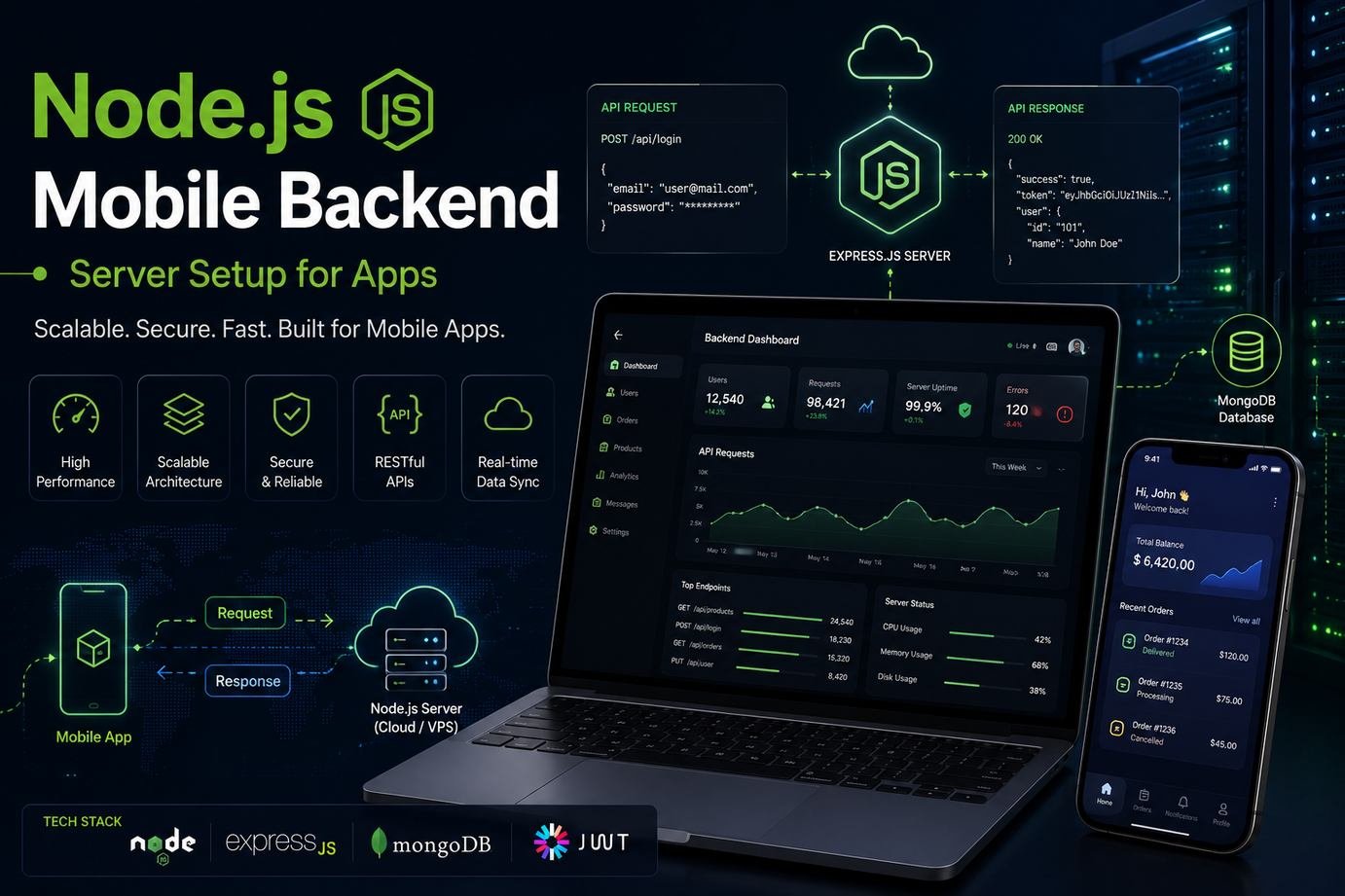
A mobile backend acts as the central system that manages communication between the mobile application, databases, third-party services, and cloud infrastructure.
A typical request follows this flow:
- User performs an action in the mobile app.
- The app sends an API request to the Node.js server.
- The backend validates the request.
- Business logic is executed.
- Data is fetched or updated in the database.
- The server sends a response back to the mobile application.
This architecture ensures that sensitive business logic and data remain secure while the mobile application focuses on delivering a smooth user experience.
Node.js Backend Architecture
A well-structured backend improves maintainability, scalability, and performance.
A typical Node.js backend includes:
- Client Application (Android/iOS)
- API Layer
- Authentication Layer
- Controllers
- Services
- Business Logic
- Repository Layer
- Database
- Cache Layer
- Cloud Storage
- Notification Services
This layered architecture helps development teams build applications that are easier to maintain and expand as business requirements evolve.
Express.js: The Foundation of Node.js APIs
Although Node.js provides the runtime environment, most backend applications use Express.js, a lightweight web framework that simplifies server development.
Express.js makes it easy to:
- Create REST APIs
- Manage routing
- Handle middleware
- Validate requests
- Process authentication
- Return structured JSON responses
Its simplicity and flexibility make it the most widely used framework for Node.js backend development.
Building REST APIs with Node.js
REST APIs act as the communication bridge between mobile applications and the backend.
Every feature within a mobile app typically relies on one or more APIs.
Examples include:
- User Registration
- Login
- Product Listing
- Order Management
- Payment Processing
- Notifications
- User Profiles
- Search
- Wishlist
- Reviews
Node.js makes it easy to build secure, fast, and scalable REST APIs capable of handling thousands of requests every second.
Authentication and Authorization
Security is one of the most important aspects of backend development.
Node.js applications typically implement secure authentication using JSON Web Tokens (JWT) or OAuth-based authentication.
A secure authentication system generally includes:
- User Registration
- Secure Login
- Password Encryption
- Token Generation
- Token Validation
- Session Management
- Role-Based Access Control
These mechanisms ensure that only authorized users can access protected resources and perform sensitive operations.
Database Integration
Node.js supports both SQL and NoSQL databases, allowing businesses to choose the solution that best fits their requirements.
Common database options include:
MongoDB
MongoDB is a NoSQL database known for its flexibility and scalability.
It is ideal for:
- Social Media Apps
- Chat Applications
- Content Platforms
- Real-Time Systems
- Startups
MySQL
MySQL remains one of the most trusted relational databases for structured business applications.
It is commonly used for:
- eCommerce Platforms
- CRM Systems
- ERP Software
- Banking Applications
- Inventory Management
PostgreSQL
PostgreSQL offers advanced relational database capabilities and is widely used in enterprise applications requiring high data integrity and complex queries.
Real-Time Features with Socket.IO
Many modern mobile applications rely on real-time communication to enhance user engagement.
Node.js integrates seamlessly with Socket.IO, enabling instant, bidirectional communication between clients and the server.
Common real-time features include:
- Live Chat
- Instant Notifications
- Ride Tracking
- Order Status Updates
- Multiplayer Games
- Live Auctions
- Collaboration Tools
This makes Node.js an excellent choice for applications where users expect immediate updates without refreshing the app.
Why Businesses Choose Node.js
Node.js has become a preferred backend technology for startups and enterprises because it combines speed, scalability, and development efficiency.
Some key business benefits include:
- Faster development with JavaScript
- High performance under heavy traffic
- Scalable architecture for growing applications
- Large ecosystem of open-source packages
- Excellent support for cloud deployment
- Cost-effective development and maintenance
- Real-time communication capabilities
- Easy integration with third-party services
Whether launching a startup MVP or building an enterprise platform, Node.js provides a reliable foundation for modern mobile applications.
Node.js vs Laravel
Node.js and Laravel are both excellent backend technologies, but they are designed with different programming languages and development approaches.
Laravel is a PHP framework known for rapid web application development, while Node.js is a JavaScript runtime built for high-performance, event-driven applications.
| Feature |
Node.js |
Laravel |
| Language |
JavaScript |
PHP |
| Performance |
Excellent |
Very Good |
| Real-Time Features |
Built-in Support |
Additional Packages Required |
| API Development |
Excellent |
Excellent |
| Scalability |
High |
High |
| Learning Curve |
Moderate |
Easy |
| Best For |
Mobile APIs, Real-Time Apps |
Business Web Applications |
Choose Node.js When
- Building mobile application backends
- Creating chat applications
- Developing live tracking systems
- Handling thousands of concurrent users
- Developing streaming applications
Choose Laravel When
- Building business portals
- Creating CMS platforms
- Developing ERP or CRM systems
- Building content-heavy websites
- Working primarily with PHP technologies
Node.js vs Django
Django is a Python-based backend framework, whereas Node.js uses JavaScript for server-side development.
| Feature |
Node.js |
Django |
| Language |
JavaScript |
Python |
| Performance |
Excellent |
Very Good |
| Real-Time Communication |
Excellent |
Moderate |
| AI Integration |
Through APIs |
Native Python Ecosystem |
| Development Speed |
Fast |
Fast |
| Scalability |
High |
High |
Django is ideal for AI, machine learning, and data-driven applications, while Node.js excels in real-time and high-concurrency mobile applications.
Node.js vs Firebase
Firebase provides Backend-as-a-Service (BaaS), whereas Node.js allows developers to build and manage a fully customized backend.
| Feature |
Node.js |
Firebase |
| Backend Control |
Full |
Limited |
| Custom APIs |
Yes |
Limited |
| Database Choice |
Multiple |
Firestore / Realtime DB |
| Authentication |
Fully Customizable |
Built-in |
| Scalability |
Excellent |
Excellent |
| Vendor Lock-in |
No |
Yes |
| Best For |
Medium & Large Applications |
MVPs & Small Apps |
If your application requires complete flexibility, Node.js is generally the better option.
Performance Optimization
Node.js is known for its high performance, but proper optimization is essential as applications grow.
Some best practices include:
- Database indexing
- Response caching
- Gzip compression
- Lazy loading
- Image optimization
- Connection pooling
- Efficient API design
- Load balancing
These techniques reduce server load and improve response times.
Security Best Practices
A secure backend protects user data and business operations.
Recommended security practices include:
JWT Authentication
Use secure token-based authentication for API access.
Password Encryption
Store passwords using modern hashing algorithms such as bcrypt.
HTTPS Everywhere
Encrypt communication between mobile apps and servers.
Input Validation
Validate and sanitize all user input before processing.
Rate Limiting
Protect APIs against brute-force attacks and abuse.
Environment Variables
Store sensitive credentials securely instead of hardcoding them.
Regular Dependency Updates
Keep Node.js packages updated to address known security vulnerabilities.
Scaling Node.js Applications
As user traffic grows, backend infrastructure should scale without affecting performance.
Popular scaling techniques include:
- Horizontal Scaling
- Load Balancers
- Docker Containers
- Kubernetes
- Redis Caching
- Microservices Architecture
- CDN Integration
- Cloud Auto Scaling
These strategies help applications handle millions of requests efficiently.
Microservices Architecture
Large applications often divide backend functionality into independent services.
Examples include:
- Authentication Service
- Payment Service
- Notification Service
- User Management
- Product Catalog
- Analytics Service
- Search Service
Microservices improve maintainability, scalability, and deployment flexibility.
Cloud Deployment
Node.js applications can be deployed on a variety of cloud platforms.
Popular options include:
- AWS
- Microsoft Azure
- Google Cloud Platform
- DigitalOcean
- Railway
- Render
- Vercel (for APIs)
- Heroku (legacy/small projects)
Cloud deployment provides high availability, automated scaling, backups, and improved reliability.
Advantages of Node.js
Node.js offers numerous technical and business benefits.
Some key advantages include:
- Fast request processing
- Non-blocking architecture
- Real-time communication
- Large NPM ecosystem
- JavaScript across frontend and backend
- Easy cloud deployment
- Excellent API development
- Strong community support
- High scalability
- Cost-effective development
- Cross-platform compatibility
- Rapid development cycle
These benefits make Node.js one of the most widely adopted backend technologies for modern applications.
Limitations of Node.js
While Node.js is powerful, it's important to understand its limitations.
Some challenges include:
- CPU-intensive tasks can impact performance
- Callback complexity in poorly structured projects
- Heavy computations may require worker threads
- Package quality varies across the NPM ecosystem
- Poor architecture can reduce scalability
With experienced developers and proper architecture, these challenges can be effectively managed.
Best Use Cases
Node.js is suitable for a wide variety of mobile applications.
Popular use cases include:
- E-commerce Apps
- Food Delivery Platforms
- Taxi Booking Apps
- Healthcare Applications
- FinTech Solutions
- Social Media Platforms
- Live Chat Systems
- Video Streaming Apps
- IoT Platforms
- Logistics Systems
- Education Platforms
- Enterprise Applications
Its flexibility makes it a strong choice for both startups and large enterprises.
Industries Using Node.js
Node.js is widely adopted across industries that require speed, scalability, and real-time communication.
Common industries include:
- E-commerce
- Healthcare
- Banking & Finance
- Logistics
- Education
- Real Estate
- Travel & Hospitality
- Manufacturing
- Media & Entertainment
- SaaS Platforms
Its versatility allows businesses in nearly every sector to build reliable backend systems.
Common Mistakes Businesses Make
Many backend issues arise from poor planning rather than technology limitations.
Avoid these common mistakes:
- Designing APIs without documentation
- Ignoring authentication and authorization
- Skipping input validation
- Not implementing caching
- Writing tightly coupled code
- Ignoring monitoring and logging
- Delaying performance testing
- Hardcoding sensitive credentials
- Not planning for scalability
- Choosing technology before defining business goals
Following backend best practices from the beginning helps reduce future maintenance costs.
Future of Node.js
Node.js continues to evolve with improvements in performance, developer tools, and cloud-native architecture.
Several trends are shaping its future:
- Wider adoption of TypeScript
- Serverless computing
- Edge Functions
- AI-powered backend services
- Event-driven microservices
- Improved security tools
- Better cloud integration
- Faster runtime performance
As mobile applications continue to demand real-time experiences and scalable APIs, Node.js is expected to remain one of the leading backend technologies.
Why Businesses Choose Argenius
A reliable backend is the backbone of every successful mobile application. At Argenius, we build robust Node.js backend systems designed for performance, security, and long-term scalability.
Our services include backend architecture planning, REST API development, authentication systems, database design, cloud deployment, third-party integrations, payment gateway implementation, real-time communication, and ongoing maintenance.
Whether you're launching a startup MVP or developing an enterprise-grade mobile application, our team ensures your backend is secure, scalable, and ready to support future growth.
Final Thoughts
Node.js has transformed backend development by providing a fast, lightweight, and scalable platform capable of powering modern mobile applications. Its event-driven architecture, extensive package ecosystem, and ability to handle real-time communication make it one of the best choices for Android and iOS application backends.
From authentication and API development to cloud deployment and microservices, Node.js offers everything businesses need to build secure and future-ready mobile solutions.
If you're planning to develop a high-performance mobile application, choosing the right backend architecture is just as important as selecting the right frontend technology. A well-designed Node.js backend provides the flexibility and scalability needed to support your application's long-term success.
At Argenius, we help businesses build enterprise-grade Node.js backends that deliver speed, security, and seamless user experiences.
Frequently Asked Questions
Why is Node.js popular for mobile app backends?
Node.js offers fast request processing, real-time communication, scalability, and an extensive ecosystem, making it ideal for powering modern mobile applications.
Is Node.js better than Laravel for mobile APIs?
Both are excellent choices, but Node.js is generally preferred for real-time features and high-concurrency mobile applications, while Laravel excels in PHP-based business systems.
Which database works best with Node.js?
Node.js supports MongoDB, MySQL, PostgreSQL, MariaDB, and many other databases. The best choice depends on your application's requirements.
Can Node.js handle millions of users?
Yes. With proper architecture, caching, load balancing, and cloud infrastructure, Node.js can efficiently support applications with millions of users.
Is Node.js secure for enterprise applications?
Yes. When implemented with JWT authentication, HTTPS, input validation, encryption, and secure coding practices, Node.js is suitable for enterprise-grade applications.
Does Node.js support real-time features?
Absolutely. Libraries such as Socket.IO make it easy to build live chat, notifications, tracking systems, multiplayer games, and other real-time functionalities.
Is Node.js suitable for startups?
Yes. Its rapid development cycle, scalability, and cost-effectiveness make Node.js an excellent choice for startups building MVPs and scalable products.
Can Argenius build a complete Node.js backend?
Yes. Argenius provides end-to-end Node.js backend development, including architecture design, API development, database integration, cloud deployment, security implementation, and long-term maintenance.