Confused between Progressive Web Apps (PWAs) and Native Apps? This complete guide compares both technologies based on performance, development cost, user experience, SEO, security, offline capabilities, and business use cases to help you make the right decision.
Introduction
Businesses today have more options than ever when it comes to building mobile experiences for their customers. While native mobile applications have been the standard for years, Progressive Web Apps (PWAs) have emerged as a powerful alternative that combines the accessibility of websites with many features traditionally associated with mobile apps.
Companies like Starbucks, Pinterest, Uber, Twitter Lite, and Alibaba have successfully used PWAs to improve user engagement, increase conversions, and reduce development costs. At the same time, millions of businesses continue investing in native Android and iOS applications because of their unmatched performance, security, and deep integration with mobile devices.
So which approach is right for your business?
The answer depends on your goals, target audience, budget, feature requirements, and long-term digital strategy. Choosing the wrong platform can result in higher development costs, lower user engagement, and slower business growth.
In this comprehensive guide, we'll compare Progressive Web Apps vs Native Apps across every important factor, including performance, offline functionality, SEO, security, development cost, scalability, maintenance, and user experience. By the end, you'll have a clear understanding of which solution best fits your business.
At Argenius, we help startups, SMEs, and enterprises build both Progressive Web Apps and Native Mobile Applications that are secure, scalable, and optimized for long-term business success.
What Is a Progressive Web App (PWA)?
A Progressive Web App is a web application that behaves like a mobile app while running inside a web browser.
Unlike traditional websites, PWAs can:
- Be installed on a user's home screen
- Work offline or with limited internet
- Send push notifications (supported browsers)
- Load quickly
- Provide app-like navigation
- Update automatically without manual downloads
PWAs are built using modern web technologies such as HTML, CSS, JavaScript, and frameworks like React, Angular, Vue.js, or Next.js, along with Service Workers and Web App Manifests.
What Is a Native App?
A Native App is developed specifically for one operating system using platform-specific technologies.
Android development typically uses:
iOS development typically uses:
Native apps are downloaded from app stores and are designed to take full advantage of device hardware and operating system features.
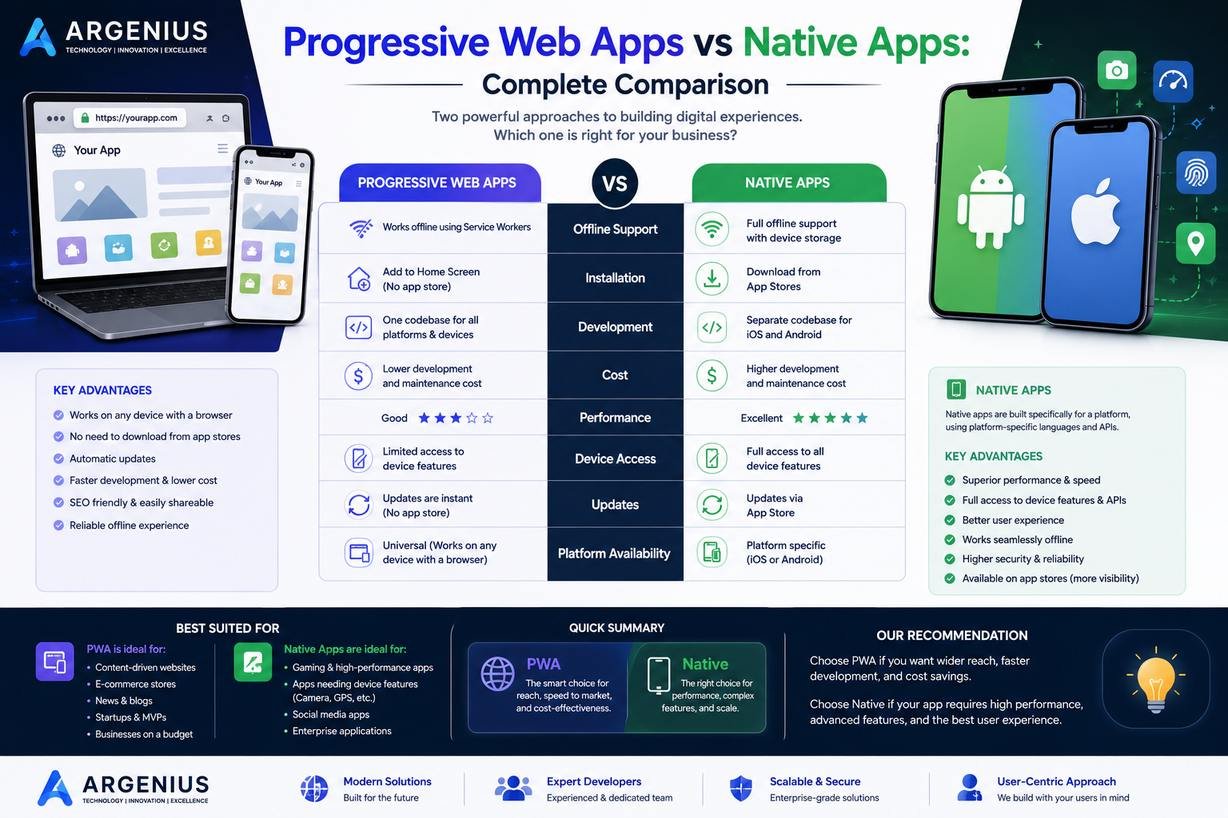
Progressive Web Apps vs Native Apps: Quick Comparison
| Feature |
Progressive Web App |
Native App |
| Installation |
Browser/Home Screen |
App Store |
| Development Cost |
Lower |
Higher |
| Development Time |
Faster |
Longer |
| Performance |
Very Good |
Excellent |
| Offline Support |
Good |
Excellent |
| SEO |
Yes |
No |
| App Store Required |
No |
Yes |
| Push Notifications |
Supported on many platforms (limitations on some) |
Full Support |
| Device Hardware Access |
Limited |
Full Access |
| Maintenance |
Easier |
Separate Platform Updates |
| User Experience |
Excellent |
Outstanding |
Development Cost Comparison
Budget is often one of the biggest deciding factors.
Progressive Web Apps
PWAs usually cost less because developers maintain:
- One codebase
- One deployment
- One hosting environment
- One update process
This makes them highly attractive for startups and growing businesses.
Native Apps
Native applications require:
- Android development
- iOS development
- Independent testing
- Separate deployments
- Platform-specific maintenance
As a result, the initial investment is generally higher.
Performance Comparison
Performance directly influences user satisfaction.
Progressive Web Apps
Modern PWAs deliver excellent performance for:
- E-commerce
- Booking systems
- Education platforms
- CRM software
- Business portals
- Service marketplaces
They are fast enough for most business applications.
Native Apps
Native applications communicate directly with the operating system.
Advantages include:
- Faster startup
- Better animations
- Lower latency
- Better memory management
- Higher frame rates
- Superior graphics performance
Native apps remain the preferred option for performance-intensive applications.
User Experience
An intuitive user experience encourages higher engagement and customer retention.
Progressive Web Apps
PWAs offer:
- No installation barrier
- Instant access through URLs
- Automatic updates
- Responsive design
- App-like interfaces
These benefits reduce friction during onboarding.
Native Apps
Native applications provide:
- Platform-specific navigation
- Smooth animations
- Rich interactions
- Better gesture support
- Deeper system integration
For users who spend significant time in an app, native experiences often feel more polished.
Offline Functionality
Offline access can be a major advantage for users with unreliable internet connections.
Progressive Web Apps
Using Service Workers, PWAs can:
- Cache content
- Display previously viewed pages
- Store temporary data
- Continue limited functionality offline
The extent of offline capability depends on how the app is designed.
Native Apps
Native applications can store large amounts of local data and continue functioning even without an internet connection, depending on the application's architecture.
SEO Advantages
One of the biggest benefits of PWAs is discoverability.
Progressive Web Apps
Because they are web-based, PWAs can:
- Be indexed by Google
- Rank in search results
- Generate organic traffic
- Support content marketing
- Improve lead generation
This makes them an excellent choice for businesses relying on SEO.
Native Apps
Native applications are discovered primarily through:
- Google Play Store
- Apple App Store
- App Store Optimization (ASO)
They do not benefit from traditional search engine indexing in the same way web pages do.
Device Hardware Access
Hardware integration is another major differentiator.
Progressive Web Apps Support
- Camera
- Microphone
- Location
- File uploads
- Clipboard
- Limited push notifications
- Home screen installation
Native Apps Support
- Camera
- GPS
- Bluetooth
- NFC
- Face ID
- Fingerprint Scanner
- Contacts
- Accelerometer
- Gyroscope
- Background services
- Health sensors
- Advanced push notifications
Native apps provide deeper access to device capabilities.
Security Comparison
Security should never be compromised.
Progressive Web Apps
PWAs use:
- HTTPS
- SSL certificates
- Authentication
- Secure APIs
- Data encryption
Native Apps
Native applications add:
- Secure Keychain/Keystore
- Biometric authentication
- Device-level encryption
- Hardware-backed security
- Secure local storage
Both approaches can be highly secure when implemented correctly.
Maintenance and Updates
Keeping your application updated is essential.
Progressive Web Apps
Advantages include:
- Instant updates
- No user downloads
- Centralized deployment
- Easier maintenance
Users always access the latest version automatically.
Native Apps
Updates require:
- App Store submission
- Review process
- User downloads
- Platform-specific testing
Maintenance is generally more time-consuming.
Scalability
Both PWAs and Native Apps can support business growth.
PWAs
Ideal for:
- SaaS platforms
- Business portals
- E-commerce
- Booking websites
- Educational platforms
- CRM software
Native Apps
Ideal for:
- Banking
- Healthcare
- Gaming
- Social networking
- Ride-sharing
- Fitness tracking
- Video streaming
- Enterprise mobility
The choice depends on the complexity of your product.
When Should You Choose a Progressive Web App?
A Progressive Web App is an excellent choice if you:
- Need a faster launch
- Have a limited budget
- Want SEO benefits
- Need broad device compatibility
- Build a customer portal
- Develop an e-commerce store
- Want easier maintenance
- Expect users to access your service via browsers
PWAs are especially effective for businesses focused on discoverability and rapid deployment.
When Should You Choose a Native App?
Choose native development if your application requires:
- Maximum performance
- Offline-first functionality
- Advanced hardware access
- Rich animations
- High-security environments
- Enterprise-grade features
- Gaming capabilities
- Real-time mobile experiences
Native apps are the best choice for feature-rich, mobile-first products.
Can You Combine Both?
Absolutely.
Many successful businesses use both technologies together.
A common strategy is:
Phase 1
Launch a PWA to attract users through search engines and validate the business concept.
Phase 2
Develop Android and iOS apps for loyal customers who require advanced mobile features.
Phase 3
Synchronize both platforms through shared APIs, allowing users to enjoy a consistent experience across web and mobile devices.
This hybrid digital strategy balances accessibility, cost, and user engagement.
Common Mistakes Businesses Make
Avoid these common errors when selecting your technology stack:
- Choosing native apps without evaluating actual feature requirements
- Assuming PWAs can replace every native capability
- Ignoring SEO opportunities
- Underestimating maintenance costs
- Focusing only on initial development expenses
- Overlooking future scalability
- Skipping user research
- Ignoring offline requirements
- Choosing technology based on trends rather than business needs
- Delaying long-term product planning
A technology decision should always align with business objectives rather than short-term preferences.
Why Businesses Choose Argenius
At Argenius, we believe that the best technology is the one that supports your business goals—not the one that's simply trending. Our experts evaluate your audience, business model, budget, expected traffic, feature requirements, and future growth strategy before recommending the most suitable solution.
Whether you need a Progressive Web App, a Native Android application, an iOS app, or a complete web and mobile ecosystem, we provide end-to-end development services. From strategy and UI/UX design to backend architecture, API integration, cloud deployment, testing, and ongoing maintenance, we deliver secure, scalable, and high-performing digital products that help businesses grow.
Final Thoughts
The debate between Progressive Web Apps and Native Apps isn't about finding a universal winner—it's about selecting the right solution for your unique business needs.
Progressive Web Apps excel in affordability, SEO, accessibility, and rapid deployment, making them an excellent choice for businesses that prioritize reach and cost-efficiency. Native Apps continue to lead in performance, security, offline capabilities, and advanced hardware integration, making them the preferred option for feature-rich mobile experiences.
For many businesses, the smartest approach is to combine both. A Progressive Web App can attract new users through search engines while Native Apps provide loyal customers with a richer and more engaging mobile experience.
At Argenius, we help businesses choose the right technology stack and build future-ready digital products that deliver exceptional user experiences, measurable business results, and sustainable long-term growth.
Frequently Asked Questions
What is the difference between a Progressive Web App and a Native App?
A Progressive Web App runs through a web browser and can be installed on a device without an app store, while a Native App is built specifically for Android or iOS and is downloaded from an app store.
Are Progressive Web Apps cheaper than Native Apps?
Yes. PWAs generally have lower development and maintenance costs because they use a single codebase and don't require separate Android and iOS development.
Can Progressive Web Apps work offline?
Yes. PWAs use Service Workers to cache content and provide offline functionality, although the extent of offline support depends on the application's design.
Which is better for SEO?
Progressive Web Apps are better for SEO because they are web-based and can be indexed by search engines, helping businesses generate organic traffic.
Can Argenius develop both PWAs and Native Apps?
Yes. Argenius develops high-performance Progressive Web Apps, Android applications, iOS applications, and integrated web-mobile solutions tailored to your business objectives.