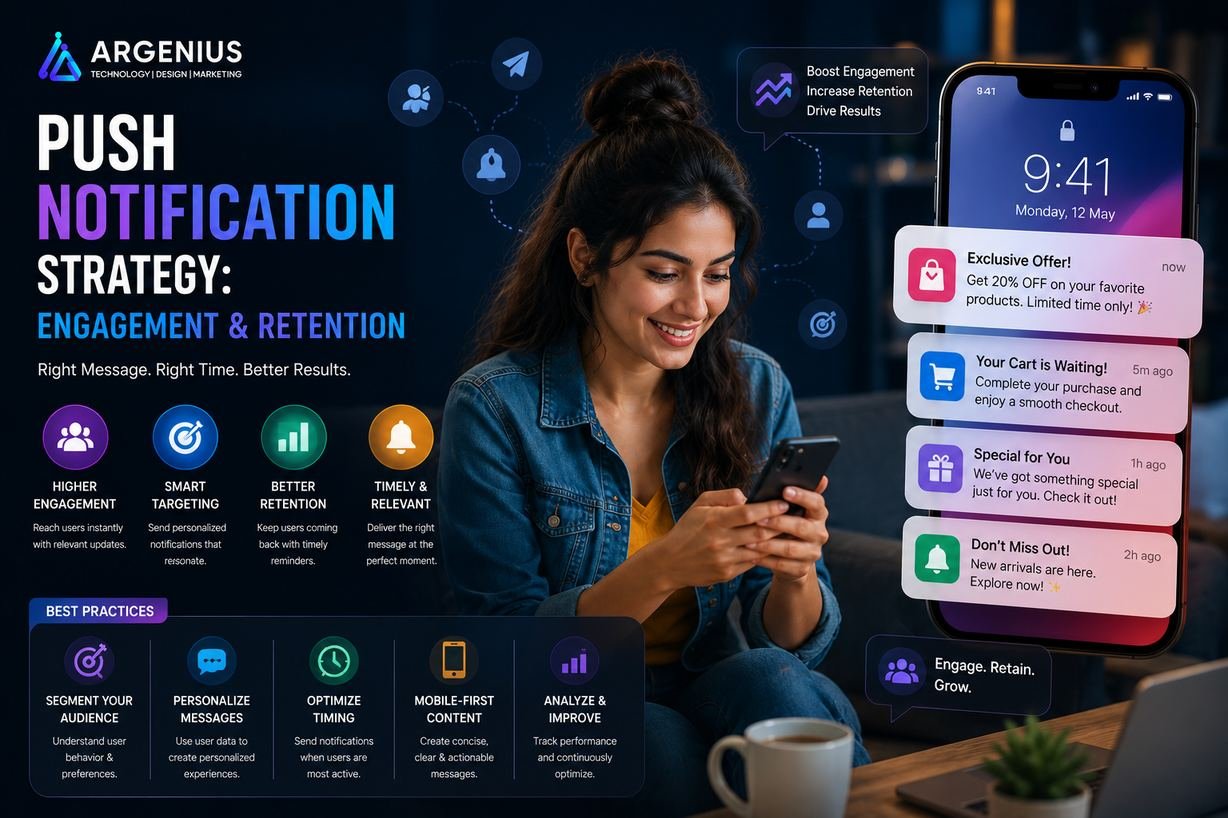
Push notifications are one of the most effective ways to improve user engagement, increase app retention, and boost conversions. This complete guide explains push notification strategies, personalization, segmentation, AI automation, best practices, technology stack, implementation methods, and how businesses can maximize customer engagement through smart notifications.
Keeping users engaged after they install a mobile application is one of the biggest challenges for businesses today. Millions of apps compete for user attention, and many are uninstalled within the first few weeks due to a lack of ongoing engagement. This is where a well-planned push notification strategy becomes one of the most powerful tools for improving user retention, increasing activity, and driving long-term customer loyalty.
Push notifications are short, timely messages delivered directly to a user's device, even when the application is not actively being used. They help businesses remind users about important updates, encourage them to complete actions, promote new offers, re-engage inactive users, and deliver personalized experiences.
However, sending too many irrelevant notifications can frustrate users and lead to higher opt-out or uninstall rates. A successful push notification strategy focuses on delivering the right message to the right user at the right time. Personalization, segmentation, automation, and analytics are essential for maximizing engagement while maintaining a positive user experience.
Whether you're developing an eCommerce app, food delivery platform, fintech solution, healthcare application, fitness app, education platform, or SaaS product, a smart notification strategy can significantly improve customer retention and business growth.
In this comprehensive guide, you'll learn everything about Push Notification Strategy, including notification types, engagement techniques, personalization, AI automation, implementation methods, technology stack, best practices, common mistakes, and future trends.
At Argenius, we build intelligent mobile applications with advanced push notification systems that help businesses increase engagement, improve retention, and maximize customer lifetime value.
What is a Push Notification Strategy?
A push notification strategy is a planned approach to sending relevant, personalized, and timely notifications that encourage users to interact with an application and complete desired actions.
Rather than sending random promotional messages, businesses use data-driven strategies to deliver notifications based on user behavior, preferences, activity, and business goals.
A successful strategy helps businesses:
- Increase Daily Active Users
- Improve User Retention
- Reduce App Abandonment
- Boost Sales & Conversions
- Encourage Repeat Purchases
- Improve Customer Loyalty
- Deliver Personalized Experiences
- Increase Session Duration
- Promote New Features
- Improve Customer Satisfaction
Why Push Notifications Matter
Push notifications have become one of the highest-performing engagement channels for mobile applications.
Key reasons include:
- Instant Communication
- High Visibility
- Better User Engagement
- Increased App Retention
- Improved Customer Experience
- Higher Conversion Rates
- Personalized Marketing
- Lower Marketing Costs
- Better Customer Relationships
- Real-Time Updates
Businesses that implement intelligent notification strategies generally experience better retention and higher customer lifetime value.
Types of Push Notifications
Different business goals require different notification strategies.
Transactional Notifications
Transactional notifications provide important account or order updates.
Examples include:
- Payment Confirmation
- Order Status
- Booking Confirmation
- Password Reset
- OTP Verification
- Account Alerts
These notifications are expected by users and typically have very high open rates.
Promotional Notifications
Promotional notifications help businesses increase sales and engagement.
Examples include:
- Limited-Time Offers
- Discount Coupons
- Flash Sales
- New Product Launches
- Seasonal Campaigns
- Referral Rewards
Behavioral Notifications
Behavior-based notifications are triggered by user actions.
Examples include:
- Abandoned Cart Reminder
- Incomplete Registration
- Subscription Renewal Reminder
- Wishlist Price Drop
- Reward Expiration
These notifications are highly effective because they are directly related to user activity.
Personalized Notifications
Personalized notifications use customer data to create more relevant experiences.
Examples include:
- Recommended Products
- Personalized Workout Reminder
- Learning Progress
- Financial Insights
- Investment Suggestions
- Health Tracking Updates
Engagement Notifications
Designed to encourage users to open the application regularly.
Examples include:
- Daily Challenges
- Weekly Reports
- New Content Alerts
- Community Updates
- Achievement Badges
Location-Based Notifications
These notifications use GPS or geofencing.
Examples include:
- Nearby Store Offers
- Restaurant Promotions
- Event Notifications
- Travel Updates
Reminder Notifications
Help users complete important tasks.
Examples include:
- Appointment Reminder
- Bill Payment Reminder
- Medicine Reminder
- Fitness Reminder
- Study Reminder
How Push Notifications Work
A typical notification workflow includes:
- User grants notification permission.
- Device receives a unique push token.
- Backend securely stores the device token.
- Business creates a notification campaign.
- Notification service (such as Firebase Cloud Messaging) processes the request.
- The notification is delivered to eligible devices.
- User opens the notification.
- Analytics record delivery, open rate, and conversion data.
- Businesses optimize future campaigns based on insights.
This process enables businesses to deliver real-time communication while measuring campaign effectiveness.
Business Models That Benefit from Push Notifications
Push notifications are valuable across many industries.
Popular use cases include:
- eCommerce Apps
- Food Delivery Apps
- Banking & Finance Apps
- Healthcare Apps
- Fitness Apps
- Education Platforms
- Travel Booking Apps
- Taxi Booking Apps
- OTT Streaming Apps
- News Apps
- Social Media Platforms
- SaaS Applications
Essential User Notification Features
A successful notification system should include:
- Personalized Notifications
- Rich Notifications
- Silent Notifications
- Action Buttons
- Deep Linking
- Notification History
- Scheduled Notifications
- Preference Management
- Multi-Language Support
- Notification Categories
Admin Panel Features
Businesses require complete control over notification campaigns.
Key features include:
- Campaign Dashboard
- Audience Segmentation
- Notification Scheduling
- A/B Testing
- Analytics Dashboard
- User Segmentation
- Automation Rules
- Delivery Reports
- Open Rate Tracking
- Conversion Analytics
Recommended Technology Stack
Mobile Development
- Flutter
- React Native
- Kotlin
- Swift
Backend
Notification Services
- Firebase Cloud Messaging (FCM)
- OneSignal
- Amazon SNS
Database
Cloud Infrastructure
- AWS
- Google Cloud
- Microsoft Azure
Analytics
- Firebase Analytics
- Google Analytics
- Mixpanel
A modern notification infrastructure ensures reliable delivery, scalability, and real-time campaign management.
Push Notification Implementation Process
Implementing a successful push notification system requires more than connecting a notification service. Businesses must design an intelligent notification architecture that delivers relevant, timely, and personalized messages while respecting user preferences.
1. Define Business Goals
Start by identifying the primary objectives of your notification strategy.
Common goals include:
- Increase Daily Active Users (DAU)
- Improve User Retention
- Recover Abandoned Carts
- Increase Sales
- Promote New Features
- Encourage Repeat Purchases
- Improve Customer Engagement
2. Select the Right Notification Platform
Choose a reliable push notification service based on your application's requirements.
Popular platforms include:
- Firebase Cloud Messaging (FCM)
- OneSignal
- Amazon SNS
- Azure Notification Hub
3. User Permission Strategy
Instead of requesting notification permission immediately after app installation, ask users at the right moment when they understand the value of notifications.
Best practices include:
- Explain Benefits First
- Request Permission Contextually
- Allow Users to Customize Preferences
- Support Easy Opt-In/Opt-Out
4. Backend Development
The backend manages device tokens, notification campaigns, scheduling, analytics, and automation.
Core modules include:
- Device Token Management
- Notification Scheduling
- Audience Segmentation
- Campaign Management
- Analytics Tracking
- Delivery Reports
- API Integration
5. Testing & Quality Assurance
Before launching notification campaigns, verify that the system performs correctly across different devices and operating systems.
Testing includes:
- Delivery Testing
- Notification Display
- Deep Linking
- Scheduling Validation
- Click Tracking
- Analytics Verification
- Device Compatibility Testing
6. Deployment & Monitoring
After successful testing, deploy the notification system and continuously monitor campaign performance.
Deployment tasks include:
- Production Configuration
- Analytics Setup
- Error Monitoring
- Performance Tracking
- Delivery Monitoring
User Engagement Strategy
Push notifications should create value for users instead of becoming interruptions.
Effective engagement techniques include:
- Welcome Notifications
- Personalized Recommendations
- Daily Tips
- Weekly Progress Reports
- New Feature Announcements
- Event Reminders
- Limited-Time Offers
- Loyalty Rewards
- Achievement Badges
- Community Updates
Consistent and meaningful communication keeps users actively engaged with your application.
User Retention Strategy
Retaining existing users is often more cost-effective than acquiring new ones.
High-performing retention campaigns include:
- Inactive User Reminders
- Abandoned Cart Recovery
- Subscription Renewal Alerts
- Reward Expiration Notifications
- Personalized Discounts
- Milestone Celebrations
- Birthday Offers
- Progress Tracking
- Goal Completion Reminders
- Re-engagement Campaigns
These notifications encourage users to return without feeling overwhelmed.
Audience Segmentation
Sending the same notification to every user usually leads to poor engagement.
Instead, segment users based on meaningful data such as:
- Age
- Location
- Language
- Purchase History
- Device Type
- App Usage
- Subscription Status
- User Interests
- Last Activity
- Customer Lifetime Value
Segmentation improves notification relevance and increases open rates.
Personalization
Personalized notifications significantly outperform generic campaigns because they are tailored to individual user behavior and preferences.
Examples include:
- Product Recommendations
- Personalized Workout Plans
- Learning Progress Updates
- Investment Insights
- Health Reminders
- Favorite Category Alerts
- Wishlist Price Drops
- Recently Viewed Products
- Location-Based Offers
- Personalized Greetings
Relevant messages create stronger customer relationships and improve long-term retention.
AI-Powered Push Notifications
Artificial Intelligence enables businesses to automate notification delivery and optimize user engagement.
Popular AI-powered capabilities include:
- Smart Send Time Optimization
- Predictive User Behavior
- Personalized Content Recommendations
- Churn Prediction
- Intelligent Audience Segmentation
- AI Message Generation
- Automated Campaign Optimization
- Recommendation Engines
- Engagement Prediction
- Customer Lifetime Value Analysis
AI helps deliver the right message to the right user at the ideal time.
A/B Testing
A/B testing helps businesses continuously improve notification performance.
Test different variables such as:
- Notification Title
- Message Content
- Emoji Usage
- CTA Buttons
- Send Time
- Images
- Audience Segments
- Personalization Level
Measure results using:
- Open Rate
- Click-Through Rate (CTR)
- Conversion Rate
- User Retention
- Revenue Generated
Continuous testing helps maximize campaign effectiveness.
Notification Timing Best Practices
Timing has a significant impact on notification success.
Recommended practices include:
- Respect User Time Zones
- Avoid Late-Night Notifications
- Send Based on User Activity
- Limit Daily Frequency
- Use Event-Based Triggers
- Schedule Promotional Messages During Peak Engagement Hours
Sending notifications at appropriate times increases engagement while reducing opt-outs.
Common Mistakes
Many applications lose users because of poor notification practices.
Avoid these common mistakes:
- Sending Too Many Notifications
- Generic Messaging
- Ignoring User Preferences
- Poor Timing
- No Audience Segmentation
- Excessive Promotional Content
- Broken Deep Links
- Lack of Analytics
- No A/B Testing
- Irrelevant Notifications
A thoughtful strategy helps build trust and keeps users engaged.
Push Notification Tools Comparison
| Feature |
Firebase Cloud Messaging |
OneSignal |
Amazon SNS |
| Free Tier |
✅ Yes |
✅ Yes |
Limited |
| Android Support |
✅ Excellent |
✅ Excellent |
✅ Yes |
| iOS Support |
✅ Yes |
✅ Yes |
✅ Yes |
| Audience Segmentation |
Basic |
Advanced |
Basic |
| Automation |
Basic |
Advanced |
Moderate |
| Analytics |
Basic |
Advanced |
Basic |
| A/B Testing |
Limited |
✅ Yes |
Limited |
| Best For |
Mobile Apps |
Marketing Campaigns |
Enterprise Systems |
Push Notification Development Cost (₹ INR)
The cost depends on the complexity of the notification system, automation, AI capabilities, and analytics.
| Solution Type |
Estimated Cost |
| Basic Push Notification Setup |
₹50,000 – ₹1,50,000 |
| Standard Notification System |
₹1,50,000 – ₹4,00,000 |
| AI-Powered Notification Platform |
₹4,00,000 – ₹10,00,000 |
| Enterprise Customer Engagement Platform |
₹10,00,000+ (Custom Pricing) |
Factors Affecting Cost
Development cost depends on:
- Android & iOS Support
- Notification Platform
- AI Personalization
- Audience Segmentation
- Automation Workflows
- Analytics Dashboard
- Third-Party Integrations
- Cloud Infrastructure
- Maintenance & Support
Benefits of a Strong Push Notification Strategy
A well-planned notification strategy offers measurable business benefits.
Key advantages include:
- Higher User Engagement
- Better Customer Retention
- Increased Conversion Rates
- More Repeat Purchases
- Reduced App Abandonment
- Stronger Customer Relationships
- Improved Customer Lifetime Value
- Personalized User Experiences
- Better Marketing ROI
- Scalable Customer Communication
These benefits make push notifications one of the most effective mobile marketing channels.
Future Trends
Push notification technology continues to evolve with AI and customer experience innovations.
Key trends include:
- AI-Generated Notifications
- Hyper-Personalization
- Predictive Engagement
- Voice Notifications
- Rich Interactive Notifications
- Cross-Channel Messaging
- Behavioral Automation
- Geofencing Campaigns
- IoT Device Notifications
- Privacy-First Notification Strategies
Businesses adopting these trends can create more relevant and engaging customer experiences.
Why Businesses Choose Argenius
At Argenius, we help businesses design and implement intelligent push notification systems that increase engagement, improve retention, and maximize customer lifetime value.
Our services include:
- Push Notification Strategy
- Firebase Cloud Messaging Integration
- OneSignal Integration
- AI-Powered Notification Automation
- Audience Segmentation
- Personalized Campaign Development
- Analytics & Performance Tracking
- Flutter & React Native Development
- Backend API Development
- Long-Term Support & Optimization
Whether you're building an eCommerce platform, fintech app, healthcare solution, fitness application, or SaaS product, Argenius delivers scalable notification systems tailored to your business goals.
Final Thoughts
Push notifications are much more than simple alerts—they are a powerful communication channel that can strengthen customer relationships, increase engagement, and improve retention when used strategically.
The key to success lies in delivering relevant, personalized, and timely messages rather than overwhelming users with excessive notifications. By combining audience segmentation, AI-driven personalization, automation, analytics, and continuous optimization, businesses can create notification campaigns that deliver measurable results.
If you're planning to build a mobile application with an intelligent engagement strategy, Argenius can help you implement a secure, scalable, and data-driven push notification system that keeps users active and connected.
Frequently Asked Questions
What is a push notification strategy?
A push notification strategy is a structured approach to sending relevant and timely notifications that improve user engagement, retention, conversions, and overall customer experience.
Which platform is best for push notifications?
Firebase Cloud Messaging (FCM) is a popular choice for most mobile applications, while OneSignal provides advanced marketing automation and audience segmentation features. Amazon SNS is commonly used in enterprise environments.
How often should I send push notifications?
The ideal frequency depends on your industry and user behavior. Focus on delivering valuable notifications rather than sending messages too frequently, as excessive notifications can increase opt-out and uninstall rates.
How can AI improve push notifications?
AI can optimize send times, personalize message content, predict user behavior, automate campaigns, segment audiences, and recommend the most effective engagement strategies.
What are the biggest mistakes in push notification marketing?
Common mistakes include sending irrelevant messages, overloading users with notifications, poor timing, lack of personalization, ignoring user preferences, and failing to analyze campaign performance.
Which industries benefit the most from push notifications?
Push notifications are widely used in eCommerce, banking, healthcare, fitness, education, food delivery, travel, OTT streaming, SaaS, news, and social networking applications.
Can Argenius build a custom push notification system?
Yes. Argenius provides complete push notification solutions, including Firebase Cloud Messaging integration, OneSignal setup, AI-powered automation, audience segmentation, analytics dashboards, and custom backend development for Android, iOS, and cross-platform applications.