React Native enables businesses to build Android and iOS applications using a single codebase, reducing development costs while maintaining a near-native user experience. Discover how React Native works, its advantages, limitations, and when it's the right choice for your next mobile app.
Introduction
Businesses today need mobile applications that reach users on both Android and iOS without doubling development costs or extending launch timelines. Building separate native applications for each platform can provide excellent performance, but it also requires maintaining two codebases, two development teams, and two release cycles.
This is why React Native has become one of the most popular frameworks for cross-platform mobile app development.
Created by Meta, React Native allows developers to build applications for Android and iOS using a shared codebase while delivering a user experience that feels close to native. Instead of writing separate applications in Kotlin for Android and Swift for iOS, developers can reuse a significant portion of their code, accelerating development and reducing maintenance.
From startups launching their first MVP to enterprises expanding digital services, React Native has been adopted across industries because it offers a balance between performance, cost efficiency, and development speed. Companies such as Instagram, Shopify, Discord, and Walmart have used React Native in parts of their mobile applications, demonstrating its ability to support products used by millions of people.
However, React Native is not the perfect solution for every project. Applications requiring intensive graphics, complex animations, or deep hardware integration may benefit from native development instead.
This guide explores everything you need to know about React Native App Development, including how it works, its architecture, advantages, limitations, performance, business use cases, development costs, and how to determine whether it is the right choice for your next application.
At Argenius, we help businesses evaluate their requirements and build scalable React Native applications that deliver excellent performance, faster time-to-market, and long-term business value.
What Is React Native?
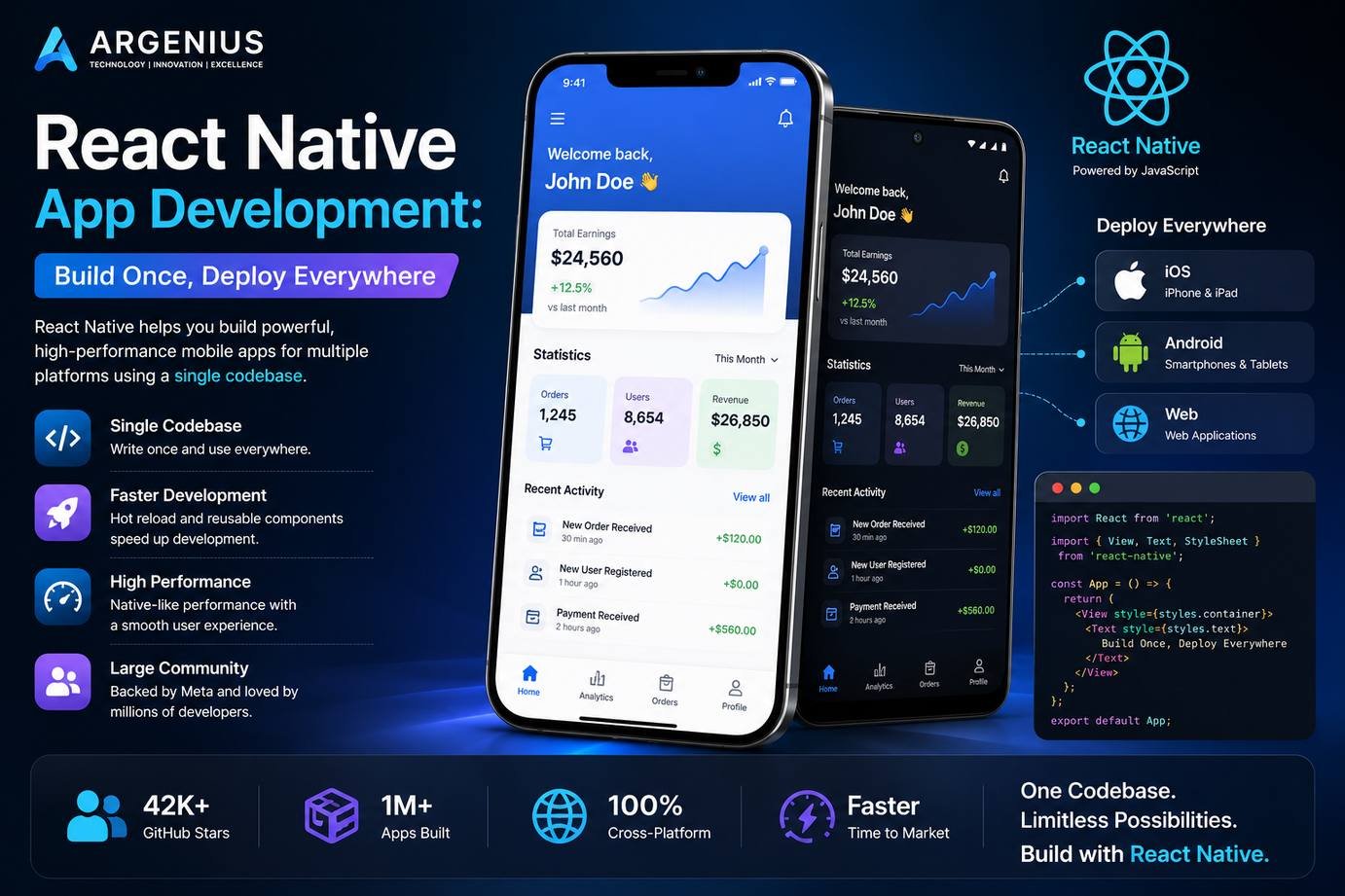
React Native is an open-source framework developed by Meta for building mobile applications using JavaScript and React.
Instead of creating separate Android and iOS applications, developers write a shared codebase that renders native UI components on each platform.
This approach provides:
- Cross-platform development
- Faster development cycles
- Native-like user interfaces
- Code reusability
- Lower development costs
Unlike traditional hybrid applications that rely on WebViews, React Native uses native components, making applications feel much closer to fully native apps.
How React Native Works
React Native follows a component-based architecture.
A typical application consists of:
- User Interface (React Components)
- Business Logic
- Native Bridge
- Native APIs
- Platform-Specific Modules
When users interact with the application, JavaScript communicates with native platform components, allowing the app to access device features while maintaining a responsive user experience.
Modern versions of React Native have significantly improved performance through the New Architecture, including Fabric and TurboModules, reducing communication overhead between JavaScript and native code.
Why Businesses Choose React Native
Businesses increasingly select React Native because it helps balance development speed, quality, and cost.
Key advantages include:
- One codebase for Android and iOS
- Faster product launches
- Lower development costs
- Easier maintenance
- Consistent user experience
- Large developer community
- Strong ecosystem
- Continuous improvements
For startups and growing businesses, these benefits often translate into quicker market validation and better return on investment.
React Native vs Native Development
| Feature |
React Native |
Native Development |
| Codebase |
Single |
Separate |
| Development Cost |
Lower |
Higher |
| Time to Market |
Faster |
Longer |
| Performance |
Excellent |
Best |
| Maintenance |
Easier |
More Complex |
| Hardware Access |
Very Good |
Complete |
| User Experience |
Near Native |
Native |
| Scalability |
High |
Excellent |
For many business applications, React Native provides performance that is more than sufficient while significantly reducing development effort.
Key Features of React Native
Cross-Platform Development
One application supports:
without maintaining completely separate projects.
Code Reusability
Developers can reuse a substantial portion of the code across both platforms.
Benefits include:
- Reduced development time
- Lower maintenance
- Faster feature releases
- Easier debugging
Hot Reloading
React Native enables developers to view changes instantly during development.
Advantages include:
- Faster testing
- Improved productivity
- Rapid UI adjustments
- Better developer experience
Native UI Components
React Native renders native platform components instead of HTML.
This results in:
- Smooth interfaces
- Familiar navigation
- Better responsiveness
- Platform-specific appearance
Third-Party Library Support
React Native integrates with thousands of libraries for:
- Payments
- Authentication
- Maps
- Push Notifications
- Analytics
- Social Login
- Cloud Storage
This accelerates development and expands functionality.
Performance
Performance is often one of the biggest concerns businesses have when considering React Native.
For most business applications, React Native provides excellent responsiveness and smooth interactions.
It performs particularly well for:
- E-commerce
- Food Delivery
- Healthcare
- CRM
- Education
- Booking Platforms
- Finance Dashboards
- Social Communities
Applications involving advanced gaming, 3D rendering, augmented reality, or intensive video processing may still benefit more from fully native development.
React Native Architecture
A modern React Native application typically includes:
Frontend
- React
- TypeScript or JavaScript
State Management
- Redux
- Zustand
- Context API
- MobX
Backend
- Laravel
- Node.js
- ASP.NET
- Django
Database
- MySQL
- PostgreSQL
- MongoDB
- Firebase
APIs
REST APIs or GraphQL connect the mobile application to backend services.
Cloud
Applications are commonly deployed using AWS, Google Cloud, or Microsoft Azure for scalability and reliability.
Benefits of React Native for Businesses
React Native offers several business advantages:
- Faster MVP development
- Reduced project costs
- Shared development resources
- Simultaneous Android and iOS releases
- Easier updates
- Simplified maintenance
- Better return on investment
- Faster feature delivery
These advantages make it especially attractive for startups and SMEs.
Challenges of React Native
Although React Native is highly capable, businesses should understand its limitations.
Common challenges include:
- Slightly lower performance than fully native apps
- Some platform-specific code may still be required
- Dependency management
- Native module integration
- Framework updates
- Limited support for highly specialized hardware features
An experienced development team can address these challenges effectively.
Best Use Cases
React Native is an excellent choice for:
- Startup MVPs
- E-commerce Apps
- Food Delivery Apps
- Booking Platforms
- Healthcare Applications
- Learning Management Systems
- Social Networking Apps
- CRM Applications
- Enterprise Mobility
- Marketplace Apps
These applications benefit from rapid development and broad platform support.
When React Native May Not Be the Best Choice
Consider native development if your application requires:
- High-end gaming
- AR/VR experiences
- Heavy graphics processing
- Advanced camera processing
- Complex background services
- Intensive hardware communication
- Real-time rendering
In these scenarios, native technologies often provide greater flexibility and performance.
React Native vs Flutter
Both frameworks support cross-platform development, but they differ in several ways.
| Feature |
React Native |
Flutter |
| Language |
JavaScript / TypeScript |
Dart |
| UI Rendering |
Native Components |
Custom Rendering Engine |
| Learning Curve |
Easier for React Developers |
Requires Dart |
| Performance |
Excellent |
Excellent |
| Community |
Very Large |
Rapidly Growing |
| Ecosystem |
Mature |
Mature |
| Best For |
Business Apps |
Highly Customized UI |
Choosing between the two depends on your team's expertise, project goals, and UI requirements.
Common Mistakes Businesses Make
Avoid these common mistakes when choosing React Native:
- Assuming one framework fits every project
- Ignoring long-term scalability
- Choosing inexperienced developers
- Neglecting performance optimization
- Skipping architecture planning
- Underestimating testing requirements
- Ignoring platform-specific design guidelines
- Overusing third-party libraries
- Failing to optimize APIs
- Not planning for future feature expansion
Proper planning reduces technical debt and improves long-term maintainability.
Why Businesses Choose Argenius
At Argenius, we specialize in building high-quality React Native applications that combine speed, scalability, and exceptional user experiences. Before development begins, our experts analyze your business objectives, target audience, expected traffic, and feature requirements to determine whether React Native is the best fit for your project.
Our services include product strategy, UI/UX design, React Native development, backend API integration, cloud deployment, performance optimization, testing, App Store and Google Play publishing, and ongoing maintenance. Whether you're launching a startup MVP or scaling an enterprise platform, we deliver secure and future-ready mobile solutions designed for long-term success.
Final Thoughts
React Native has transformed mobile app development by allowing businesses to build Android and iOS applications from a single codebase without sacrificing quality or user experience. Its ability to reduce development costs, accelerate product launches, and simplify maintenance has made it one of the leading choices for cross-platform development.
However, selecting React Native should be a strategic decision based on your application's goals, performance requirements, hardware integrations, and long-term roadmap. While it is ideal for many business applications, native development remains the preferred option for highly specialized or performance-intensive products.
At Argenius, we help businesses make informed technology decisions and develop React Native applications that are scalable, secure, and optimized for growth—ensuring your investment delivers measurable results today and remains adaptable for tomorrow.
Frequently Asked Questions
What is React Native?
React Native is an open-source framework developed by Meta that enables developers to build Android and iOS applications using a single JavaScript-based codebase.
Is React Native suitable for enterprise applications?
Yes. React Native is widely used for enterprise mobility solutions, customer-facing applications, dashboards, and internal business tools when designed with a scalable architecture.
Is React Native faster than native development?
React Native offers excellent performance for most business applications, but fully native apps generally provide the highest performance for graphics-intensive or hardware-dependent use cases.
Can React Native access device features?
Yes. React Native supports access to cameras, GPS, push notifications, biometrics, storage, Bluetooth, and many other device capabilities through native modules and libraries.
Can Argenius build React Native applications?
Yes. Argenius provides end-to-end React Native app development services, including UI/UX design, backend development, API integration, testing, deployment, and long-term support.