Discover everything about Swift App Development in this comprehensive guide. Learn Swift architecture, history, features, performance, and why businesses choose Swift for building secure, high-performance iOS applications in 2026.
Swift App Development: Building the Future of Modern iOS Applications
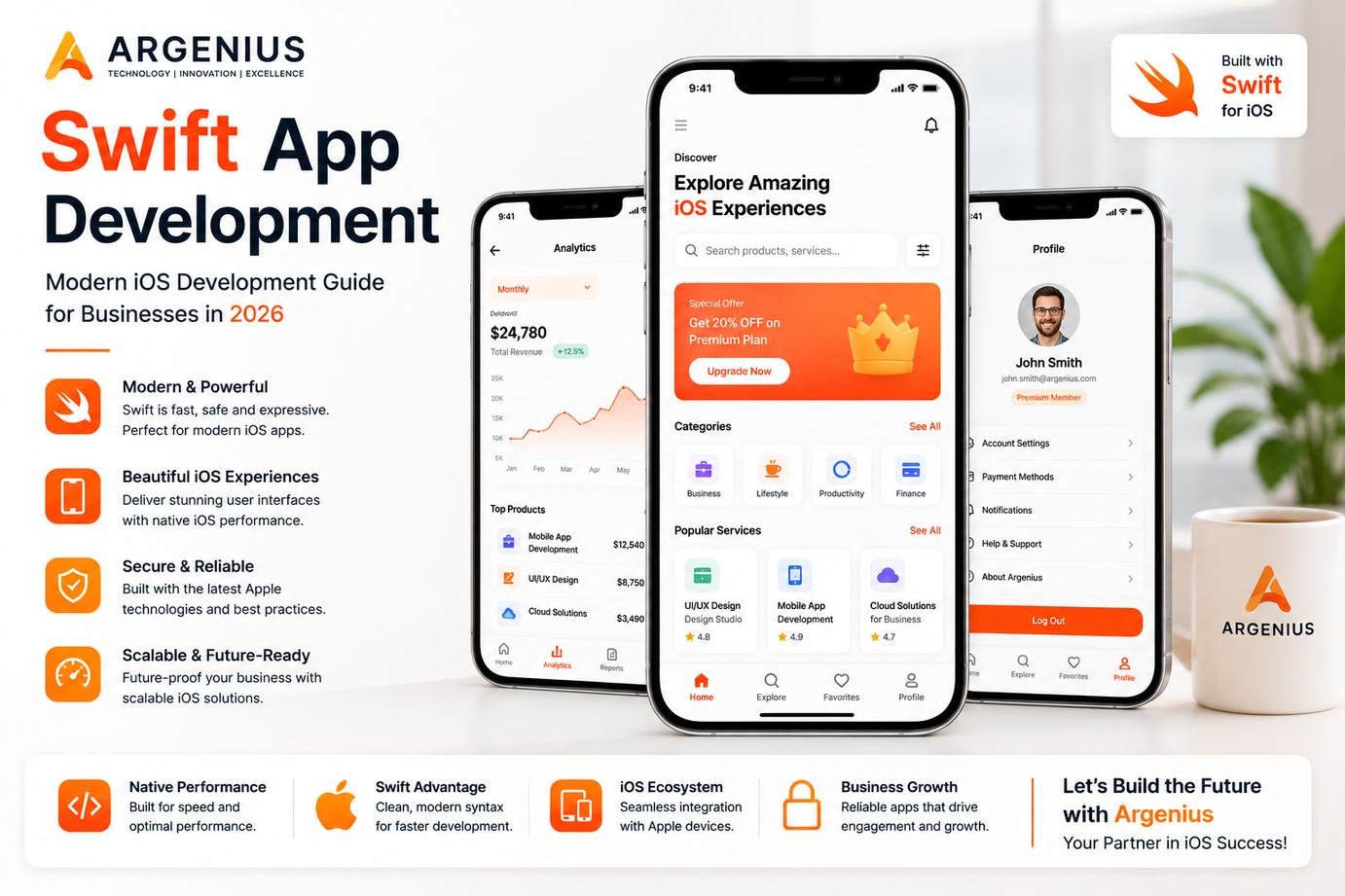
The mobile app industry continues to evolve rapidly, and businesses are investing heavily in high-performance, secure, and user-friendly applications. Among all technologies available for Apple platforms, Swift App Development has become the preferred choice for startups, enterprises, and global brands looking to deliver exceptional digital experiences.
Developed by Apple, Swift is a modern programming language designed to simplify application development while improving speed, security, and code reliability. From iPhone and iPad applications to Apple Watch, Apple TV, and Mac software, Swift enables developers to build scalable applications that meet today's business requirements and tomorrow's innovations.
Whether you're launching a new startup, digitizing business operations, or creating an enterprise-grade mobile application, choosing the right technology directly impacts your application's performance, maintenance costs, and long-term success.
At Argenius, we help businesses transform ideas into powerful iOS applications using modern Swift development practices, clean architecture, and scalable engineering that align with business goals rather than simply writing code.
What is Swift App Development?
Swift App Development refers to the process of building applications for Apple's ecosystem using the Swift programming language. Introduced by Apple, Swift was designed to replace Objective-C with a faster, safer, and easier-to-maintain language.
Today, Swift powers millions of applications across:
- iPhone
- iPad
- Apple Watch
- Apple TV
- Mac
- Vision Pro
- Enterprise Apple Solutions
Swift combines modern programming concepts with excellent performance, making it one of the most developer-friendly languages available today.
Unlike older programming languages, Swift minimizes common coding errors, improves application security, and reduces development time, making it ideal for businesses seeking long-term technology investments.
Featured Snippet
Swift App Development is the process of creating iPhone, iPad, Mac, Apple Watch, and other Apple platform applications using Apple's Swift programming language. Swift offers high performance, enhanced security, modern syntax, excellent scalability, and seamless integration with the Apple ecosystem, making it the preferred choice for modern iOS application development.
Swift at a Glance
| Feature |
Details |
| Language |
Swift |
| Developed By |
Apple Inc. |
| Initial Release |
2014 |
| Latest Evolution |
Continuously updated with modern language improvements |
| Platforms |
iOS, macOS, watchOS, tvOS, visionOS |
| IDE |
Xcode |
| Primary Use |
Native Apple Application Development |
| Type |
Open Source Programming Language |
Why Was Swift Created?
Before Swift, most Apple applications were developed using Objective-C. Although Objective-C was powerful, developers often faced challenges such as:
- Complex syntax
- Higher learning curve
- Manual memory management concepts
- Increased development time
- Greater chances of runtime errors
Apple recognized the need for a modern programming language capable of supporting the future of mobile computing.
Swift was created with several goals in mind:
Faster Development
Swift reduces boilerplate code and provides a clean, readable syntax, allowing developers to build applications more efficiently.
Improved Security
Swift introduces features like optionals, type safety, and automatic memory management to reduce crashes and improve application stability.
Better Performance
Swift applications compile efficiently and execute quickly, providing users with a smooth and responsive experience.
Developer Productivity
Modern language features help development teams write cleaner, maintainable, and scalable code.
Future-Proof Technology
Swift continues to evolve with Apple's ecosystem, ensuring compatibility with future devices and operating systems.
Businesses investing in Swift today are investing in a technology actively maintained and improved by Apple.
Evolution of Swift (2014–2026)
Swift has evolved significantly since its introduction, becoming one of the world's fastest-growing programming languages.
Swift 1.0 (2014)
Apple introduced Swift during WWDC 2014 to modernize iOS development and provide an alternative to Objective-C.
Key Highlights:
- Modern syntax
- Improved safety
- Interactive Playground
- Better readability
Swift 2
Apple improved error handling and performance while making the language more stable for production applications.
Enhancements included:
- Better debugging
- Improved compiler
- Enhanced error handling
Swift 3
Swift underwent major syntax refinements, making the language cleaner and easier to understand.
This version focused heavily on consistency and long-term maintainability.
Swift 4
Apple introduced better string handling, Codable support for JSON, and numerous performance improvements.
Developers experienced easier API integration and improved data management.
Swift 5
One of the biggest milestones.
Highlights included:
- Stable ABI
- Improved runtime performance
- Faster launch times
- Smaller application sizes
Swift 5.5
Swift embraced modern asynchronous programming with:
- async/await
- Structured Concurrency
- Actors
- Improved parallel processing
This dramatically simplified network operations and background tasks.
Swift (2026)
Today Swift supports:
- AI-powered applications
- Machine Learning integration
- Cloud services
- Vision Pro development
- Enterprise-grade architecture
- High-performance native applications
- Enhanced developer productivity
Swift continues to receive regular updates, making it one of the most future-ready programming languages available.
Understanding Swift Architecture
One of the biggest strengths of Swift App Development is its clean architecture. Swift encourages developers to build applications that are modular, scalable, and easy to maintain.
A modern Swift application generally consists of the following layers:
Presentation Layer
This layer manages everything users interact with, including screens, animations, buttons, navigation, and user inputs. Frameworks like SwiftUI and UIKit are commonly used to build intuitive interfaces.
Business Logic Layer
The business logic layer contains the application's core functionality. It processes user actions, validates data, handles workflows, and ensures business rules are followed consistently.
Data Layer
The data layer manages communication with APIs, local databases, cloud services, and caching mechanisms. It ensures smooth data synchronization and efficient storage.
Service Layer
This layer handles integrations with third-party services such as payment gateways, authentication providers, analytics platforms, push notifications, and cloud infrastructure.
Storage Layer
Swift applications use various storage solutions depending on business needs, including UserDefaults, Core Data, SQLite, Keychain, and cloud-based storage.
This layered architecture improves maintainability, simplifies testing, and allows development teams to scale applications as business requirements evolve.
At Argenius, we implement clean architecture principles to ensure every Swift application remains reliable, secure, and easy to enhance over time.
Key Features of Swift
Swift has become the preferred language for Apple platform development because it combines modern programming principles with exceptional performance.
Clean and Readable Syntax
Swift's syntax is simple, expressive, and easy to understand, reducing development time and improving collaboration among developers.
Type Safety
Swift minimizes programming mistakes by checking data types during compilation, helping developers catch errors before applications are deployed.
Automatic Memory Management
Swift uses Automatic Reference Counting (ARC) to efficiently manage memory, reducing the risk of memory leaks while improving application performance.
High Performance
Swift is optimized for speed, delivering fast execution times that enhance user experience across Apple devices.
Built-in Error Handling
The language includes powerful error-handling mechanisms, making applications more stable and easier to debug.
Open Source
Swift is open source, enabling developers worldwide to contribute improvements and expand its capabilities beyond Apple's platforms.
Modern Language Features
Swift supports advanced programming concepts such as generics, protocol-oriented programming, closures, property wrappers, result builders, and concurrency, making it suitable for building complex enterprise applications.
Why Businesses Prefer Swift App Development
For businesses planning to invest in Apple's ecosystem, Swift offers several strategic advantages:
- Faster development cycles
- Excellent application performance
- Lower maintenance costs
- Strong security standards
- Seamless Apple ecosystem integration
- Long-term scalability
- Enhanced user experience
- Active community and continuous updates
At Argenius, we leverage these strengths to build custom Swift applications that help startups, SMEs, and enterprises deliver secure, high-performing digital products while reducing long-term development costs.