Introduction
Apple's ecosystem has become one of the most profitable platforms for mobile applications. From startups launching innovative products to enterprises developing secure business solutions, iOS applications continue to generate high user engagement and strong revenue opportunities.
When planning an iOS application, one of the first technical decisions developers and businesses face is choosing the programming language. For many years, Objective-C was the foundation of Apple's software ecosystem, powering countless iPhone, iPad, and macOS applications. In 2014, Apple introduced Swift, a modern programming language designed to simplify development, improve safety, and deliver better performance.
Today, Swift is Apple's recommended language for developing new iOS applications. However, Objective-C remains important because many enterprise applications, legacy projects, and mature codebases still rely on it.
So, should you build your next iOS app with Swift or Objective-C?
The answer depends on your project's goals, existing codebase, development team, maintenance strategy, and future scalability requirements.
In this comprehensive guide, we'll compare Swift vs Objective-C across performance, syntax, security, development speed, scalability, interoperability, learning curve, and business use cases to help you choose the right technology for your iOS application.
At Argenius, we develop high-performance iOS applications using modern Apple technologies while helping businesses select the most suitable development approach for long-term success.
What Is Swift?
Swift is Apple's modern programming language introduced in 2014 to replace Objective-C as the preferred language for developing applications across Apple's ecosystem.
Swift supports development for:
- iPhone
- iPad
- Apple Watch
- Apple TV
- Mac
- Vision Pro
It was designed with simplicity, safety, speed, and maintainability in mind.
Key Features of Swift
- Modern syntax
- Type safety
- Automatic memory management
- Optionals
- High performance
- Fast compilation
- Strong security
- Excellent readability
Today, Swift powers most newly developed iOS applications.
What Is Objective-C?
Objective-C is an object-oriented programming language that served as Apple's primary development language for decades before Swift was introduced.
Many well-established applications and enterprise systems still contain Objective-C code.
Key Features of Objective-C
- Mature ecosystem
- Dynamic runtime
- Strong backward compatibility
- Extensive Apple framework support
- Stable enterprise applications
- Rich legacy codebase
Although newer projects generally use Swift, Objective-C continues to play an important role in maintaining older applications.
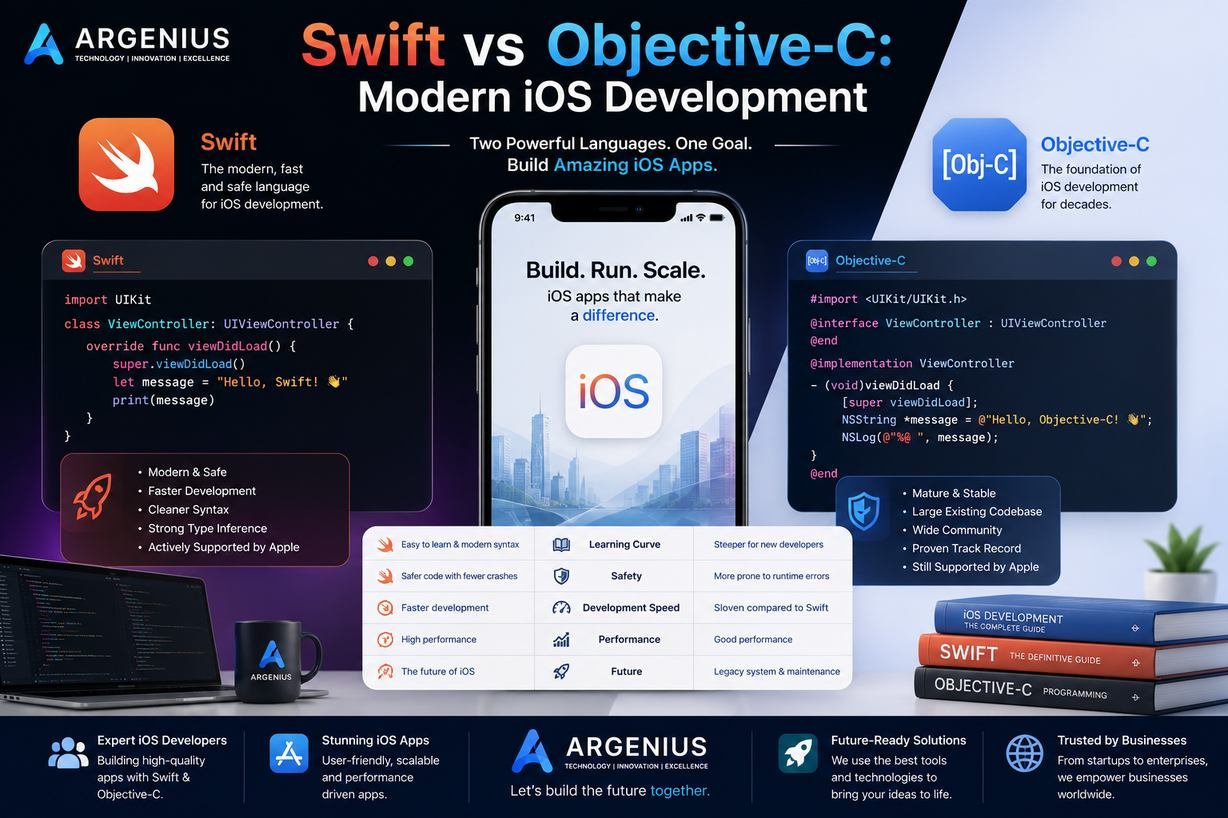
Swift vs Objective-C: Quick Comparison
| Feature |
Swift |
Objective-C |
| Official Apple Recommendation |
✅ Yes |
Legacy Support |
| Syntax |
Modern & Simple |
Verbose |
| Learning Curve |
Easier |
Steeper |
| Performance |
Excellent |
Very Good |
| Memory Safety |
Excellent |
Good |
| Development Speed |
Faster |
Slower |
| Readability |
Excellent |
Moderate |
| Community Growth |
Rapid |
Stable |
| Legacy Project Support |
Good |
Excellent |
| Best for New Projects |
✅ Yes |
Existing Apps |
Syntax Comparison
One of Swift's biggest advantages is its clean and expressive syntax.
Swift
Swift reduces repetitive code while improving readability.
Benefits include:
- Cleaner code
- Less boilerplate
- Easier maintenance
- Better developer productivity
Developers often complete features more quickly using Swift.
Objective-C
Objective-C uses a more verbose syntax with square brackets and message-passing conventions.
Advantages include:
- Familiarity for legacy developers
- Powerful runtime capabilities
- Mature programming patterns
However, new developers often find Objective-C more difficult to read and write.
Performance Comparison
Performance is critical for delivering smooth user experiences.
Swift
Swift was designed with performance optimization in mind.
Advantages include:
- Fast execution
- Optimized compiler
- Efficient memory usage
- Better runtime optimization
- Improved application responsiveness
Swift is ideal for modern consumer applications.
Objective-C
Objective-C remains highly reliable but generally introduces slightly more runtime overhead because of its dynamic messaging architecture.
For most business applications, however, both languages provide excellent performance.
Development Speed
Reducing development time lowers overall project costs.
Swift
Swift increases developer productivity through:
- Type inference
- Optionals
- Automatic memory management
- Modern language constructs
- Better debugging tools
- SwiftUI support
These features help teams build applications faster.
Objective-C
Developers typically write more code for similar functionality, which can increase development and maintenance time.
Code Safety
Application stability directly impacts user satisfaction.
Swift
Swift was built to reduce common programming mistakes.
Safety features include:
- Optionals
- Type safety
- Memory safety
- Automatic reference counting
- Compile-time error detection
These features reduce crashes caused by unexpected null values and memory issues.
Objective-C
Objective-C provides flexibility but requires developers to manually handle many situations that Swift addresses automatically.
This increases the need for careful coding and testing.
User Interface Development
Apple has modernized UI development significantly.
Swift
Swift works seamlessly with:
- SwiftUI
- UIKit
- Combine
- Modern Apple APIs
SwiftUI enables developers to build attractive interfaces with less code.
Objective-C
Objective-C primarily relies on UIKit and older development patterns.
While fully capable, it doesn't integrate as naturally with newer Apple frameworks.
Interoperability
One of Swift's strengths is its compatibility with Objective-C.
Developers can:
- Use both languages in the same project
- Gradually migrate legacy applications
- Reuse existing Objective-C libraries
- Modernize apps without rebuilding everything
This makes migration practical for businesses with existing iOS applications.
Community and Ecosystem
Swift
Swift's ecosystem continues to expand rapidly.
Benefits include:
- Active developer community
- Frequent language improvements
- Extensive tutorials
- Open-source development
- Strong Apple support
Objective-C
Objective-C continues to benefit from decades of documentation and mature libraries.
Its large legacy ecosystem remains valuable for maintaining older applications.
Security
Both languages support secure application development.
Common security practices include:
- Secure authentication
- Keychain storage
- Data encryption
- API security
- Secure networking
- Biometric authentication
Swift's modern language design helps prevent certain programming errors, but overall application security depends more on architecture and implementation than on the programming language itself.
Scalability
Both languages support enterprise-scale applications.
Swift
Ideal for:
- Startup apps
- Fintech
- Healthcare
- E-commerce
- SaaS
- Enterprise applications
- Consumer mobile apps
Objective-C
Still suitable for:
- Legacy enterprise software
- Existing iOS applications
- Large corporate codebases
- Long-running maintenance projects
When Should You Choose Swift?
Swift is the best option if you:
- Are building a new iOS application
- Want faster development
- Need better code safety
- Plan long-term scalability
- Want compatibility with modern Apple frameworks
- Need a clean and maintainable codebase
- Want to leverage SwiftUI
For almost all new projects, Swift is the recommended choice.
When Should You Choose Objective-C?
Objective-C remains a practical option when:
- Maintaining an existing Objective-C application
- Extending legacy enterprise software
- Reusing mature Objective-C libraries
- Working with teams experienced in Objective-C
- Gradually migrating to Swift
For new applications, Objective-C is generally chosen only when there is a strong business or technical reason.
Common Mistakes Businesses Make
Choosing the wrong development strategy can increase long-term costs.
Avoid these common mistakes:
- Starting new projects in Objective-C without a compelling reason
- Migrating legacy apps without proper planning
- Ignoring long-term maintenance requirements
- Underestimating migration complexity
- Choosing technology based solely on familiarity
- Failing to train development teams
- Ignoring Apple's latest frameworks
- Not planning for scalability
- Skipping automated testing during migration
- Neglecting code quality and documentation
A well-planned technology roadmap reduces risk and improves long-term maintainability.
Why Businesses Choose Argenius
At Argenius, we build modern, scalable, and secure iOS applications tailored to business goals. Our team evaluates your existing technology stack, project complexity, budget, and future roadmap before recommending Swift, Objective-C, or a phased migration strategy.
Our end-to-end services include product consulting, UI/UX design, iOS development, backend APIs, cloud integration, App Store deployment, quality assurance, and long-term maintenance. Whether you're launching a brand-new application or modernizing a legacy iOS product, we deliver solutions that are optimized for performance, security, and future growth.
Final Thoughts
The comparison between Swift and Objective-C clearly reflects the evolution of Apple's development ecosystem.
Swift has become the preferred language for modern iOS development because of its cleaner syntax, stronger safety features, better developer productivity, and seamless integration with the latest Apple frameworks. For most new applications, Swift provides the best balance of performance, maintainability, and future readiness.
Objective-C, however, remains an important technology for maintaining legacy applications and supporting organizations with established codebases. Rather than replacing Objective-C overnight, many businesses adopt a gradual migration strategy that combines both languages within the same project.
At Argenius, we help businesses choose the right iOS development approach based on technical requirements, business objectives, and long-term scalability—ensuring every application is built for sustained success.
Frequently Asked Questions
Which is better for iOS development: Swift or Objective-C?
Swift is the preferred choice for new iOS applications because of its modern syntax, improved safety, faster development, and official support from Apple. Objective-C remains valuable for maintaining legacy projects.
Is Swift faster than Objective-C?
Swift generally delivers better performance and more efficient memory management for modern applications, although the difference varies depending on the project.
Can Swift and Objective-C be used together?
Yes. Swift is fully interoperable with Objective-C, allowing developers to use both languages within the same project and migrate applications gradually.
Is Objective-C still used today?
Yes. Many enterprise and legacy iOS applications continue to use Objective-C, particularly where large existing codebases make a complete migration impractical.
Can Argenius build iOS apps using Swift?
Yes. Argenius develops custom iOS applications using Swift and modern Apple technologies while also supporting and modernizing existing Objective-C applications.