Video has become the most engaging form of digital content, powering everything from OTT platforms and online learning to fitness apps and live commerce. This guide explains how video streaming works, the architecture behind modern streaming apps, essential technologies, and best practices for building a secure, scalable, and high-performance streaming platform.
A few years ago, streaming a high-quality video on a mobile phone often meant waiting for endless buffering or lowering the video quality just to keep it playing. Today, users expect something completely different. Whether they're watching a movie on Netflix, attending an online class, joining a live sports event, or scrolling through short videos on social media, they expect playback to start instantly and continue smoothly—even on slower internet connections.
Meeting those expectations isn't easy.
Behind every seamless streaming experience is a sophisticated architecture that captures, processes, stores, delivers, and optimizes video content in real time. Multiple technologies work together behind the scenes to ensure viewers receive the best possible quality without interruptions.
For businesses, video streaming has become much more than an entertainment feature. It's now an essential part of education platforms, healthcare consultations, online events, fitness applications, gaming communities, social networking apps, eCommerce live selling, corporate training, and enterprise collaboration tools.
However, building a successful streaming application requires more than embedding a video player. Developers must carefully design the backend architecture, choose the right cloud infrastructure, optimize media delivery, implement adaptive bitrate streaming, secure copyrighted content, and ensure the platform can scale as the audience grows.
Whether you're planning an OTT platform, an online learning application, a live streaming service, or a social media platform with video features, understanding the right architecture from the beginning can save significant development time and infrastructure costs.
In this guide, you'll learn how modern video streaming applications work, the technologies involved, essential architecture components, recommended development stacks, and the best practices that help deliver fast, secure, and reliable streaming experiences.
At Argenius, we design scalable streaming solutions that combine cloud infrastructure, intelligent video delivery, and secure media management to create exceptional viewing experiences for users across Android, iOS, and web platforms.
What is Video Streaming in Apps?
Video streaming is the process of delivering video content over the internet without requiring users to download the entire file before watching it.
Instead of waiting for a complete download, the video is divided into small segments that are transmitted continuously while playback is already in progress.
This allows users to:
- Watch videos instantly
- Skip to different sections
- Continue playback while data downloads
- Switch video quality automatically
- Resume playback across devices
Modern streaming applications rely on cloud infrastructure and intelligent delivery systems to ensure smooth playback regardless of the user's internet speed.
Why Video Streaming Matters
Video content has become one of the most powerful ways to educate, entertain, and engage audiences.
For businesses, streaming offers opportunities to increase customer engagement, improve retention, and create new revenue streams.
Some of the biggest advantages include:
- Higher User Engagement
- Better Learning Experience
- Increased Watch Time
- Global Content Delivery
- Live Customer Interaction
- Subscription-Based Revenue
- Personalized Viewing Experience
- Multi-Device Accessibility
- Improved Brand Visibility
- Higher Customer Retention
Whether the goal is education, entertainment, or business communication, video has become an essential digital experience.
Types of Video Streaming
Different applications require different streaming approaches depending on their audience and business objectives.
Live Streaming
Live streaming broadcasts video in real time as events happen.
Common use cases include:
- Sports Events
- Online Classes
- Webinars
- Live Shopping
- Gaming Streams
- Religious Events
- Product Launches
- Virtual Conferences
Video on Demand (VOD)
Video on Demand allows users to watch recorded videos whenever they choose.
Examples include:
- OTT Platforms
- Online Courses
- Movie Libraries
- Corporate Training
- Fitness Programs
- Tutorial Applications
Short Video Streaming
Short-form video platforms focus on quick, engaging content.
Popular use cases include:
- Social Media Apps
- Entertainment Platforms
- Creator Communities
- Marketing Campaigns
- User-Generated Content
Audio & Video Streaming
Many platforms combine both audio and video delivery.
Examples include:
- Podcasts
- Music Streaming
- Video Podcasts
- Live Audio Rooms
- Virtual Meetings
How Video Streaming Works
Although streaming appears simple to viewers, several technologies work together behind the scenes.
A typical streaming workflow looks like this:
- Video is recorded or uploaded.
- The server receives the original file.
- The video is converted into multiple resolutions.
- Streaming files are generated.
- Files are stored securely in cloud storage.
- CDN distributes the content globally.
- Users request the video.
- The player automatically selects the best quality based on internet speed.
- Playback continues while additional video segments load in the background.
This entire process happens within seconds, allowing viewers to enjoy uninterrupted playback.
Business Models That Use Video Streaming
Streaming technology is now used across many industries.
Popular examples include:
- OTT Platforms
- Online Learning Apps
- Healthcare Consultation Apps
- Fitness Applications
- News Platforms
- Religious Streaming Apps
- Live Shopping Platforms
- Gaming Communities
- Social Media Apps
- Corporate Training Platforms
- Event Streaming Platforms
- Video-Based SaaS Products
Each business model has unique streaming requirements, but all depend on a reliable and scalable video delivery system.
Essential User Features
A successful streaming application should provide an intuitive and enjoyable viewing experience.
Important user features include:
- HD Video Playback
- Adaptive Video Quality
- Search & Filters
- Continue Watching
- Watch History
- Playlist Management
- Offline Downloads
- Multi-Language Support
- Subtitles & Captions
- Picture-in-Picture Mode
- Chromecast & Smart TV Support
- Personalized Recommendations
Admin Features
Administrators require powerful tools to manage content, users, and platform performance.
Essential admin features include:
- Video Upload Dashboard
- Live Stream Management
- Content Approval
- User Management
- Analytics Dashboard
- Revenue Reports
- Advertisement Management
- Subscription Control
- Video Performance Monitoring
- Content Moderation
- Copyright Management
- Storage Management
These features help businesses efficiently operate and scale their streaming platforms.
Recommended Technology Stack
Mobile Development
- Flutter
- React Native
- Kotlin
- Swift
Backend
- Laravel
- Node.js
- Django
- Spring Boot
- Go
Streaming Protocols
- HLS (HTTP Live Streaming)
- MPEG-DASH
- RTMP (for ingestion)
- WebRTC (for ultra-low latency)
Video Processing
- FFmpeg
- AWS Elemental MediaConvert
- Bitmovin
- Cloudinary
Cloud Storage
- AWS S3
- Firebase Storage
- Azure Blob Storage
- Google Cloud Storage
CDN
- Amazon CloudFront
- Cloudflare CDN
- Akamai
- Fastly
Database
Monitoring
- Prometheus
- Grafana
- Firebase Crashlytics
Choosing the right combination of technologies ensures smooth playback, efficient video processing, and the ability to scale as your user base grows.
Video Streaming Architecture
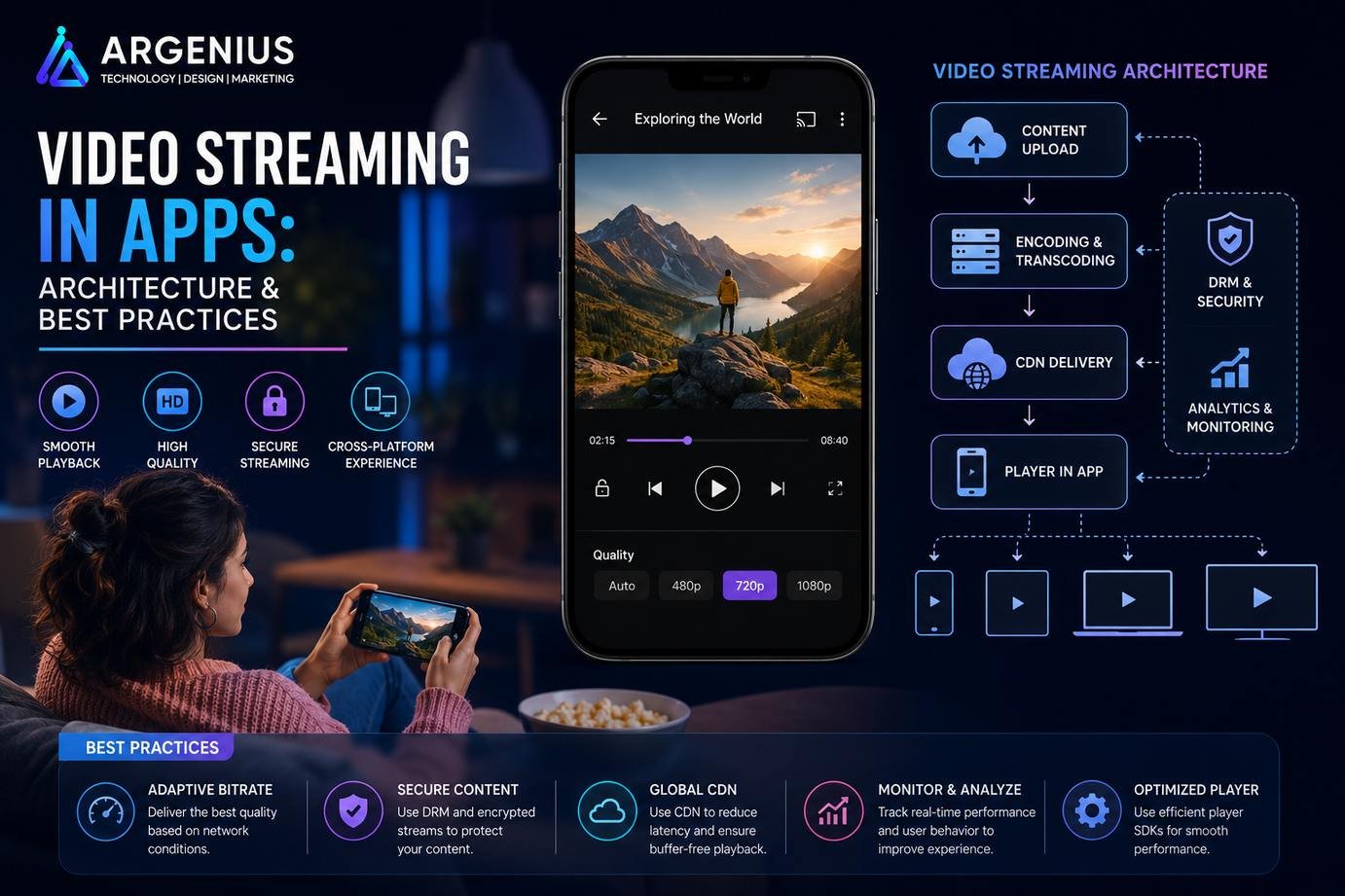
A successful streaming platform is built on a layered architecture that ensures videos are uploaded, processed, stored, and delivered efficiently to users around the world.
A modern streaming architecture generally includes:
- Mobile or Web Application
- Authentication Service
- Backend API
- Video Upload Service
- Media Processing Pipeline
- Cloud Storage
- Content Delivery Network (CDN)
- Streaming Server
- Analytics & Monitoring
- Database
Each component has a specific responsibility, helping the platform remain scalable, secure, and reliable even during peak traffic.
Video Upload & Processing Pipeline
Every video uploaded by a creator goes through multiple processing stages before viewers can watch it.
A typical workflow looks like this:
- User uploads a video.
- Backend validates the file.
- Video is stored temporarily.
- Media processing begins.
- Video is transcoded into multiple resolutions.
- Streaming playlists are generated.
- Thumbnail images are created.
- Processed files are stored in cloud storage.
- CDN caches the content.
- Video becomes available for playback.
This automated pipeline ensures every user receives the best possible viewing experience regardless of their internet speed.
Content Delivery Network (CDN)
A CDN is one of the most important components of a video streaming platform.
Instead of serving every request from a single server, a CDN stores cached copies of videos across multiple geographic locations. When someone starts watching a video, the content is delivered from the nearest server.
Benefits include:
- Faster Video Loading
- Reduced Buffering
- Lower Server Load
- Global Availability
- Better Scalability
- Improved User Experience
Popular CDN providers include:
- Amazon CloudFront
- Cloudflare CDN
- Akamai
- Fastly
- Google Cloud CDN
Without a CDN, streaming performance can quickly degrade as traffic increases.
Adaptive Bitrate Streaming (HLS & DASH)
Internet speeds vary widely from one user to another. Adaptive bitrate streaming solves this problem by automatically switching between different video qualities during playback.
For example:
- 240p for slow networks
- 480p for standard quality
- 720p for HD
- 1080p for Full HD
- 4K for high-speed connections
The player continuously monitors the network and adjusts the quality without interrupting playback.
HLS (HTTP Live Streaming)
HLS, developed by Apple, is one of the most widely adopted streaming protocols.
Advantages include:
- Excellent device compatibility
- Reliable playback
- Strong CDN support
- Adaptive bitrate streaming
- High scalability
MPEG-DASH
MPEG-DASH is another popular streaming protocol used across Android, Smart TVs, and modern browsers.
Benefits include:
- Platform Independence
- Adaptive Streaming
- Efficient Bandwidth Usage
- High Video Quality
- Broad Industry Support
Both HLS and DASH are excellent choices for most on-demand streaming applications.
Live Streaming Workflow
Live streaming differs from video-on-demand because content is delivered while it's being recorded.
A typical live streaming process includes:
- Camera captures video.
- Encoder compresses the stream.
- Stream is sent to the ingestion server.
- Media server processes the stream.
- Multiple resolutions are generated.
- CDN distributes the stream.
- Users watch with minimal delay.
This workflow enables businesses to broadcast events, webinars, gaming sessions, online classes, and live shopping experiences to thousands of viewers simultaneously.
Video Transcoding & Compression
Uploading videos in their original format isn't practical because different devices and internet connections require different versions.
Transcoding converts a single video into multiple optimized formats.
Common outputs include:
- 360p
- 480p
- 720p
- 1080p
- 1440p
- 4K
Benefits include:
- Reduced File Size
- Faster Streaming
- Lower Bandwidth Usage
- Device Compatibility
- Adaptive Quality Support
Popular transcoding tools include:
- FFmpeg
- AWS Elemental MediaConvert
- Bitmovin
- Cloudinary
Development Cost (₹ INR)
The cost of developing a video streaming application depends on content type, cloud infrastructure, streaming features, scalability, and security requirements.
| Solution Type |
Estimated Cost |
| Basic Video Streaming App |
₹3,00,000 – ₹8,00,000 |
| OTT Platform |
₹8,00,000 – ₹20,00,000 |
| Live Streaming Platform |
₹12,00,000 – ₹30,00,000 |
| Enterprise Streaming Solution |
₹30,00,000+ (Custom Pricing) |
Factors Affecting Cost
Several factors influence the overall development budget:
- Live vs On-Demand Streaming
- Number of Concurrent Users
- Cloud Infrastructure
- CDN Usage
- Video Transcoding
- Subscription System
- DRM Protection
- Recommendation Engine
- Analytics Dashboard
- Ongoing Maintenance
DRM & Security Best Practices
Video content is a valuable digital asset, making security a top priority for streaming platforms.
Recommended security practices include:
- Digital Rights Management (DRM)
- HTTPS Encryption
- Token-Based Authentication
- Signed Streaming URLs
- AES Video Encryption
- Secure API Authentication
- Watermarking
- User Access Control
- Device Management
- Activity Monitoring
These measures help prevent unauthorized access, piracy, and content sharing.
Common Challenges
Building a streaming platform involves several technical challenges.
Common issues include:
- Video Buffering
- Slow Upload Speeds
- High Storage Costs
- Bandwidth Optimization
- CDN Configuration
- Video Encoding Delays
- Live Stream Latency
- Device Compatibility
- Network Interruptions
- Scaling During Peak Traffic
Proper architecture and testing significantly reduce these problems.
Performance Optimization
A high-performance streaming application keeps viewers engaged and minimizes playback interruptions.
Best practices include:
- Use Adaptive Bitrate Streaming
- Deploy a Global CDN
- Compress Videos Efficiently
- Enable Lazy Loading
- Cache Frequently Viewed Content
- Optimize API Responses
- Monitor Server Performance
- Scale Infrastructure Automatically
- Reduce Startup Time
- Continuously Track Playback Analytics
Performance optimization directly impacts user satisfaction and retention.
HLS vs DASH vs WebRTC
| Feature |
HLS |
MPEG-DASH |
WebRTC |
| Best For |
Video on Demand & Live Streaming |
Cross-Platform Streaming |
Real-Time Communication |
| Latency |
Low |
Low |
Ultra-Low |
| Adaptive Bitrate |
✅ Yes |
✅ Yes |
Limited |
| Browser Support |
Excellent |
Excellent |
Excellent |
| Mobile Support |
Excellent |
Excellent |
Excellent |
| Primary Use Cases |
OTT, Education, Media |
OTT & Enterprise |
Video Calls, Live Auctions, Telemedicine |
For most OTT and educational platforms, HLS or DASH are the preferred options. WebRTC is ideal for applications that require real-time interaction, such as video conferencing or online consultations.
Benefits of Video Streaming
Video streaming offers significant advantages for both businesses and end users.
Key benefits include:
- Higher User Engagement
- Better Customer Retention
- Global Reach
- Subscription Revenue Opportunities
- Improved Learning Experiences
- Interactive Live Events
- Stronger Brand Presence
- Scalable Infrastructure
- Multi-Device Compatibility
- Personalized Viewing Experiences
These benefits make video streaming one of the most valuable features for modern digital platforms.
Future Trends
The streaming industry continues to evolve with new technologies that improve quality, speed, and user engagement.
Emerging trends include:
- AI-Based Video Recommendations
- 8K Video Streaming
- AV1 Video Codec Adoption
- Low-Latency Streaming
- Cloud-Native Media Processing
- Interactive Live Streaming
- Personalized Content Delivery
- Edge Computing
- AI-Powered Content Moderation
- Virtual Reality (VR) & Augmented Reality (AR) Streaming
Businesses that invest in these technologies will be better positioned to deliver next-generation streaming experiences.
Why Businesses Choose Argenius
At Argenius, we build scalable, secure, and high-performance video streaming solutions tailored to the needs of startups, enterprises, educational institutions, healthcare providers, and media companies.
Our expertise includes:
- OTT Platform Development
- Live Streaming Solutions
- Video-on-Demand (VOD) Platforms
- Cloud Video Infrastructure
- HLS & DASH Streaming
- CDN Integration
- AWS Media Services
- Firebase & Cloud Storage Integration
- Flutter & React Native Development
- Laravel & Node.js Backend Development
From architecture planning to deployment and long-term maintenance, Argenius helps businesses launch streaming platforms that deliver exceptional performance and seamless user experiences.
Final Thoughts
Video streaming has become a core feature across industries, powering everything from entertainment and education to healthcare, eCommerce, and enterprise collaboration. Building a successful streaming application requires more than a video player—it demands a well-planned architecture, efficient media processing, scalable cloud infrastructure, secure content delivery, and continuous performance optimization.
By choosing the right technologies, implementing adaptive streaming, leveraging a global CDN, and following modern security practices, businesses can provide viewers with smooth, reliable, and engaging video experiences on any device.
If you're planning to build a Video-on-Demand platform, Live Streaming application, or OTT service, Argenius can help you design and develop a future-ready streaming solution that scales with your business.
Frequently Asked Questions
What is video streaming in mobile apps?
Video streaming allows users to watch video content over the internet without downloading the entire file. The content is delivered in small segments, enabling instant playback and smoother viewing.
Which streaming protocol is best for mobile applications?
HLS is widely used because of its excellent compatibility and adaptive bitrate support. MPEG-DASH is another strong option for cross-platform streaming, while WebRTC is best suited for ultra-low-latency applications such as video conferencing.
How much does it cost to build a video streaming app?
A basic streaming application typically costs ₹3 lakh–₹8 lakh. Advanced OTT platforms or enterprise streaming solutions with live broadcasting, subscriptions, analytics, and DRM can cost ₹30 lakh or more, depending on complexity.
Why is a CDN important for video streaming?
A Content Delivery Network (CDN) stores video content closer to users in multiple geographic locations, reducing buffering, improving load times, and ensuring consistent playback even during high traffic.
How can video content be protected from piracy?
Content protection involves using DRM, encrypted streaming, signed URLs, token-based authentication, watermarking, and strict access controls to prevent unauthorized viewing and distribution.
Can Argenius build custom video streaming platforms?
Yes. Argenius develops end-to-end streaming solutions, including OTT platforms, live streaming applications, cloud video infrastructure, CDN integration, secure media delivery, Flutter and React Native apps, and scalable backend systems.